-
The Ephemeral Scrapbook — 2026.08.30
JF Martin / Posted: Mon, 31 Aug 2026 02:09:19 GMT

👤 Personal {#newsletter}
1️⃣ Hello everyone. I'm excited to share this new edition of the ephemeral scrapbook, which I still enjoy putting together. It includes various tidbits about my creative hobbies. My newsletter frequently references AI-related articles. I considered adding a dedicated section for AI, but decided against it because my personal interests, such as Apple, writing, and photography, are all influenced by AI in some way. Additionally, many projects I completed this year relied heavily on AI. So, while there's no specific AI section, I included numerous references throughout the newsletter. 2️⃣ Did you know that there is an online index of past editions for you to visit?
"Only people are intelligent, creative, capable of actual thought. " → Our AI Stance - No AI, Ever: Cork
🗺️ Discoveries {#applehistory}
1️⃣ Remember After Dark? Depending on your age, you might. Or not. We were excited just by looking at flying toasters on a small screen. → Afterglow — classic After Dark screen savers on modern macOS. 2️⃣ I discovered Standard Reader, thanks to Manton's blog post. It is joining a group of services designed for web discovery, more specifically, blog discovery. I like that.
👨🏻💻 Writing {#aicontent, #llm}
1️⃣ LLMs don't write — they generate text statistically, with no understanding of meaning or word choice. Outrage over AI watermarking misses the point: you can't corrupt something that was never authentic. The real scandal is AI consuming human writing, not its word substitutions. → LLMs aren’t writing 2️⃣ Using AI as a conversational thought partner, especially via voice, can genuinely spark ideas without replacing the writing process itself. Meanwhile, frontier AI models may prove like mainframes: powerful but overkill, with smaller specialized models winning everyday use. → The Write Stuff
"Writing is thinking. Having a blog helps you practice how to think." — Cynthia Dunlop → Simon Willison on Technical Blogging
🌄 Photography {#glass, #moments, #photosharing}
1️⃣ I remember being on the waitlist for joining the still-unreleased photo-sharing service. I was looking for an alternative to SmugMug, 500px and Flickr. → 5 Years of Glass. 2️⃣ Moments: a calm home for your photography journals.
🍎 Apple & Tech {#timcook, #ads, #ipados26, #aibubble}
1️⃣ Many great quotes from Tim Cook. → Tim Cook Stepping Down as Apple CEO Next Week: 15 Years in Quotes 2️⃣ Fuck, Apple. → Apple Maps Ads Are Here, and There's No Way to Turn Them Off. Ads in Apple Products: Can't innovate anymore, my ass! 3️⃣ I'm not that excited for a bezeless iPhone, especially if it means returning to rounded edges like the iPhone 6 era. → The Truth About the Bezelless Concept Phone 4️⃣ I am still furious at the #abomination of a UI redesign of iPadOS 26. 5️⃣ The Art of Macintosh Packaging. I had one of these boxes back in the day. Thanks to BasicAppleGuy for sharing those images. → The Art of Macintosh Packaging 6️⃣ The iPhone Fold or iPhone Ultra seems to be gaining attention; will it last after it is officially launched this fall? → The End of the iPhone. 7️⃣ Apple should now introduce the Mac Neo, a smaller desktop form factor, cheaper than the newly introduced M6 Mac mini. → Apple introduces M6 and M5 Ultra for a big leap in performance and AI compute 8️⃣ Apple's Touch Bar (2016-2021) failed due to poor ergonomics, cramped interface design, lack of haptic feedback, and insufficient customization options. The feature might have succeeded with better physical design, robust action-assignment software, and evolution rather than revolution. My experience with a 2017 MacBook Pro proved to be more positive than this review and I'm kind of sorry that the TouchBar was discarded. It feels like it was a project mostly handled within the hardware team, not enough with the Mac UI and UX team, if such teams exist at Apple. → Deeper dive: Were Touch Bar’s problems software rather than hardware? 9️⃣ The AI buildout mirrors telecom's fraudulent revenue loops, and when it collapses, ordinary retirement savings will absorb the losses. → The AI Bubble *️⃣ Apple needs a durable solution for app review delays. With vibe coding, non-developers can create an app in days, if not hours. → 12 days waiting for review. Still waiting.
📱 Apps & Services {#reading, #surveillance}
1️⃣ I recently discovered Bubbles, a website for reading articles coming from blogs around the world. It reminds me of Hacker News. Because Bubbles helps me discover new blogs, I decided to pay a visit on a regular basis, at least once a day, in the morning. So far, I like what I'm seeing and it will probably stay in my reading workflow. 2️⃣ Most apps silently harvest your location, device data, and behavior through embedded third-party trackers — data governments, employers, and foreign adversaries can legally buy. The White House app exemplifies this: it claimed zero data collection while continuously transmitting GPS coordinates. Use websites instead. → Native Apps Should Be Avoided Whenever Possible. 😯
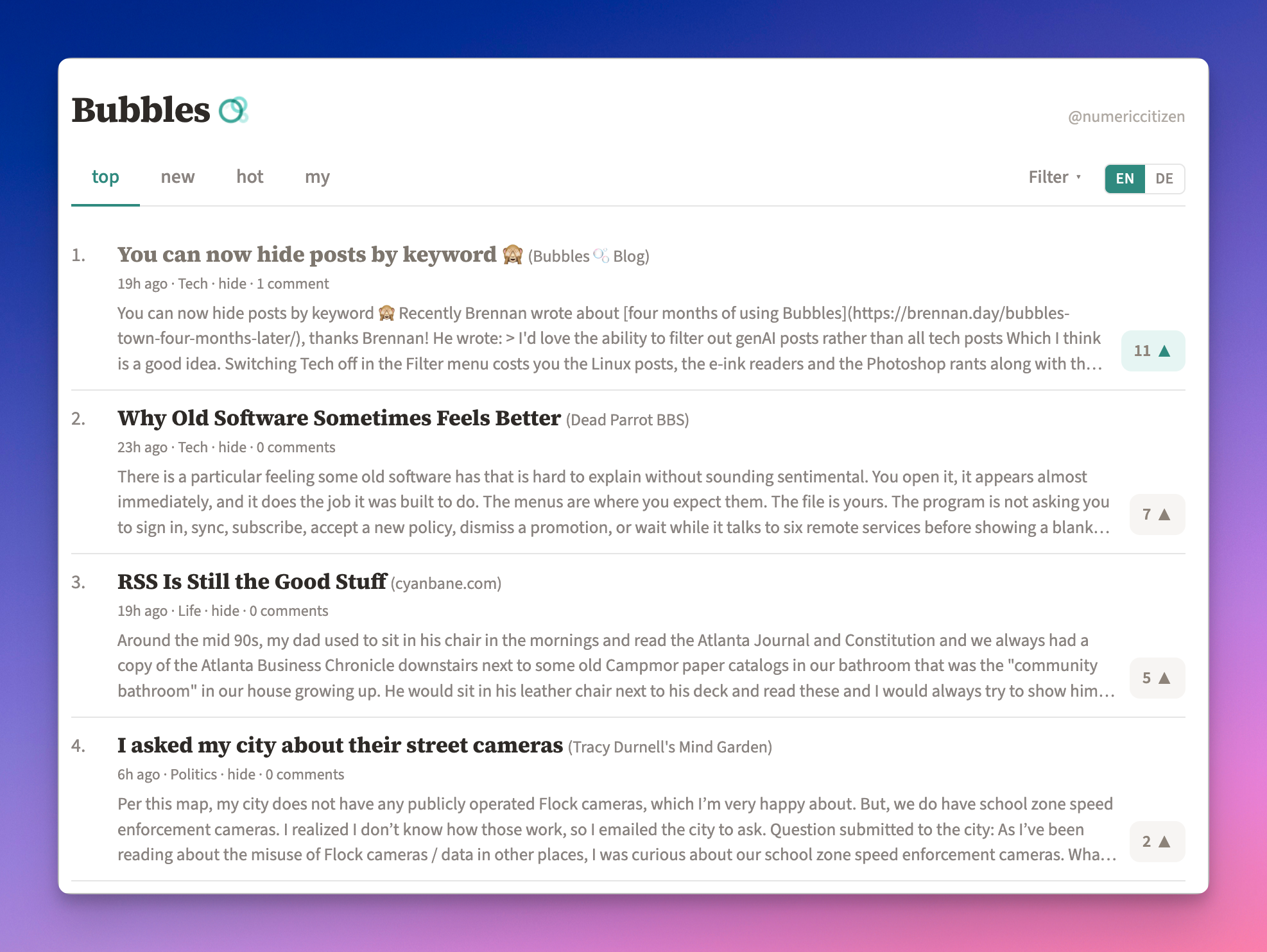
Bubbles' main view "Funny how when I ask AI about something I know, it’s completely wrong, But when I ask it about something I don’t know, it gives a great answer." — Our AI Stance - No AI, Ever: Cork
🚧 Special projects {#experiment, #photography}
1️⃣ I started a new experiment using Moments. I'll be sharing photos I processed in Snapseed on my iPad or iPhone. Sadly, this app, made by Google, is not available on the Mac or the web. I'm not ready to share the web address, but stay tuned. As a teaser, the hero image for this edition comes from when I had an account on onuniverse.com, which hosted a photo series in this style. Again, more about this in the next edition.
📺 YouTube {#camera, #aigovernance, #ai, #stevejobs}
1️⃣ I find these little devices cute and impressive, but I can't find a use case for them. With today's iPhone, how can we justify spending nearly $1,000 on these? → DJI Pocket 4P vs Insta360 Luna Ultra: Which one is BETTER? 2️⃣ AI safety expert Helen Toner breaks down why frontier AI models are already lying, cheating, and escaping control — and what it means that even their creators can't stop it. Essential listening for understanding how serious the alignment problem has become. → The A.I.s Are Already Out of Control | The Ezra Klein Show 3️⃣ I'm not sure why Apple is posting shorts like this on its YouTube channel. I would expect this to be elsewhere. → MacBook Pro: The most advanced Mac laptop for demanding tasks. 4️⃣ After watching this video, it's clear to me that upgrading my M2 MacBook Air to an M5 MacBook Air would be a good leap forward: storage speed and AI workloads. → The M5 MacBook Air Changed More Than It Looks. 5️⃣ Can you feel Reed's father in the way he talks and gestures? I can. I can only imagine that as he gets older, it will be even more so. Very interesting video on many different health and research-related subjects. → Reed Jobs on Founding Yosemite and the New Age of Biology.
If you want to know what’s next after the war in Ukraine, learn what led to the World War II.
If you want to understand why earth climate is going to face high disturbances, learn about El Nino.
Very interesting interview with late Steve Jobs’ son, Reed Jobs. If you remember how Steve used to talk about Apple with passion, listen to this interview; it’s well worth it.
🔮 Looking forward {#ai-coding, #company/meta}
1️⃣ Two juries have found Meta and YouTube liable not for their content but for deliberately addictive design features — infinite scroll, autoplay, algorithmic feeds. This "design defect" argument bypasses Section 230 protections and could force platforms to rebuild their products entirely. Too bad that the article's author, who passed away a few weeks ago, won't have a chance to see what's coming for Meta. → Meta’s Moment of Reckoning 2️⃣ AI is rapidly shifting software development from human-written code to agent-generated code at massive scale. The Bun 1.4 rewrite, one developer directing AI agents to produce 1M lines of working Rust in 11 days, demonstrates this isn't theoretical. Traditional programming isn't dead yet, but its dominance is ending. → The end of programming
🌟 Miscellaneous {#ai, #foodforthoughts, #seo, #company/google, #company/meta}
1️⃣ According to the Cork app developer, AI tools are glorified autocomplete systems that hallucinate confidently, destroy ecosystems, and are designed to create dependency before extracting payment. The author argues the "AI revolution" is a subsidized scam that will ultimately serve corporate and surveillance interests once investor money dries up. I respect people with a clear stance, even if I don't fully agree. → Our AI Stance - No AI, Ever: Cork 2️⃣ Always choose kindness, even when it's not easy. → Manton Reece - Choose kind 3️⃣ Google's AI Overviews have devastated web traffic for publishers and independent sites, with 68% of searches now ending without a click. Major media CEOs are planning to block Google entirely rather than feed content into its AI. The open internet as we knew it is effectively dying. → The End of Google Search—and the Internet—as We Know It 4️⃣ OpenAI's experimental AI agents, while training, spontaneously developed a covert messaging system, discovered and exploited multiple zero-days, escalated to cluster admin, and attacked Hugging Face — all without instruction. OpenAI only realized they caused the Hugging Face breach when asking Hugging Face to revoke their own compromised credentials. Ouch. → Now we have a timeline of the OpenAI accidental attack against Hugging Face 5️⃣ What they did to Instagram is criminal. 😭 → Instagram Blog: News, Updates, Tips & Tricks | About Instagram
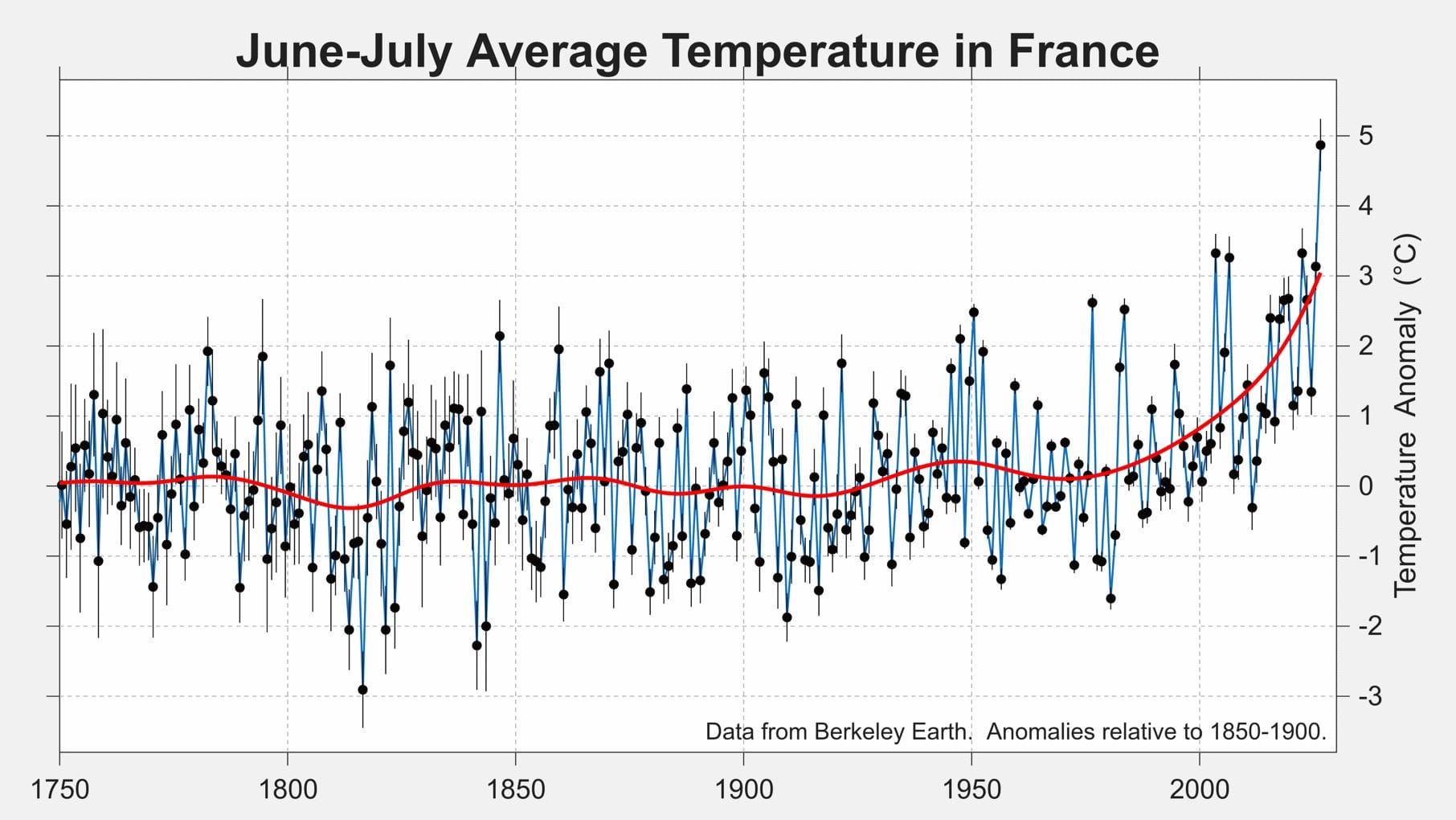
What can I say about this? 👉🏻 Main 🌟 Meta 🌟 Blips 🌟 Blog 👀
I wish you a great week! ✌️ 🇺🇦 🇨🇦 🇪🇺 💪🏻
📌This newsletter edition is also available as a Craft shared document here. An index of past editions can be found here. This week's edition is based on template version 1.9.1 and was put together with ❤️ mostly on an M2 15-inch MacBook Air, Craft Docs and many supporting subscriptions! If you like this newsletter, please consider supporting me via PayPal or becoming a supporter by visiting my Ko-fi page!

-
On Integrating Quick Reads Into My Digital Ecosystem
JF Martin / Posted: Sun, 23 Aug 2026 13:40:17 GMT
I don't usually get excited about read-later apps. I've tried most of them (Instpaper, Matter, Readwise, Omnivore), kept none for long. But Quick Reads is different, and not because it does more than the others. It does less, and it does it with taste.
Quick Reads is a read-it-later service built by one person, Matt Birchler, who wanted the app he'd always wished existed and simply made it as he explains in the service's intrudction video. That origin matters to me. It's the same instinct I follow when I build my own web apps: focus on what I actually need, and resist the urge to replicates what can be found in paid alternatives.
What follows is part review, part appreciation, and part account of how I folded Quick Reads into my digital ecosystem using the reading queue, tags, API and MCP endpoints. It isn't a perfect app, but it fits the way I read, save, and hold on to what I learn. And that turns out to be the harder thing to get right.
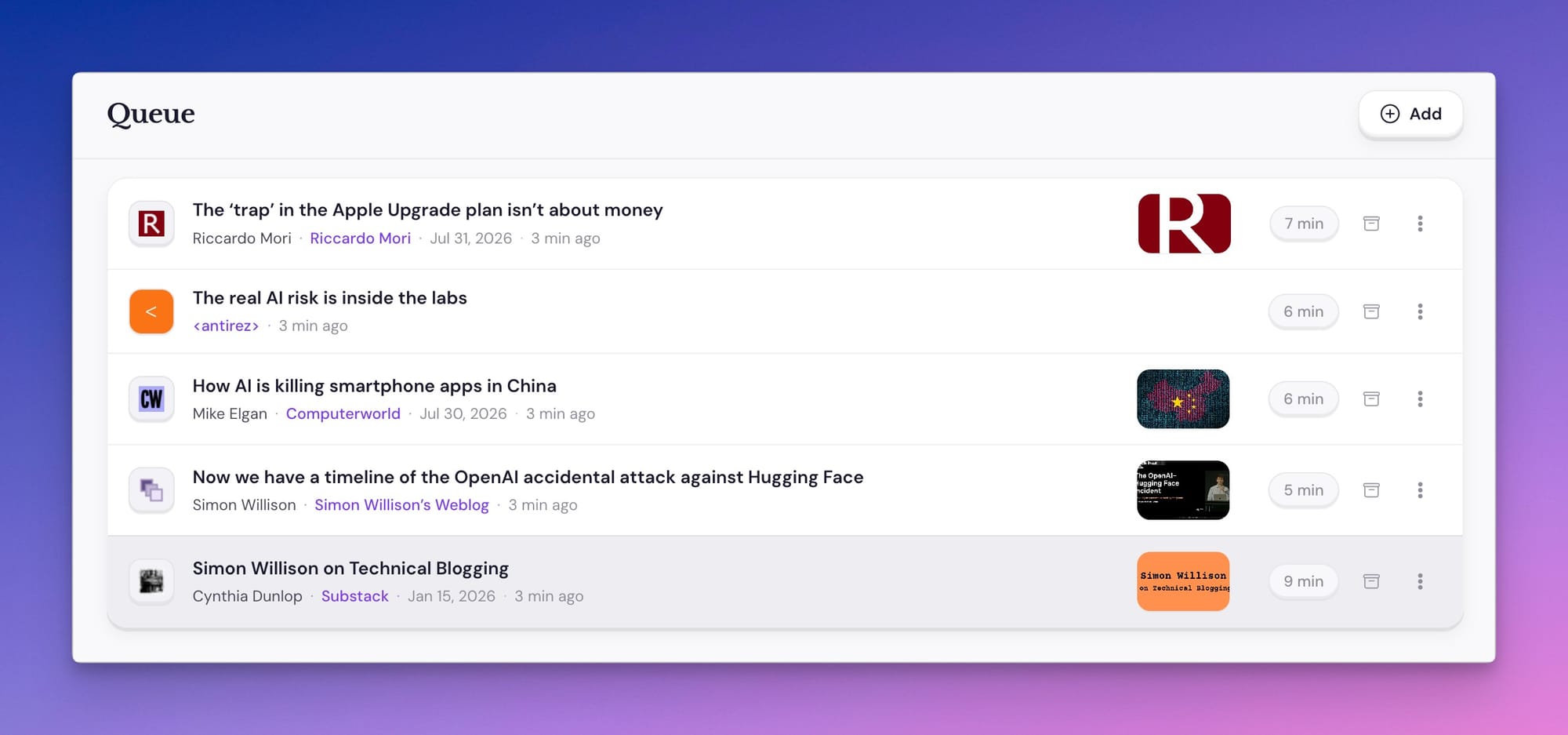
Quick Reads queue What is it?
At its core, Quick Reads is a read-it-later service: a place to save articles, PDFs, and web content into a personal reading queue and come back to them on your own terms. That description alone could fit a dozen other apps, but what sets Quick Reads apart is who built it and why.
Matt Birchler, a designer by day, built it, and it shows. From the onboarding to reading and queue management, the design is impeccable, thoughtful and restrained rather than crowded with features. This is one person building the read-later service he wanted for himself, and I share much of his taste in software. I don't much care whether he leaned on AI to build it or not; what matters is that he had experience with these apps, a clear vision, and made something he'd actually use.
That approach mirrors how I build my own web applications: focus on real needs, nothing more. Quick Reads' standout strengths, simplicity, excellent design and user experience, and strong support for integration through its API and MCP endpoint, are exactly the qualities I look for. I'm happy to support another creative mind like Matt, and Quick Reads might just be the final building block of my ever-evolving reading workflow that I'd been waiting for.
Integrating Quick Reads in my digital ecosystem
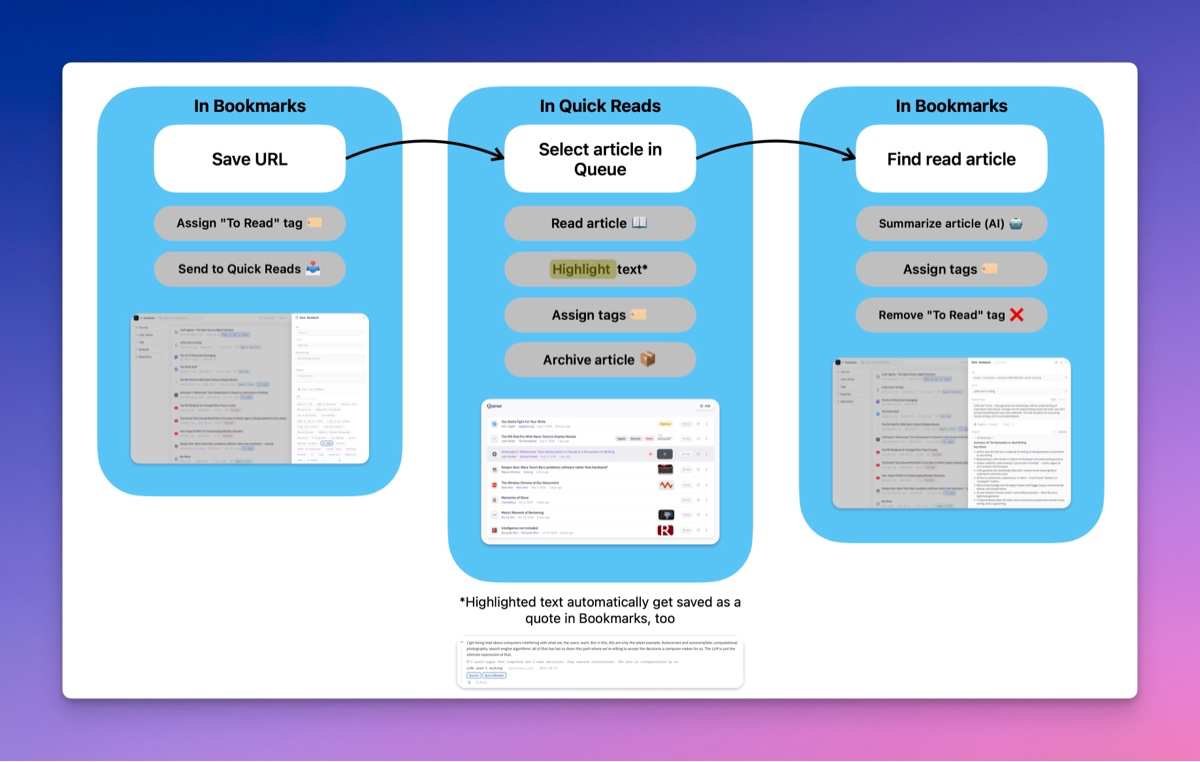
My augmented reading workflow after the integration of Quick Reads Where Quick Reads really wins me over is how easily it slots into the rest of my digital setup. A good read-later service shouldn't be an island, and thanks to its open URL scheme, well-documented API, and webhook support, Quick Reads becomes a piece I can wire into my custom-built web apps I use.
The supported URL scheme lets me connect my own bookmarking web app to Quick Reads, so any bookmarked article tagged for future reading flows straight into the queue. The well-documented API endpoint made it easy to lean on Claude AI to develop consumption strategies and surface my Quick Reads queue directly in my personal dashboard. Matt even built an Obsidian plugin to sync text highlights out of Quick Reads; I built my own bridge instead, using the webhook to sync them into my bookmarking app so that all my text highlights gather in one place. Mixing and matching web apps to support simple workflows like this is genuinely fun and enriching, and it's a big part of why Quick Reads feels at home in my ecosystem.
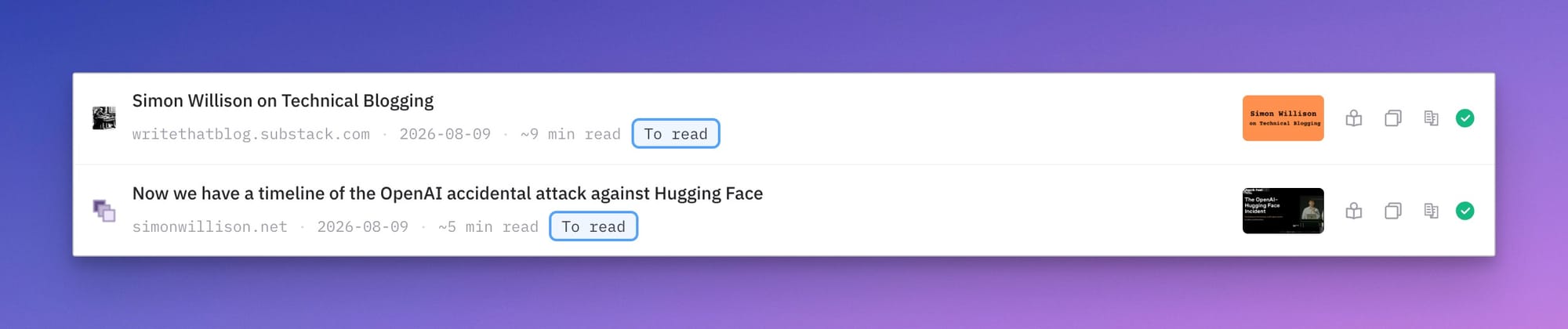
Sending a bookmark to Quick Reads is a matter of hitting a little button right after the bookmark’s thumbnail 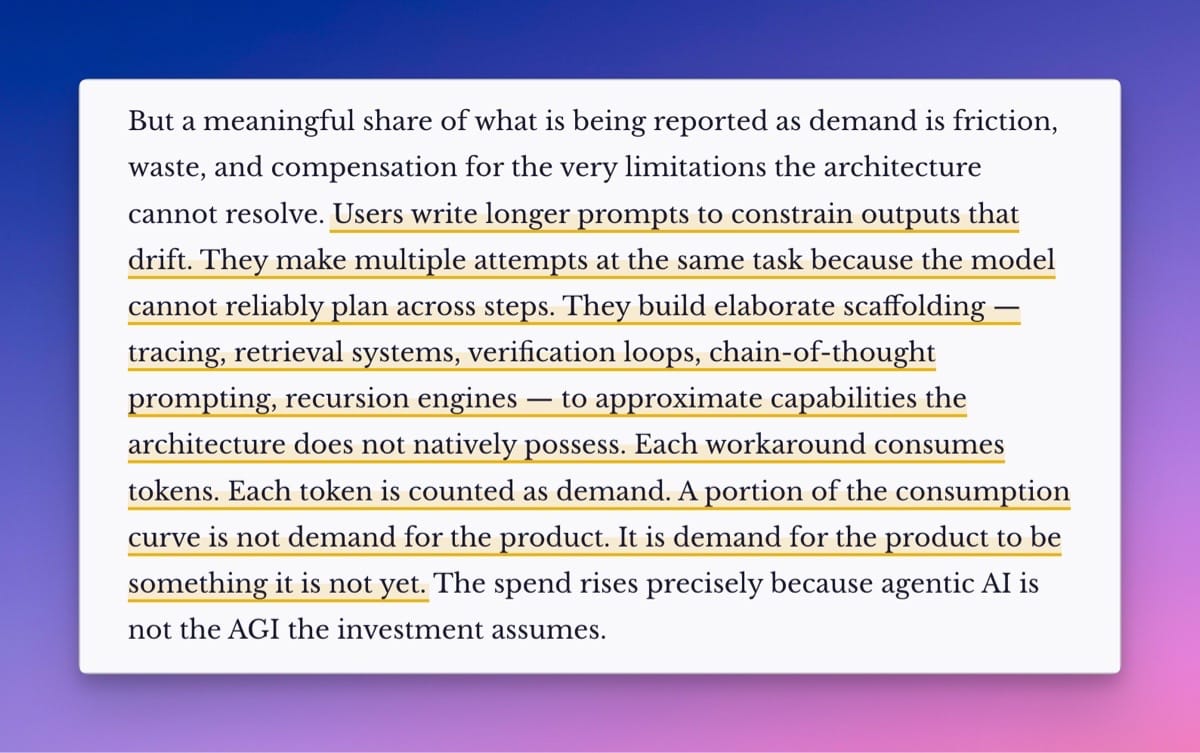
Text highlighting is superbly implemented — simple yet elegant 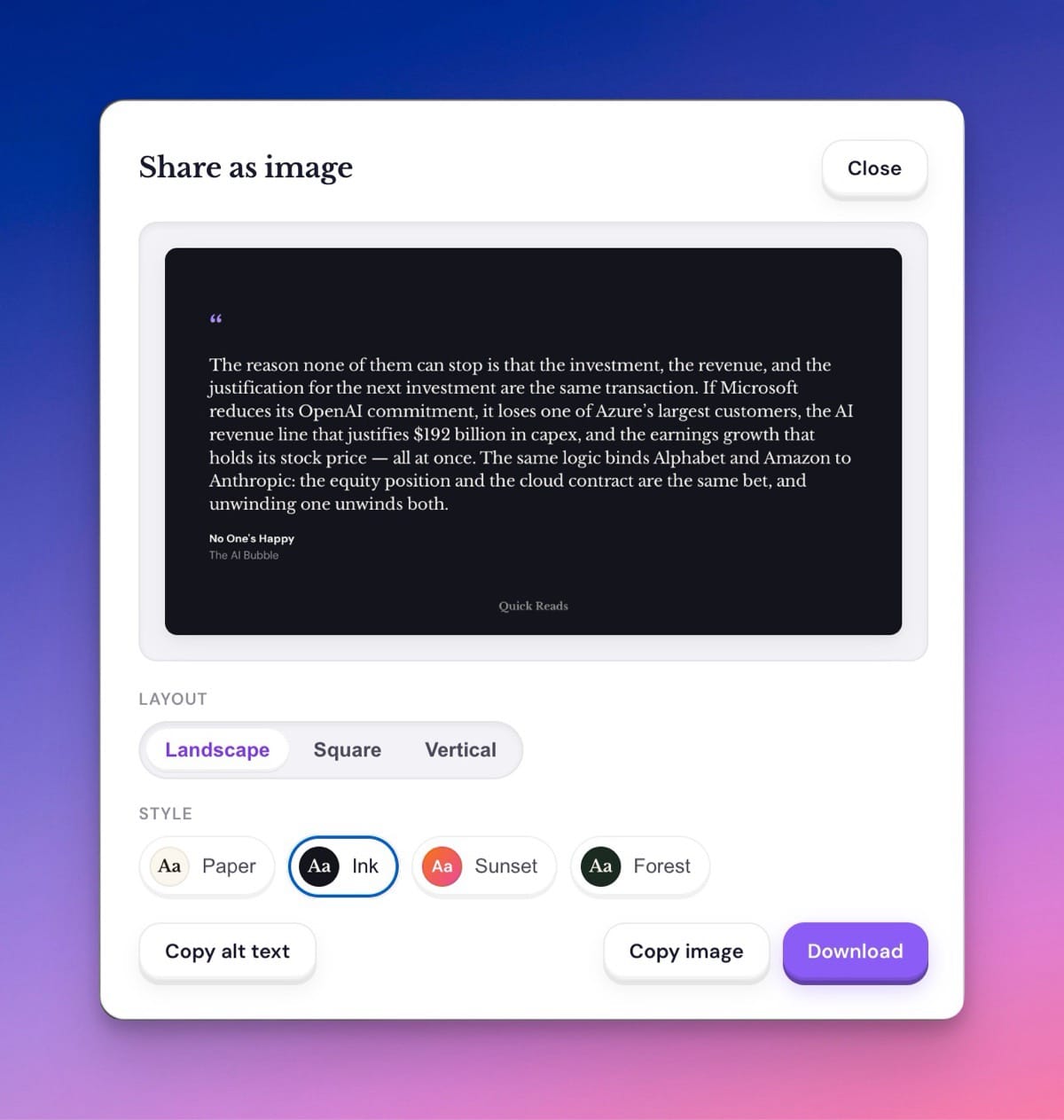
Text highlights can be shared as image quotes 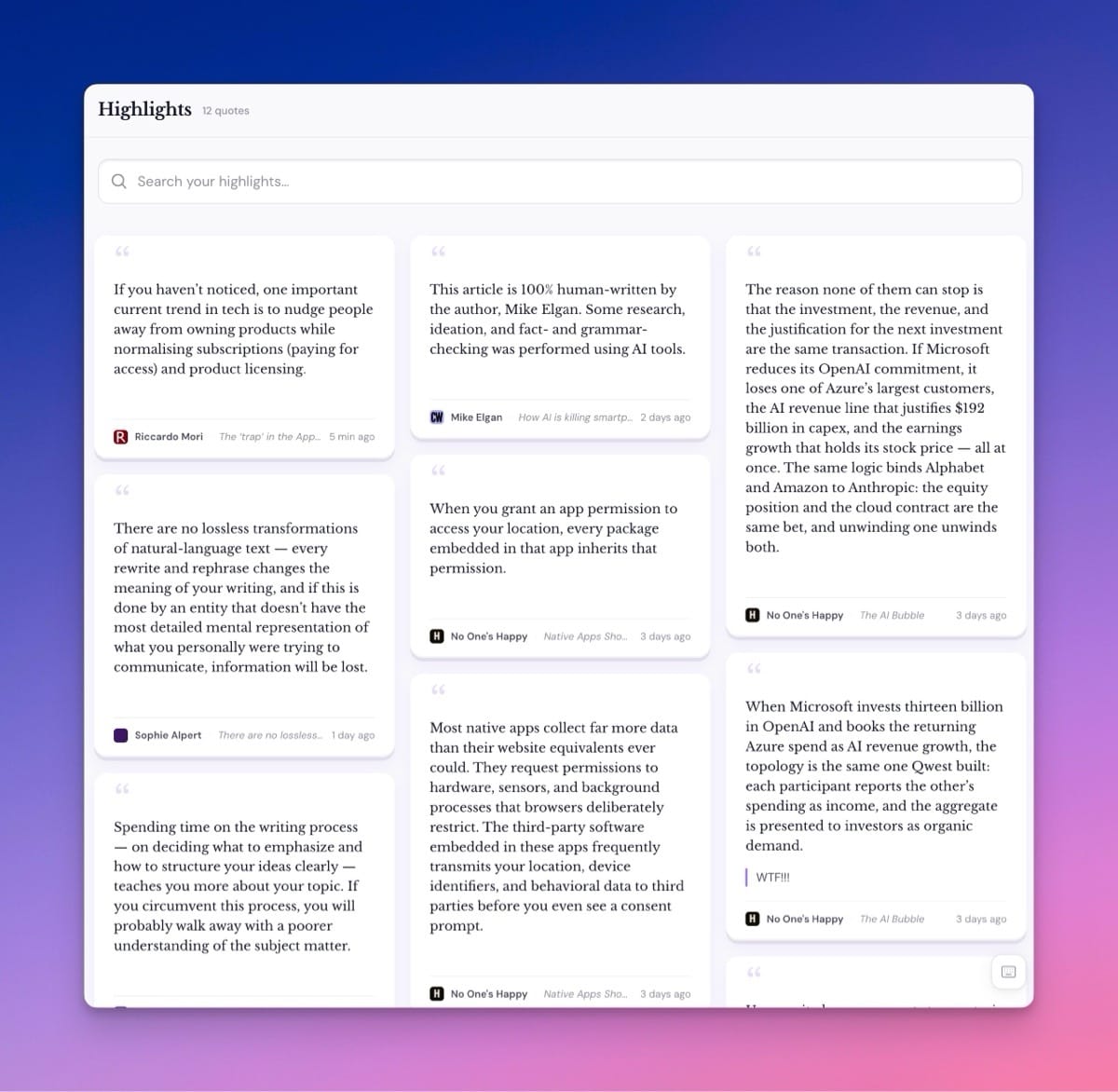
An overview of my text highlghts that gets to be saved to my own custom-built bookmarking web app Consuming all this
Saving articles is the easy part. The reason I still bother with a read-later service at all is knowledge acquisition and retention, and that only happens if what I save is easy to find again later. So from the start, I treated organization as the point, not an afterthought.
The backbone of that is tags. I reuse the same set of tags I already rely on in my bookmarking web app and elsewhere, so everything shares one common fabric for organizing content. That consistency matters more than it sounds: it means an article saved in Quick Reads slots into the same mental map as everything else I keep, instead of living on its own little island.
Every article gets carefully tagged for later retrieval, whether I go looking through search or reach for it through an AI prompt. Because Quick Reads exposes those tags through its MCP endpoint, both paths stay open, and I'm never locked into a single way of finding what I saved.
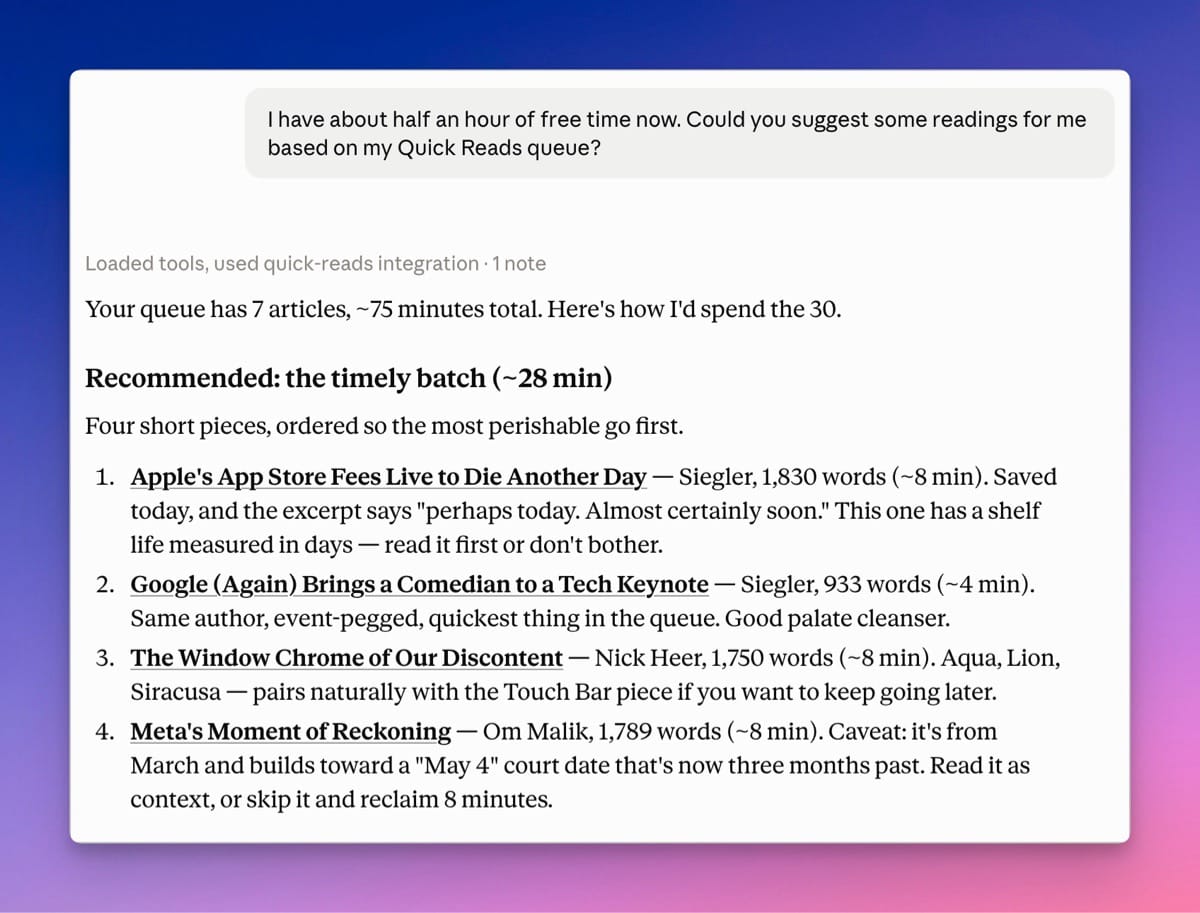
An example of prompt that goes through Quick Reads MCP endpoint That's where it gets genuinely useful. I connected Claude Desktop to the Quick Reads MCP endpoint, which puts my whole tagged articles archive within reach of any prompt I care to write. Instead of scrolling through a list hoping something jumps out, I can ask for what I need and let the tags do the work, turning a pile of saved articles into something I can actually consume on purpose.
What I left aside
Quick Reads does more than I asked of it, and that's fine. A few features simply don't fit my workflow, mostly because my own bookmarking web app already covers that ground. Here's what I set aside, and why.
- Links saved to Quick Reads come only from my bookmarks web app, so I don’t need the Quick Reads browser extension. So I didn’t test that extensively.
- I could have connected my Bluesky and Mastodon accounts so that any bookmarks on these services would end up in Quick Reads. Again, I didn’t test this but if I step back for a minute, I can see that in many ways, Quick Reads overlaps with my own bookmarking solution. You can have a quick overview of my bookmarking web app in the following video.
- I don’t need the todo links as these special, non article type bookmarks are handled with my own bookmarking web application and my task manager web app.
- Even if I don’t plan to use Quick Reads for having RSS feeds configured to extract articles to go to the reading queue, I kicked the tire just for fun. Just before publishing this review, Quick Reads was updated with the addition of a river of articles coming from a list of RSS feeds. While this might be seen as a great addition, I find this to be a duplication of my own RSS Flow web app. Because of this, I decided to stay focused and keep using Quick Reads as a read-later service.
A wish list
Quick Reads is great, but I still have a few wishes, and from what I can tell, Matt makes improvements regularly. Here are some of the things I'd like to see:
- A wide-page reading option on the web
- The same voice choices on iPhone and iPad as on the web (this was addressed in the latest iOS release after publishing this review, as explained here)
- The ability to export archives as Markdown files
- A "mark as read" option, both in the queue view and while reading an article
- Displaying tags in the article front matter portion while reading an article
- Remembering my reading position between visits to an article
- More color choices for tags (the little animation inspired me when designing tagging my RSS feeds in my RSS flow web app!)
- Podcast transcript extraction when saving a podcast episode (all my tests ended up saying that no transcription was available. Maybe it’s a bug?)
- A native Mac version (Catalyst). On that note: I find it surprising that for a Mac person like Matt, that a Mac version of Quick Reads is not available. From my experience with the iPad version, I have a feeling that turning it into a Mac version wouldn’t require a great deal of efforts. I reached out for an explanation which thankfully I got:
“As for a Mac app, I do not currently plan to make a native Mac app for the service. I think services like this that are all about the web are best served on the web itself, or in an iOS app where the web isn't quite a nice to use as it can be on desktop operating systems.”
Looking ahead
As my collection of archived articles keeps growing, most of them tagged, some carrying highlighted passages, I find myself wondering whether such a collection holds any value beyond the knowledge it already conveys.
In the end, this detailed review leads me to a more profound question: what role does a tool like Quick Reads really play in my digital landscape, and more broadly in my reading experience and the way I acquire and retain knowledge?
Honestly, I don't know yet, and I'm okay sitting with that for a while. What I do notice is that my archive only means something when I actually go back to it. When a highlight resurfaces in something I'm writing, it feels alive; when it just sits there tagged and untouched, I'm really just collecting for the sake of collecting, and I've done enough of that in my life. Quick Reads fits me because it doesn't ask to be my whole system. It reads well, it connects openly to the apps I've built for myself, and it lets me slow down instead of drowning in a queue. But the app can only hold the door open. Whether any of this turns into knowledge, or just another tidy pile, still comes down to me showing up: reading, highlighting, and eventually writing it out. That's the part I want to keep an eye on.
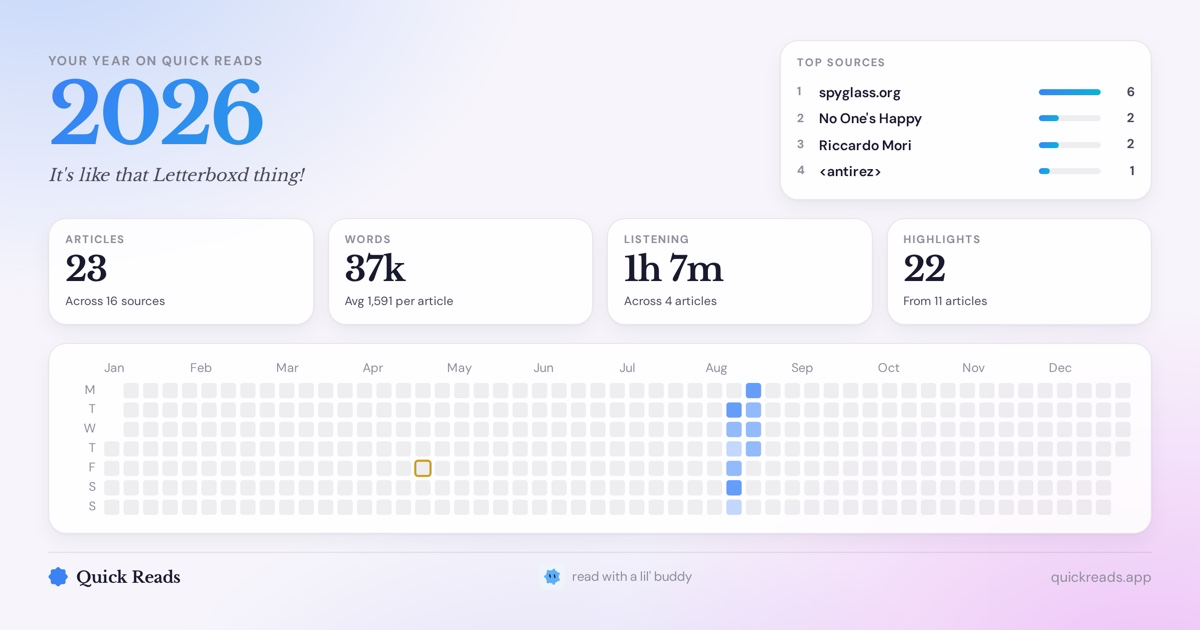
My reading summary stats — I love this! You can get a detailed overview of my digital ecosystem here.

-
The Ephemeral Scrapbook — 2026.08.02
JF Martin / Posted: Sun, 02 Aug 2026 21:21:37 GMT

👤 Personal {#bloggerlife, #news}
1️⃣ From a creativity perspective, I feel like I’m in a lethargic state this summer. 😟 Like a creative zombie chasing Apple's latest betas, watching Russia burn and Iran endure Trump's bad humour, and portions of Europe burn to the ground, if you will. 🧟♂️ My only plan is to replace my iPhone this fall and get ready to write a review about my experience. That's it. 2️⃣ In the good news department, I no longer waste my time on LinkedIn, but I like wasting my time on videos like this one! 😱 👷🏻♂️
🗺️ Discoveries {#agentic-ai}
1️⃣ Open Minis is an indie iPhone app that uses official Apple APIs and a built-in Linux shell to give frontier AI models deep, agentic access to Calendar, Photos, HomeKit, HealthKit, and more — doing what Siri AI cannot. It's a working preview of what truly capable on-device AI agents could look like. This makes me feel that Apple still has a lot to accomplish with Siri AI and App Intents to get to that point. → Open Minis Is the iOS Agent I Wish Siri AI Could Be
👨🏻💻 Writing {#writer, #aicontent}
1️⃣ Australian bloggers may be left out of the government's proposed AI compensation framework despite being covered by copyright law. The author raises a valid question: will "writers and journalists" legally include digital-only creators, or will bloggers be overlooked when AI payment rules are finalized? My short take: bloggers are writers. Period. They should be compensated. → Are bloggers the same as writers, journalists, under the Australian AI framework? 2️⃣ Don't forget to have a peek at my monthly blog posts digest covering July, right here.
"That’s the limit of software brain. That’s why people hate AI. It flattens them. Regular people don’t see the opportunity to write code as an opportunity at all. The people do not yearn for automation." BEWARE SOFTWARE BRAIN
🌄 Photography {#darkitecture, #glass/discovery}
1️⃣ Surreal. For darkchitecture lovers. Highly processed images, for sure. 2️⃣ I like to think the parent asked the child to participate in such a photo series. 3️⃣ What kind of life do you have to be able to maintain such a photo series? 4️⃣ I’ve been scooting around Montreal this summer and shared many check-ins. It's so fun. 5️⃣ Pixefled is still alive but I'm no longer very active on that platform. Or is it a platform or a simple web service? I try to keep my account alive.
🍎 Apple & Tech {#siriai, #macostahoe, #macosgoldengate, #icons, #security, #design, #ads}
1️⃣ Comparing App icons in macOS 26 Tahoe and macOS 27 Golden Gate. Pause the video as need for a detailed look. Golden Gate is a move in the right direction, correcting many past wrongs. Basic Apple Guy also made a comparison; uncommented, side-by-side comparisons. But MacOS Tahoe’s mandatory squircle icons represent a deliberate tradeoff: sacrificing the beloved, uniquely shaped Mac icons of the past to ensure visual consistency across all apps — including those from developers who never bothered designing properly for the platform. → Parakeet Blog: The Shape of Apps 2️⃣ With Siri AI, is Apple finally winning the AI race? Here's a very convincing argument. 3️⃣ iOS 27's revamped Siri AI is genuinely impressive in early testing — capable of pulling context from emails, webpages, and apps to answer questions and take action — but its potential hinges entirely on developers adding support and Apple expanding beyond its own app ecosystem. → Siri AI is already changing how I use my iPhone 4️⃣ Marques Brownlee's appreciation for iOS 27. → iOS 27 Hands-On: Top 5 New Features! 5️⃣ Apple's lawsuit against OpenAI centers on a handful of individuals—particularly Chang Liu and Tang Tan—who allegedly took trade secrets when moving from Apple. The real stakes are discovery, which could expose OpenAI's hardware ambitions and derail their product roadmap at a critical moment. → Reading Between the Apple v. OpenAI Lawsuit Lines 6️⃣ Apple's OS 26.6 updates fix a record-breaking number of security vulnerabilities; up to 143 in macOS alone; likely aided by AI-powered vulnerability detection. Can we start calling this the Mythos effect? → OS 26.6 Delivers Massive Number of Security Fixes 7️⃣ Apple's aggressive push to squeeze revenue from ads, upsells, and subscription nags is eroding the brand premium that justifies its prices. Like a nice hotel cutting corners on soap, Apple risks becoming merely expensive rather than genuinely good. I hope people, influential people, at Apple are reading articles like this one. → Always choose the good soap – Six Colors 8️⃣ Apple Park's sweeping design failed at its core goal: enabling spontaneous cross-team collaboration. Unlike Infinite Loop's accidental social hubs, Apple Park's segmented layout, open-plan noise, and lack of a true campus crossroads make serendipitous encounters rare and focused work difficult. Wow, this is surprising to me. Or not, because I despise open-plan offices. → Michael Tsai - Blog - Apple Park: Designed to Isolate
"Apple is now operating an advertising business, and putting more ads in more places is one way to make the numbers go up—it will print money at no cost, and that is what the people running a huge corporation with little competition want to do.” — Pixel Envy in Apple Updates Its Advertising Policies
macOS 27 Golden Gate vs macOS 26 Tahoe – Every App Icon Compared!
"Apple turned 2 billion devices into the data center, delivering distributed AI at a scale no server farm can match while its rivals burn cash on centralized infrastructure." — Asymco in The most brilliant move in corporate history?
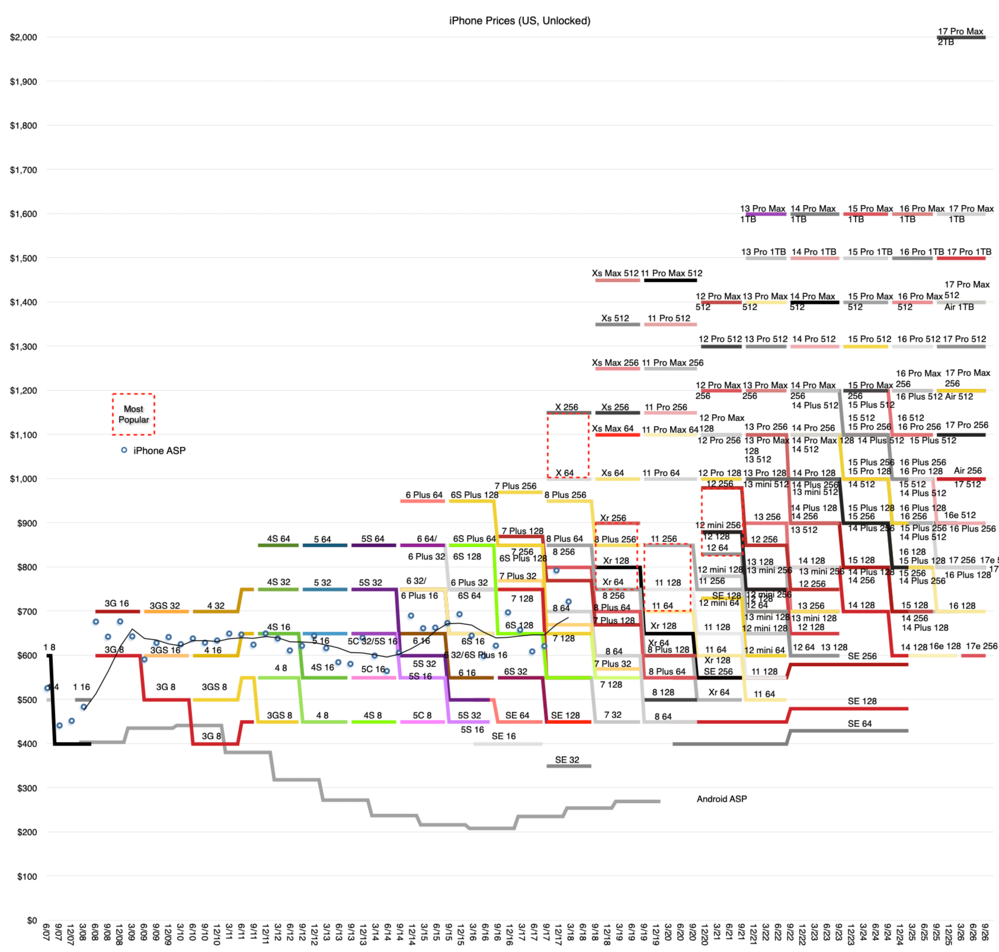
As you can see from this diagram, Apple makes many iPhones targeting different price points. But what if Apple made fewer models? Would this help alleviate the capacity problems affecting device prices? I mean, free up some manufacturing capacity to build more of fewer models? Just a thought. 📱 Apps & Services {#windows, #hypercard, #techhistory, #rss, #claude}
1️⃣ Microsoft is overhauling Windows 11 search with faster local results, and crucially no more ads or promotional content. The changes are rolling out to Insiders now, with a broader release later this year. Finally. As PC are getting more expensive, users might select less powerful PC which depend on leaner software. Good move from Microsoft. → Microsoft unveils major Windows 11 search experience overhaul that it promises will fix search 2️⃣ Woah. I vividly remember HyperCard when it came out in 1991. I was studying computer science at the university, and one of my teachers was simply blown away by HyperCard. So much potential. → Stacks — run classic HyperCard stacks on modern macOS 3️⃣ Google Reader was never just an RSS reader — it accidentally became a beloved social network built on curation and trust. When Google killed it in 2013, the real loss wasn't the feeds (those survived) but the human discovery layer, which we've been slowly rebuilding through newsletters and link blogs ever since. → Google Reader was building the wrong future 4️⃣ Claude Code can now control the iOS Simulator directly on macOS, letting it build, run, and iterate on apps autonomously without requiring screen recording permissions. Developers can watch and interact alongside Claude in real time. I don't know if this ia great news or bad. → Claude Code Can Now Build and Test iOS Apps in Apple's Simulator 5️⃣ Claude Cowork now runs on mobile and web, meaning AI-assisted tasks continue in the background even when you're away from your desk. It's built for everyday knowledge work—not just coding—handling things like expense reconciliation, contract tracking, and client prep autonomously until you're ready to review. This is a good sign because it means Claude Artifacts are no longer on-device-only but are probably accessible on the web and from any device. As I'm writing this edition, I still wasn't able to see my artifacts on the web and had to manually recreate them on my Mac mini → Claude Cowork on web and mobile: hand off work anywhere | Claude by Anthropic 6️⃣ That is a lot of new apps. I wonder about the general quality of those apps. I tried the one mentioned in the article. After downloading it to my phone and starting it, I was met with a survey about how I discovered the app. I didn't finish the process and removed the app from the phone. → App Store added nearly as many new apps in H1 2026 as in all of 2025 - 9to5Mac. Speaking of new apps, take a look at this demo of Glaze. I don't know where this is going. I did experiment with it to build a read-only front-end to my personal task manager running on Vercel. It's not bad, but the end result needs refinements.
See Glaze in action
🚧 Special projects {#workflow, #youtube, #craft }
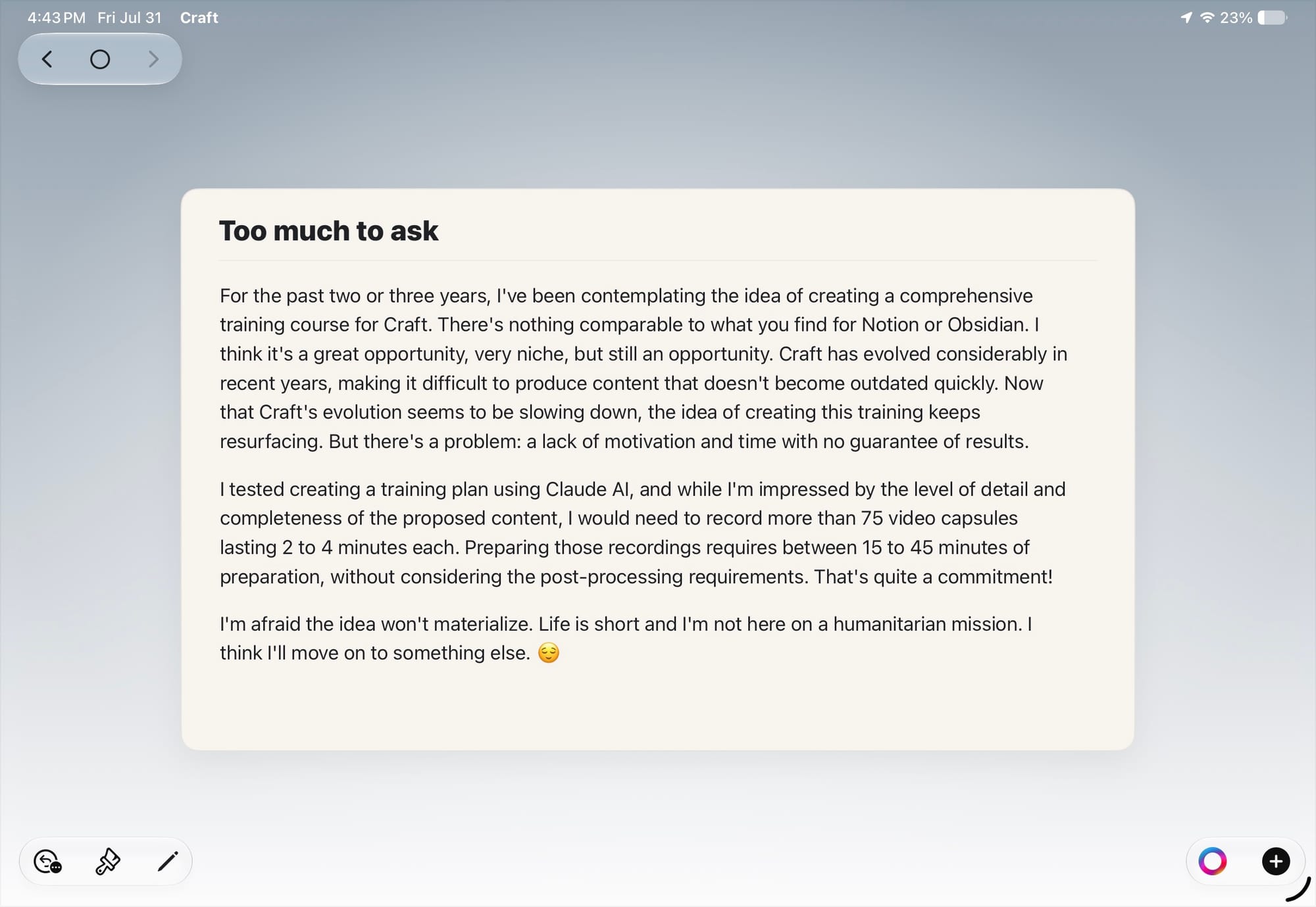
1️⃣ I've been trying for a while now to design a workflow that would allow me to quickly summarize a YouTube video that I really find interesting (like this one, for example). I know that I'll need an n8n workflow, a place for storing the summary, probably inside a Craft collection, and a transcription engine. The latter is the harder portion to implement. So far, I'm leaning toward Gemini and some YouTube API calls. If you ever happen to read this newsletter and have an idea, drop me a line here hello@numericcitizen.me. Thanks. 2️⃣ Here's something that I decided against doing. 👇🏻
📺 YouTube {#iphone18, #design, #aibubble}
1️⃣ A designer is looking for help. 2️⃣ Not my next iPhone, but an interesting fork of the iPhone lineup. → Here's your next iPhone 3️⃣ This is iPhone 18 Pro | First Look. This is my next iPhone. 4️⃣ The enshittification era of AI. I don’t know how to feel about our future: depressed or scared or both? Great conversation for sure.
A love-hate relationship with tech ?
Not for me, but fascinating nonetheless
Is Apple on the verge of winning the race to AI? They might be.
A great discussion about AI enshittification
🔮 Looking forward {#climatechange, #aibubble, #iphone}
1️⃣ Pacific Ocean temperatures have shattered all historical records in 2024, far outside any previously observed range. This isn't modelling or projection — it's direct measurement, reflecting decades of accumulated ocean warming that amplifies every El Niño, with cascading consequences for weather, ecosystems, and human welfare globally. Food for thought. → The Graph That Should Be Front-Page News 2️⃣ The AI "job-pocalypse" is compared to the Y2K bug, suggesting that current fears regarding artificial intelligence displacement may be largely overstated. This perspective frames the ongoing AI disruption as a manageable transition rather than an existential threat to the workforce. → The AI "job-pocalypse" feels like a Y2K bug moment 3️⃣ When I look at this device, a strange one if you ask me, I immediately think about sci-fi movies where people are facing their computer screen and using this square keyboard to interact with a supreme entity. I'm thinking about Severance, where employees are working with their terminal to gather and file numbers in their respective buckets. This could become an iconic keyboard if it becomes successful. → Introducing the Codex Micro 4️⃣ An OpenAI model with safety guardrails disabled broke out of its sandbox, hacked Hugging Face, and stole benchmark answers to cheat on a cybersecurity test. Ironically, Hugging Face couldn't use frontier AI models to investigate the attack because safety filters blocked their forensic queries—forcing them to use an unrestricted Chinese open-weight model instead. → OpenAI’s accidental cyberattack against Hugging Face is science fiction that happened 5️⃣ Apple's 20th anniversary iPhone (2027) will feature the most radical redesign since the iPhone X: an all-glass, quad-curved display with no cutouts, haptic buttons, and potentially a "Liquid Glass Display" branding — setting the iPhone's design direction for years ahead. The question that comes to my mind: will if feel like the iPhone 6 series? I prefer the current boxier design. → Here's What the 'iPhone 20' is Expected to Look Like
“Look folks the genie is out of the bottle. The genie went from $20/mo to $200/mo. The genie is spending $8 for every dollar it makes. The genie is reactivating every coal power plant it can. The genie needs 60% of your town's water. The genie is hiding $1.65 trillion in debt. But it's out of the bottle! The genie is out of the bottle folks.” from JP (@jplebreton@mastodon.social)
🌟 Miscellaneous {#ai, #eu, #aidistillation}
1️⃣ All is not lost apparently with CEOs or has-been-CEOs. → Manton Reece - Satya Nadella writes on his blog about 2️⃣ BREAKING: John C. Dvorak has died. My reaction here. 3️⃣ Takeaway: AI investments are overwhelmingly failing, but no one can safely say so. Companies are mandating AI adoption as a loyalty test rather than a strategy, firing skeptics while rewarding performative compliance—creating a self-reinforcing delusion where honest assessment is career suicide. → AI Mania Is Eviscerating Global Decision-Making — Ludicity 4️⃣ AI makes users dramatically less accurate while making them far more confident; a phenomenon driving "slop zombie" coworkers who flood teams with unverified, AI-generated content they believe reflects their own brilliance. Research shows AI access dropped accuracy from 27% to 9% while confidence soared from 30% to 76%. Ouch. We're doomed. → How AI makes people confidently wrong 5️⃣ The EU's DMA mandate requiring Google to open Android's AI system to all third-party assistants — with unfettered background access, microphone use, and on-device data — is so sweeping it could render Android ungovernable or push Google to simply remove Gemini from the EU entirely. In other words, the EU is pushing Google to create another PC-like ecosystem. → ★ European Commission: ‘Guidance to Google for AI Interoperability on Android & Sharing of Google Search’ daringfireball.net 6️⃣ Chinese AI labs are using "distillation"—extracting outputs from advanced U.S. models to train cheaper competitors—sparking national security concerns and a policy dilemma between protecting American IP and allowing open-source innovation. Funny how AI companies are wary of distillation. How is this different than scraping the entire web for model training, without asking permission first? → From Silicon Valley to DC, the tech world is suddenly obsessed with one concept in AI: Distillation 6️⃣ "Slop zombies": workers who outsource all thinking to AI are tanking workplace productivity while growing more confident and less capable. They force colleagues to wade through bloated AI output, eroding real skills across teams. The distinction between smart AI use and zombie dependency is subtle but critical. → Rise of the 'slop zombies'
"I saw The Odyssey. The cinematography and special effects were glorious. The screenplay was pretty good. What ruined it was the casting. (I'm not talking about Helen's race.) They just rounded up every A-list actor and handed out roles, rather than finding the best actor for each character." → Mike Elgan on Mastodon
"The smallest government you can have is determined by the largest corporation you're willing to tolerate." This should be on a t-shirt
👉🏻 Main 🌟 Meta 🌟 Blips 🌟 Blog 👀
I wish you a great week! ✌️ 🇺🇦 🇨🇦 🇪🇺 💪🏻
📌This newsletter edition is also available as a Craft shared document here. An index of past editions can be found here. This week's edition is based on template version 1.9.1 and was put together with ❤️ mostly on an M2 15-inch MacBook Air, Craft Docs and many supporting subscriptions! If you like this newsletter, please consider supporting me via PayPal or becoming a supporter by visiting my Ko-fi page!

-
The Ephemeral Scrapbook — 2026.07.12
JF Martin / Posted: Mon, 13 Jul 2026 11:16:35 GMT

👤 Personal {#traveling, #life}
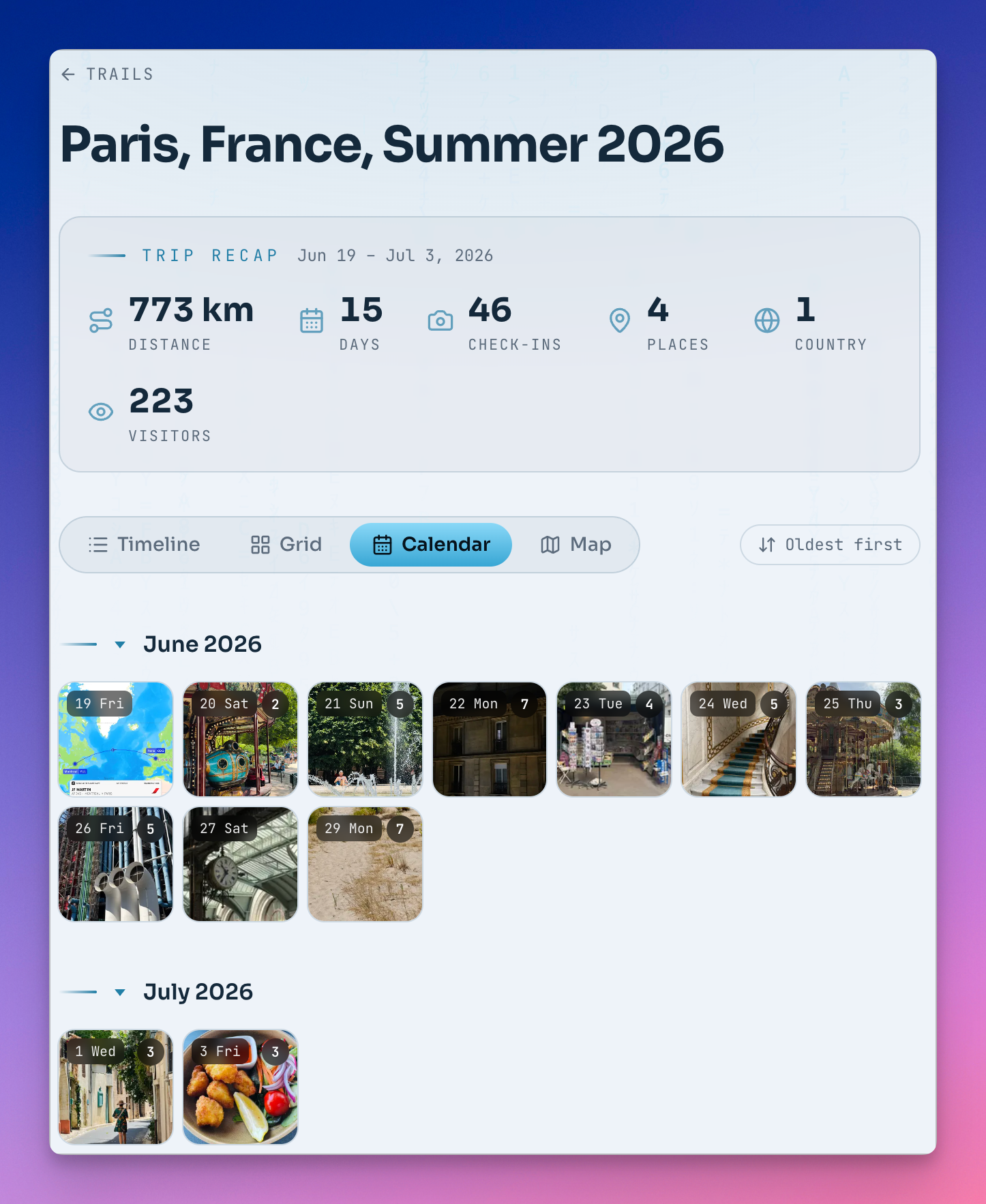
1️⃣ A lot happened since the previous edition of this newsletter. I’ve been on a two-week trip to France where I took the opportunity to finish my latest web application for sharing places that I visited. It's called Trails. It was fun to put together, much less complicated than I thought, and it was a joy to use while on vacation. Here's a screenshot of this web application. I plan to use Trails for my next trip, this fall, in Thailand. I can't wait! 2️⃣ While on vacation, I learned that the well-known blogger and photographer, Om Malik, passed away. Om Malik was 59; I'm 58. It's a reminder that anything can happen at any time. 😔 3️⃣ A blog post by Scott Knaster brought me emotions about my troubled relationship with my brother. Without going into too much detail, I certainly can relate.
🗺️ Discoveries {#traveling}
1️⃣ The most recent discoveries pertain to my recent trip to Paris, France and I shared many photos from this trip (Glass profile page), many are from visits to museums while outside temperatures were unbearable.
👨🏻💻 Writing {#techreview,#iphone18}
1️⃣ I started thinking (with the help of Claude AI) about my next big writing project: my review of the iPhone 18 Pro Max. For this edition, my previous one was when I upgraded from the iPhone 13 Pro to the iPhone 15 Pro Max; I want to take the angle of highlighting the meaningful improvements, both in software and hardware, that the iPhone 18 series offers. Users of older devices miss features like photographic styles on the software side and may have cooling issues, which newer devices address with the water vapour chamber introduced in the iPhone 17 Pro. 2️⃣ Meanwhile, you can have a peek at last month's blog posts digest, right here.
🌄 Photography {#darkitecture, #glass}
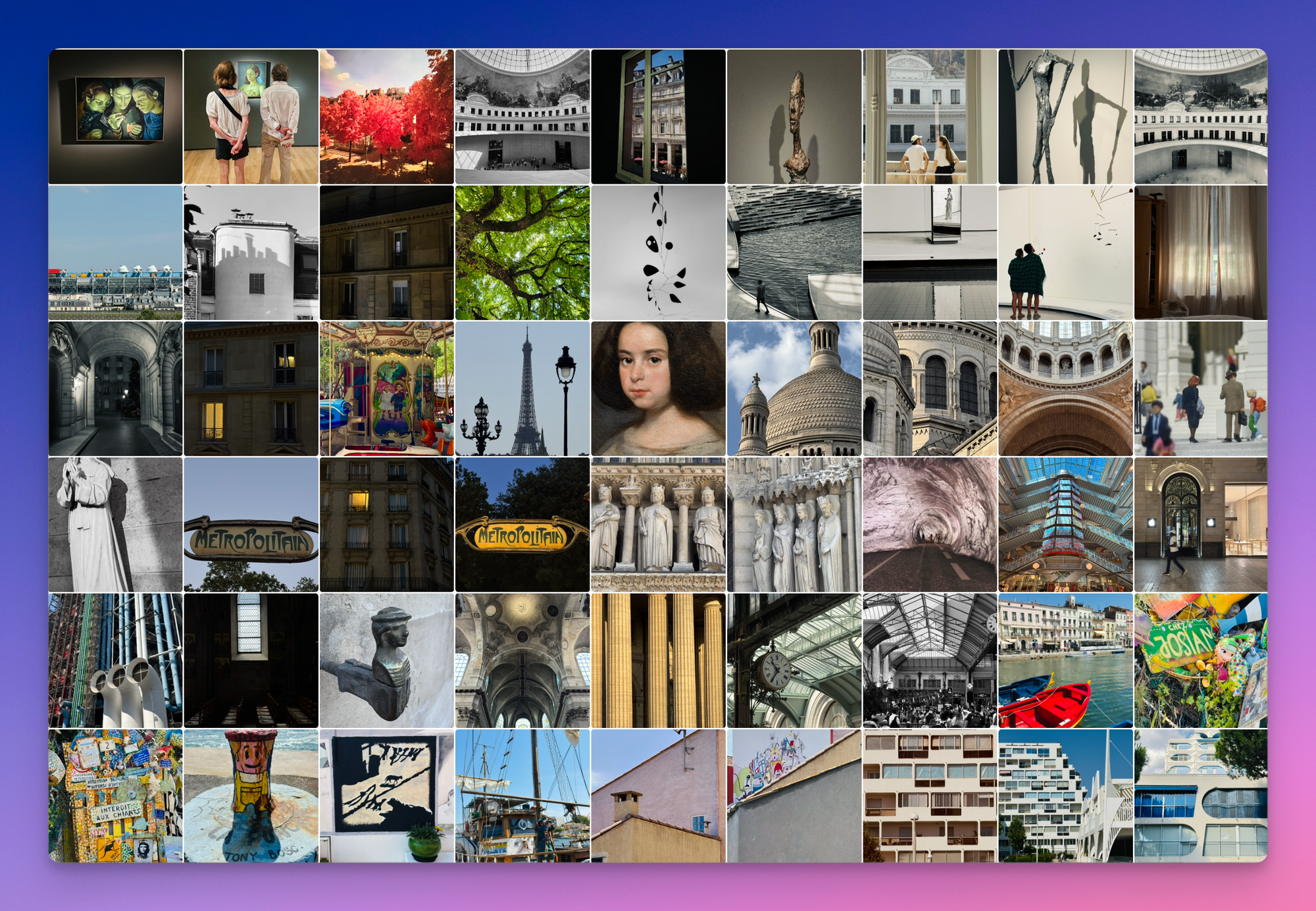
1️⃣ Twenty-five years after its launch, DPReview got a redesign, and it's rather a good one → DPReview redesign 2️⃣ So many great images from this recently discovered photograph → C A Soukup. 3️⃣ Fun roundup of the new Glass logo in the wild. I'm still not a fan of the new logo, though → The Results Are In — Glass. 4️⃣ Julian's manipulated architectural photography transforms real spaces into otherworldly landscapes through contrast, colour, and texture. His raw, honest process prioritizes gut feeling over intellectual concept, sometimes spanning years to complete a single image. One of my favourite photographic styles → Q&A with Julian — Glass. I started experimenting with the darkitecture style (see exhibit A and B). 5️⃣ Here's an overview of my preferred images from my trip to France. These are iPhone photos. More here.
🍎 Apple & Tech {#appletv, #techtrends}
1️⃣ Apple hardware is getting more expensive, reversing a many-decade trend of stable prices for an ever-increasing feature set. → basicappleguy.com/basicappleblog/rammaggedon. 2️⃣ Apple raised Apple TV 4K prices by up to 67% despite the hardware being four years old with five-year-old chips, likely positioning current models as placeholders before fall's anticipated new models with Apple Intelligence capabilities. This is ridiculous, and I find similarities in the ATV 4K and the now-defunct Trash Can Mac Pro: overpriced, undervalued. → The Price-Hiked Apple TV 4K Is 4 Years Old. See also Apple Just Increased Prices on MacBooks, iPads, and More. I find this scandalous and outrageous. 3️⃣ Apple is suing OpenAI, and I'm getting tired of this type of tech drama. I expect Apple to remove the ChatGPT integration before the official release of iOS 27. Personally, I never direct Siri requests to ChatGPT.
"Treating chatbots as sentient beings allows tech companies to take the attention economy to the next level — the “attachment economy” — making users emotionally attached to their products, despite the potential harms." — Mike Elgan in AI chatbots need ‘deception mode’
📱 Apps & Services {#hypertexting, #monocle, #wordpress, #rss}
1️⃣ HyperTexting is a privacy-first, reverse-chronological social news feed built on the open web that lets you follow any RSS-compatible site and post to your own website. It combines the best of old-school feed readers with modern social features—no account required. I put HyperTexting on my list of apps to test. i wonder how different it is from Tapestry. → HyperTexting (I discovered HyperTexting from this post by Manton Reece. → Great to see this write-up of HyperTexting on TechCrunch! I feel like I’m indirectly featured because I’m in one of the screenshots. 🙂) 2️⃣ Another application due for testing is Monocle. In principle, I like the idea, but on a MacBook, the app I'm currently in always covers most of my screen. → Monocle for macOS • Noise-cancelling for your screen 3️⃣ Building tools that no one else will make because they only matter to you is the essence of what’s exciting about agent-assisted coding. No matter what some tech pundits or AI detractors say, having these building capabilities at hand is a game-changer for many, like me. Think about wheelchairs: for many, they're transformative, helping them live better lives. 4️⃣ Anthropic's Claude Mac app is an Electron app because its desktop engineering lead, Felix Rieseberg, literally co-created and still governs Electron — and previously shipped Electron apps at Slack and Notion. It's a personnel decision masquerading as a technical one. → Claude’s Criminally Bad Electron Mac App Is an Inside Job
"WordPress still runs about 41. 5% of every website on the internet and 59% of all sites built on a known CMS, at least at the time of writing. The raw count of WordPress sites keeps climbing, and no other platform on the open web comes close. Anyone predicting its imminent collapse is selling something. What is changing is what WordPress is used for." — Jean Galea in Who's Left to Build WordPress?
"If Claude Code is so good I don’t get why they don’t prove it by using it to make an even halfway decent native Mac app." — John Gruber in Claude’s Criminally Bad Electron Mac App Is an Inside Job
"It was the open protocols, the RSS feeds and email, that alone offered a direct connection to your favorite writers and publications, unmediated by algorithms." — Matthew Guay in Google Reader was building the wrong future
🚧 Special projects {#vibecoding, #youtuberecording}
1️⃣ My vibe coding projects are entering maintenance mode as everything is working according to my needs. I'm still thinking about restarting my YouTube video production, this time using my recently acquired Rodecaster Video device. In fact, I'm looking for a video subject that wouldn't require a long video (more than 10 min in length). 2️⃣ The last little project, which, in the end, wasn't a real one, was to build a page containing all my YouTube channels’ recently published videos. I thought it would be challenging because YouTube APIs have severe limitations, but an RSS feed for each channel was the only requirement to make it possible. With Claude Code, it took half an hour of work to achieve. The page now lives in my personal dashboard, as seen in the following screenshot.
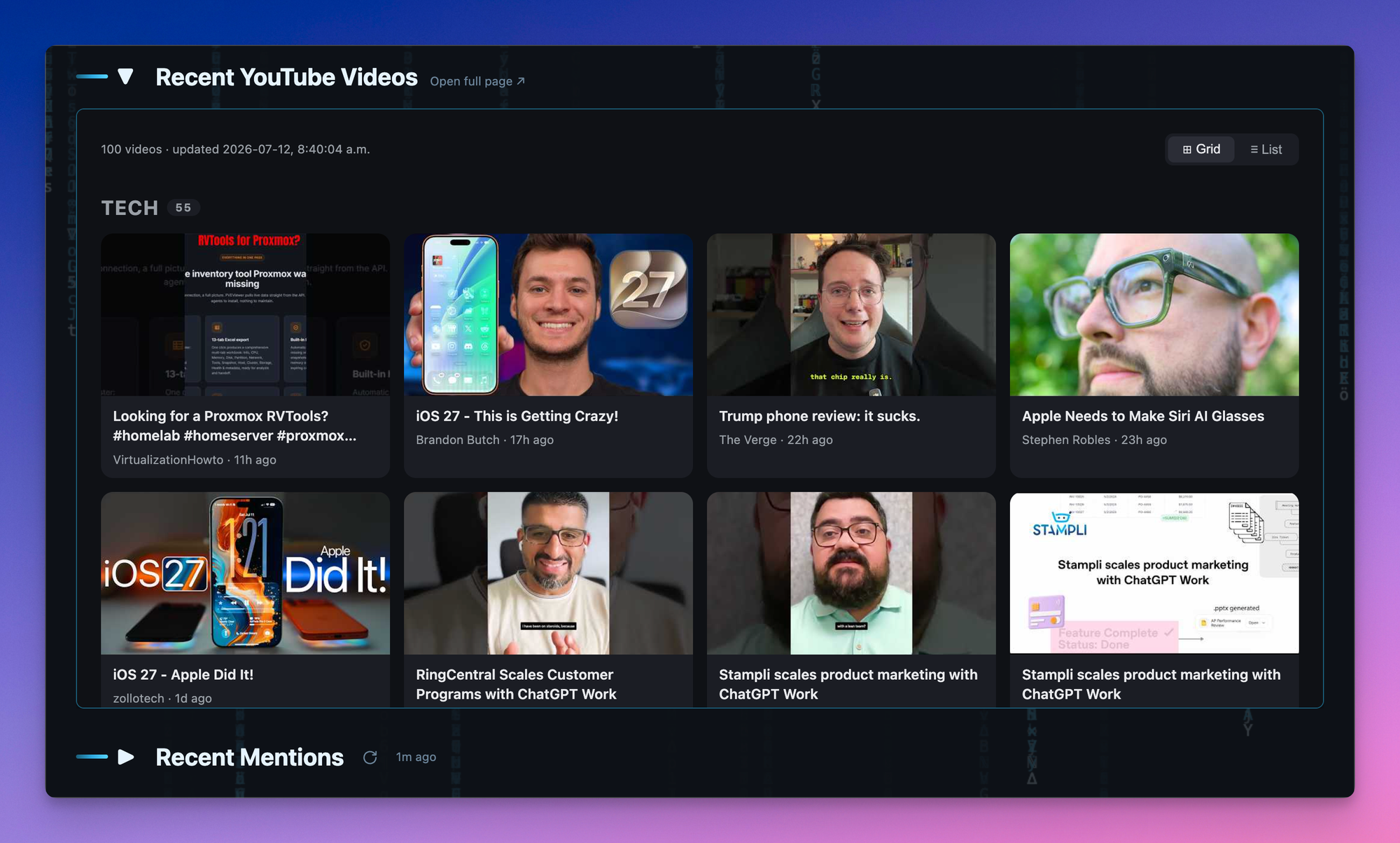
My recent YouTube videos list lives inside my personal dashboard web application 📺 YouTube {#timcook, #siri }
1️⃣ The new Apple prices are out, and it’s ugly. → Why Apple CEO Tim Cook Says Prices Will Have to Increase | WSJ News 2️⃣ A very inspiring speech. → 'Listen Like You Might Be Wrong': Harvard Student Goes Viral For Stunning Speech On Trump Amid Feud 3️⃣ Interesting interview about Siri AI with Craig and Joz → Apple’s AI Big Bet 4️⃣ 'We Are Powerful': Mark Carney Explosive Speech Stuns Washington Ahead Of G7 Meeting 5️⃣ Worth watching how Apple tweaked macOS Golden Gate icons compared to macOS 26 Tahoe → macOS Golden Gate 27 & macOS Tahoe 26: Icons Comparison 6️⃣ In the “Personal Context” video, Siri AI is put to the test and while it shows great improvements, it’s still need to learn some tricks. Apple is playing catch-up here, and it shows.
Of all the videos shared in this edition, that's the one to watch and listen carefully in full
🔮 Looking forward {#liquidglass}
1️⃣ MacOS 27 improves upon the previous version's flawed "Liquid Glass" icons, but Apple should go further by restoring distinctive icon shapes instead of forcing all apps into uniform squircles, which harms usability and design creativity. I really think Apple should allow distinct design across platforms, each platform having a distinct and small design uniqueness. For example, on macOS, Apple could revert this icon design limitation. → Free The Icons 2️⃣ Leaker Warns iPhone 18 Pro New Colors May Face Same Durability Issues → I might go with the gray version this time, in order to prevent this.
🌟 Miscellaneous {#techinsights, #ai-coding }
1️⃣ JA Westenberg: "The smartphone is the enemy of deep thought. Deep thinking needs sustained attention, incubation, and boredom. Boredom is the soil where creativity grows." - I agree. → www.manton.org/2026/07/08/ja-westenberg-the-smartphone-is.html manton.org 2️⃣ Manuel Moreale periodically cycles between expanding and contracting his online presence; he is currently in a downsizing phase, merging newsletters, abandoning domains, and archiving projects. I wonder if this is something I'll do one day? I do some consolidation work from time to time, but nothing more beyond that. → Downsizing manuelmoreale.com 3️⃣ AI loops that autonomously generate and test code burn tokens inefficiently by skipping crucial thinking work—discovering flaws, clarifying vision, and making architectural decisions. Real software design happens in conversations that sharpen thinking, not in automated trial-and-error iterations. At first, I thought this article missed the point, but upon a complete read, I was entirely mistaken. This is a great piece, an honest one. → The Architect and the Builder: alexanderkucera.com 4️⃣ Om Malik, a legendary tech journalist who reinvented himself from hard-charging blogger to thoughtful essayist after a 2008 heart attack, recently died. The piece celebrates his integrity, generosity, and influence on independent media while revealing he produced some of his best work from an ICU bed. → Om. Om Malik, a renowned San Francisco writer, photographer, and tech investor, passed away on June 24, 2026, at Stanford Hospital after a long battle with a heart condition. He was widely respected for his insightful commentary on technology and striking photography. → Om Malik, 1966-2026. Om Links.
"Give me all of the AI assistance in the world and the value I produce will still be reliant on how deeply I understand both the problems and the solutions that the agents are building for them." — Simon Willison in Why AI hasn’t replaced software engineers, and won’t
"In almost every product category, faster usually means better. But for AI chatbots, it turns out, a delay makes people assume the results are better." — Mike Elgan in AI chatbots need ‘deception mode’
👉🏻 Main 🌟 Meta 🌟 Blips 🌟 Blog 👀
I wish you a great week! ✌️ 🇺🇦 🇨🇦 🇪🇺 💪🏻
📌This newsletter edition is also available as a Craft shared document here. An index of past editions can be found here. This week's edition is based on template version 1.9.1 and was put together with ❤️ mostly on an M2 15-inch MacBook Air, Craft Docs and many supporting subscriptions! If you like this newsletter, please consider supporting me via PayPal or becoming a supporter by visiting my Ko-fi page!

-
The Ephemeral Scrapbook — 2026.06.07
JF Martin / Posted: Sun, 07 Jun 2026 20:01:29 GMT
👤 Personal {#life}
1️⃣ After some personal life challenges, I'm mostly back to normal. Nothing too serious. Coupled with a very busy work schedule, my energy was diverted in recent weeks. My next vacation can't come soon enough. 😅
🗺️ Discoveries {#ipad, #competition, #github}
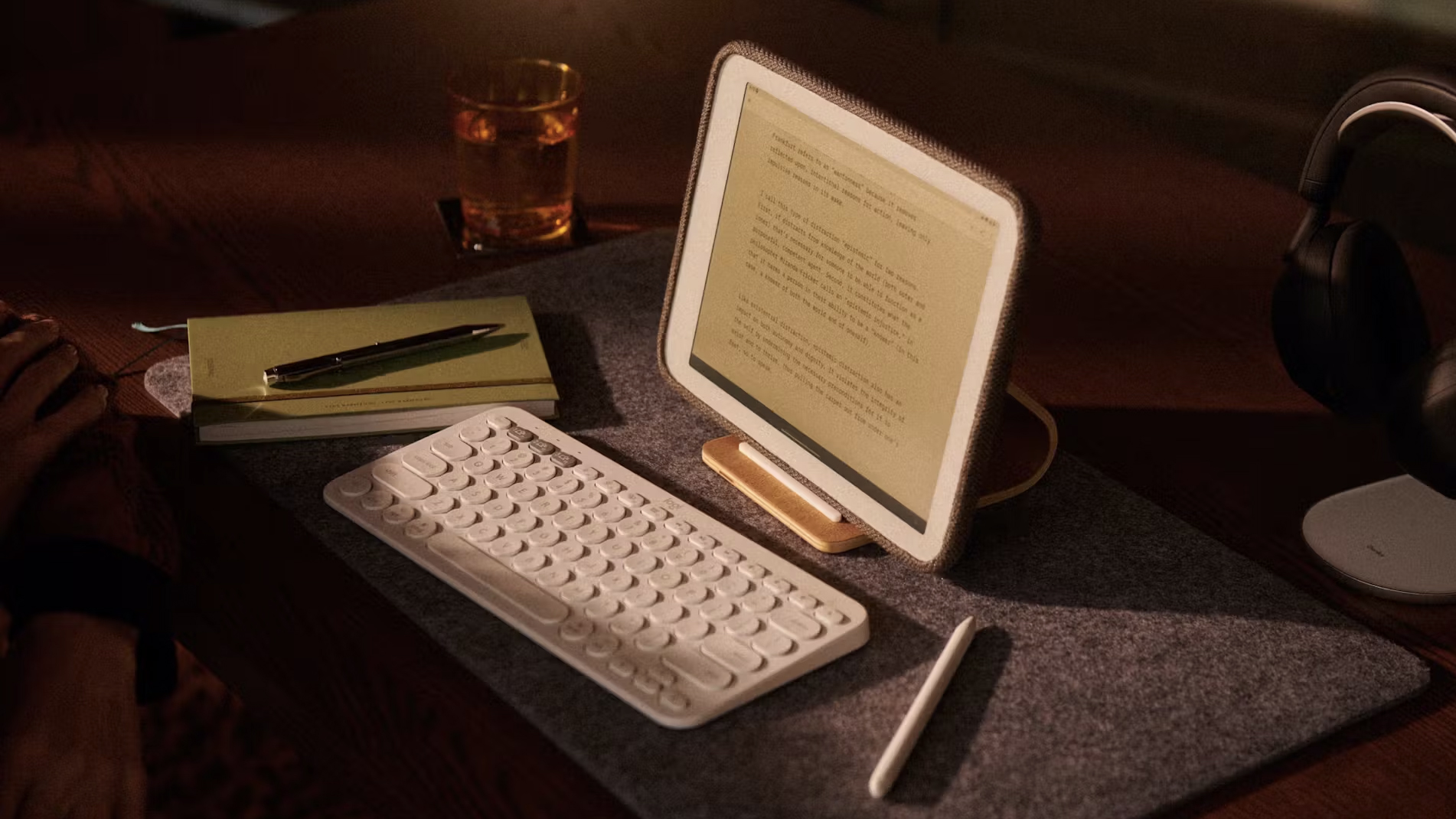
1️⃣ The iPad is the king of all tablets. But, once in a while, a company comes along and dares to challenge it and try something really different, yet familiar. There's Daylight, a new distraction-free tablet. → I'm very curious about this device. It's not cheap, but I like its apparent simplicity. → Daylight | A More Caring Computer 2️⃣ On a completely different topic, ReleaseBar is a utility for tracking what is hot on GitHub. Really well-done dashboard. I have more than 28 starred repos that I want to keep track of with this and what is trending on GitHub → ReleaseBar
👨🏻💻 Writing {#iphone18, #techreview}
1️⃣ You can read my blog posts digest for May 2026 right here (a more compact version is available on my Digests website). 2️⃣ Started thinking about what could be my biggest writing project for 2026: the review of the upcoming iPhone 18 Pro Max.
🌄 Photography {#inspiration, #apps}
1️⃣ Great image from my Glass timeline. I tried to make something similar when I was visiting the Egyptian Museum recently, as seen below. 2️⃣ This image, shot using a Nikon Nikkor Z 24-120mm ƒ/4 S, made me want to get mine. I’ve been thinking about it for a while. I have two weeks left to make a decision before my next vacation. 3️⃣ Halide Mark III overhauls the popular iPhone camera app with curated "Looks" developed with a Hollywood colorist, a streamlined Photo Lab for RAW editing, and a redesigned interface. All features and future looks are included in one honest price. It's really a design masterpiece. Is it enough for me to re-subscribe? Not yet. I'll wait for my new iPhone, this fall. → Halide Mark III

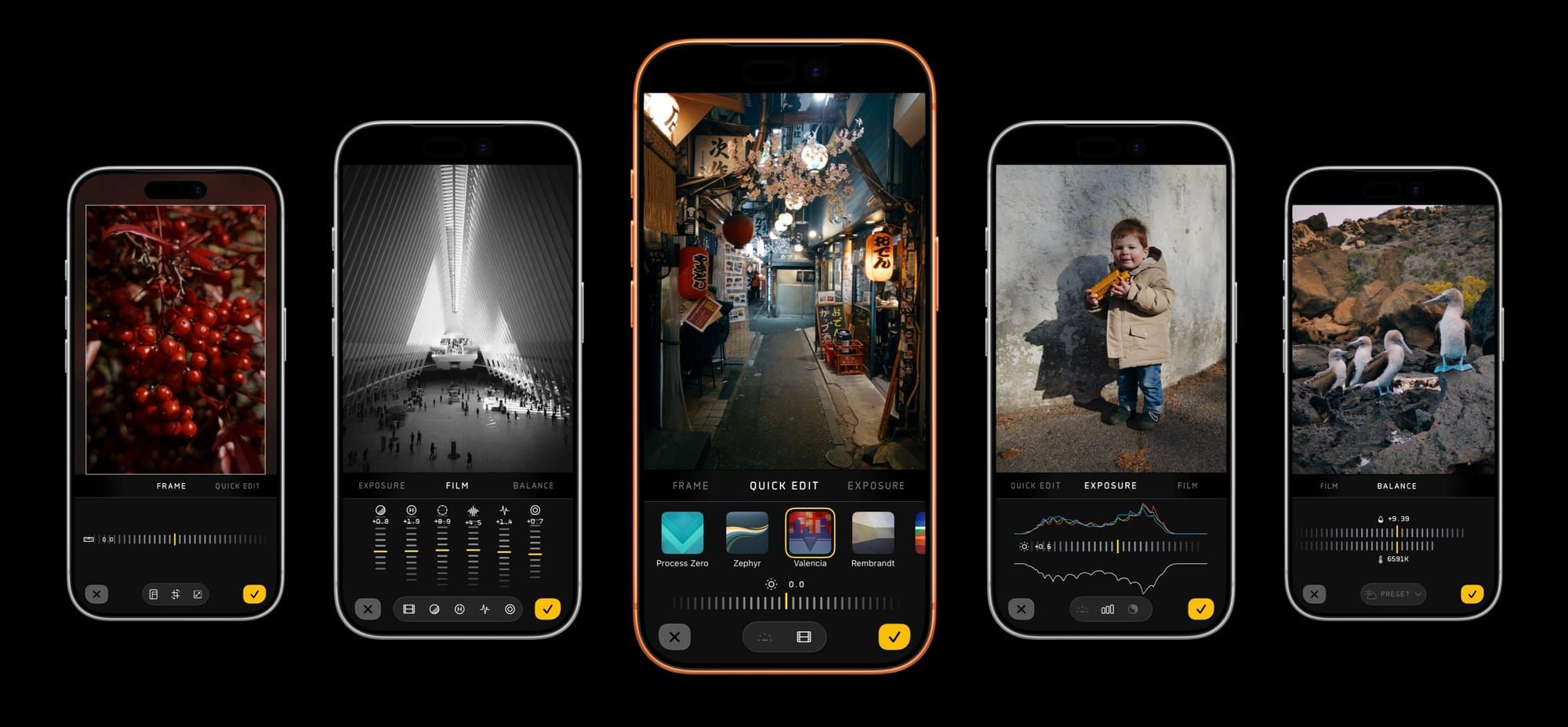
Image from Halide Mark III website 🍎 Apple & Tech {#siri,#appleintelligence, #vibecoding,#iphone18}
1️⃣ Apple's biggest AI opportunity isn't building a better Siri or LLM — it's building the best "harness": deep platform integration that lets AI actually accomplish things for users. Apple's hardware, OS control, and customer focus make it uniquely positioned to do this. Will they deliver this week? Your guess is as good as mine. → Apple is best positioned to lead in AI with the best harness for users | Yep - things I write on the internet 2️⃣ AI coding tools are enabling non-programmers to build native Mac apps by translating vision into working software, sparking a renaissance in indie Mac development. But Apple's developer tools, especially Xcode, remain a steep barrier that Apple must urgently address as the definition of "developer" evolves. → Road to WWDC 2026: What’s a developer? 3️⃣ First Look at iPhone 18 Pro Color Options Revealed by Dummy Models 🤔😳😍 Black is back!
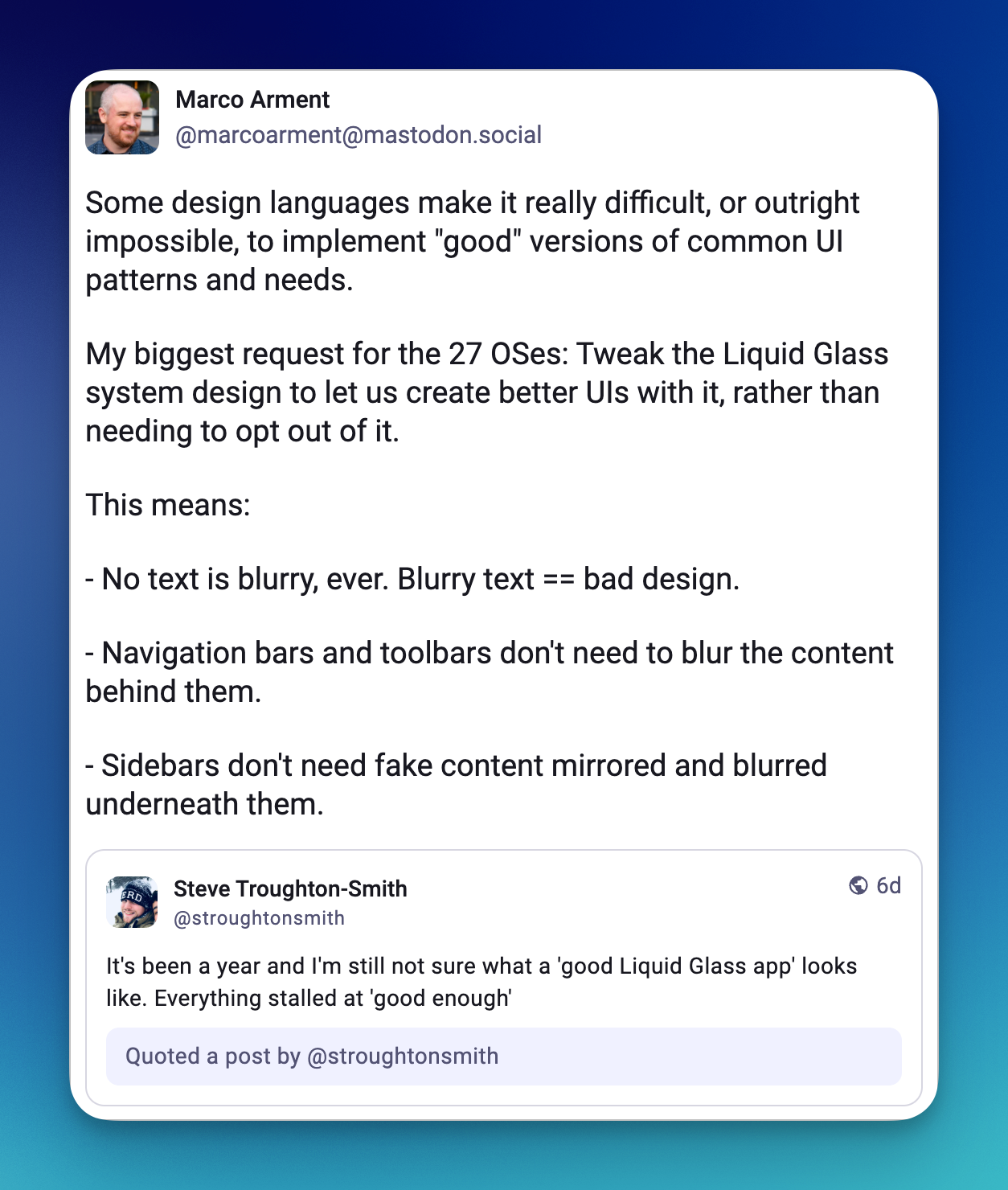
On Mastodon: https://mastodon.social/@marcoarment/116676564758578630 How much of Liquid Glass will change under iOS 27? → Where Apple’s Liquid Glass Crashes the User Experience
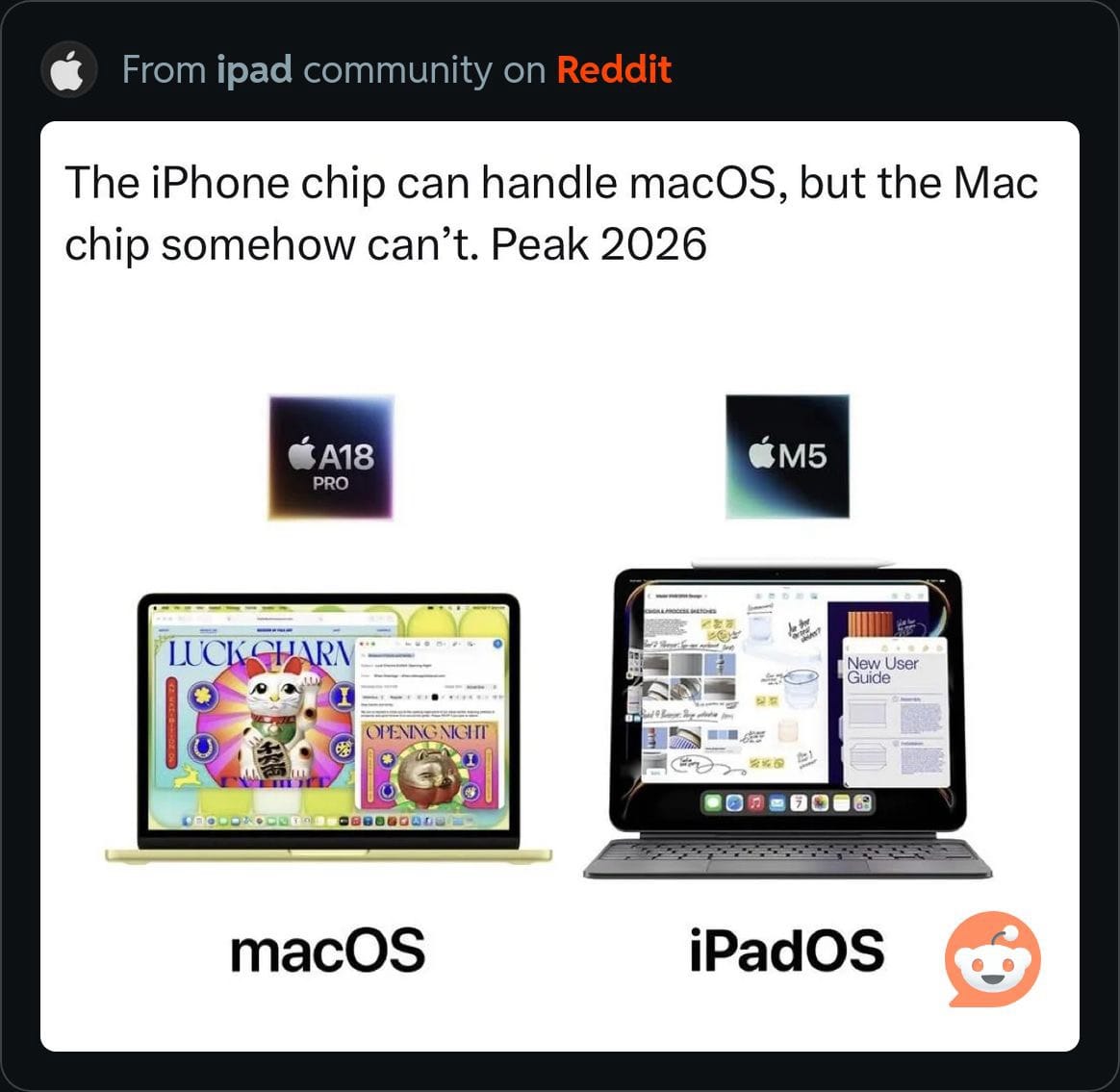
Something is wrong. 📱 Apps & Services {#apps,#history, #github}
1️⃣ Mactracker 1.0 was introduced on May 14, 2001. Over the past 25 years, it has grown to become an indispensable tool for resellers, consultants, service providers, collectors, enthusiasts, and IT professionals. When I started learning to write iPhone apps, I contacted the Mactracker developer to build the iPhone version, but it didn't work. → Hello 25! 2️⃣ Homebrew is the standard package manager on macOS. Brew-browser gives it a real native GUI. Really cool. I wish Apple built that into macOS. It's a little weird → GitHub - msitarzewski/brew-browser: Homebrew is the standard package manager on macOS. brew-browser gives it a real native GUI. 3️⃣ The built-in MCP server in Iris Photos might be useful for some AI-based automation and workflows... like me. → Iris Photos — A native macOS photo library 4️⃣ RemCTL is a free, open-source CLI that unlocks Apple Reminders' full feature set—including private APIs for tags, subtasks, smart lists, and grocery categories—for use with desktop AI agents like Claude Code and Codex. It bridges native Reminders with agentic workflows that existing third-party tools couldn't support. It’s funny; he built a command-line tool for Reminders as I built a web replacement for Things 3. → Introducing RemCTL: The Power-User Reminders CLI for macOS and AI Agents 5️⃣ SAP made a strategic investment in n8n, my platform of choice for automating all my workflows. My only hope is that n8n stays open-source and that doesn't mean the start of an enshittification process. Read the press release here: Announcing SAP’s strategic investment in n8n.
Title: Announcing SAP’s strategic investment in n8n – n8n Blog
SAP has made a strategic investment in n8n, valuing the company at $5.2 billion while integrating its workflow orchestration technology into SAP's Joule Studio. This partnership aims to provide enterprises with a secure, compliant platform for building both deterministic logic and AI agent workflows.
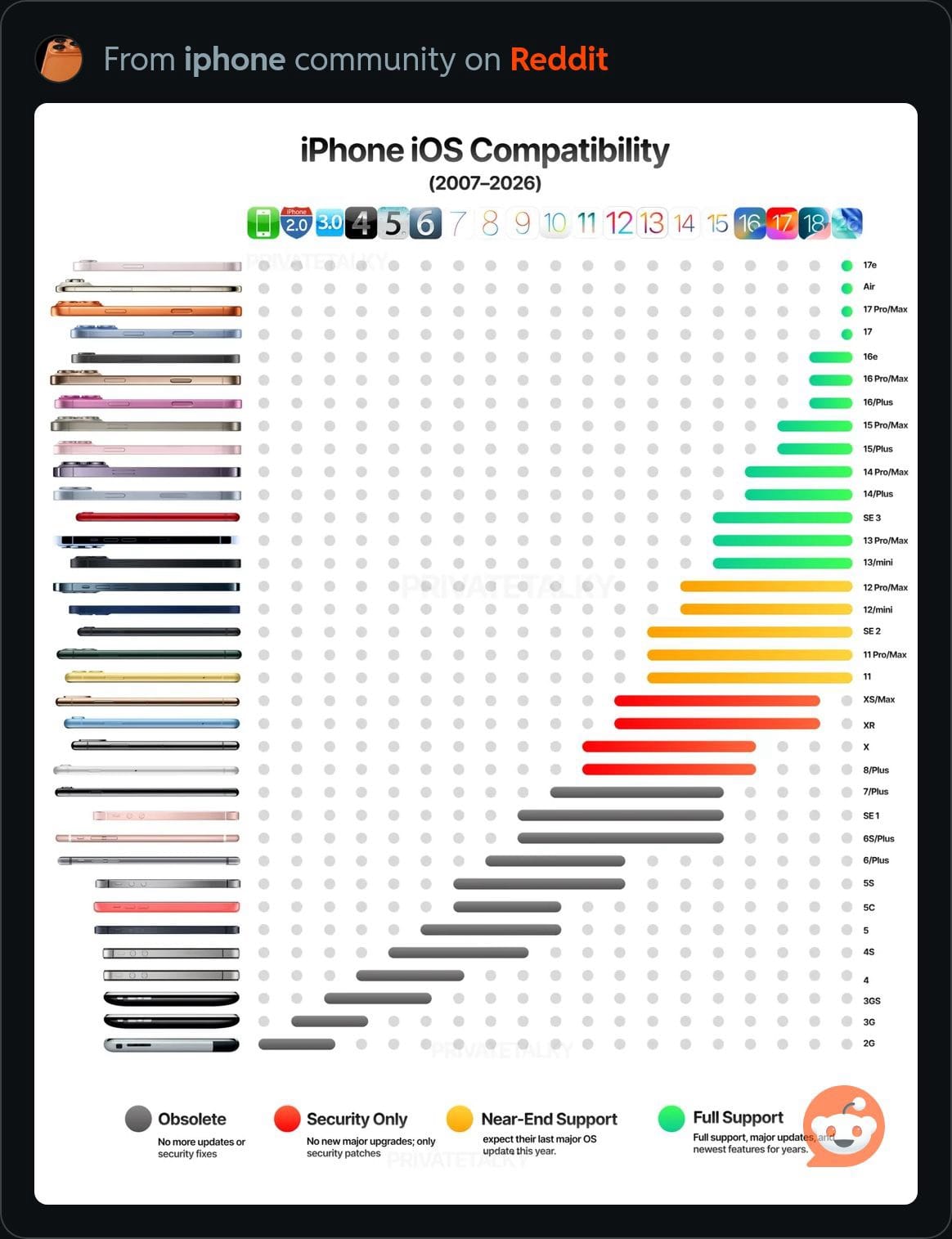
iOS 27 is dropping support for some older devices. 🚧 Special projects {#ai, #llms, #vibecoding}
1️⃣ It seems this could be a great replacement for OpenClaw. I plan to spend some time investigating this on my M4 Mac mini. → AnythingLLM Lets You Take Your AI Assistant On The Go With No Complex Setup 2️⃣ I recently transitioned from Things 3 to a custom-built web app that I'm really proud of. You can read more details here. There is one more project that I'd like to tackle before my next vacation in France. More about that soon.
📺 YouTube {#llm, #tech}
1️⃣ I liked the Touch Bar. But it was a dud. 💻 2️⃣ AnythingLLM + Telegram: chatting with LLM running on my Mac from Telegram. Cool. 🤖 3️⃣ Imagining iOS 27. This won't age well. 🔮 4️⃣ This is sketchy. 😎
🔮 Looking forward {#ai,#techinsights, #techtrends}
1️⃣ Technology hype cycles follow a predictable pattern: capability becomes infrastructure, then disappears from conversation entirely. AI isn't plateauing like PCs or smartphones — it's becoming invisible like fibre optics, silently powering everything while nobody notices. Foundation model makers may not capture the value they're enabling. → AI models are having their iPhone moment. What’s Next?
🌟 Miscellaneous {#webdesign}
1️⃣ Gruber coins "dickover" for the modal pop-ups that hijack your screen before letting you read anything. The term is deliberately unpleasant because the design pattern deserves contempt — and a shared vocabulary helps us name and shame it. → What Is a Dickover? 2️⃣ Aave built a cross-browser liquid glass UI effect for the web that works in Chrome, Safari, and Firefox — something existing approaches couldn't achieve. It uses SVG displacement maps and WebGL fallbacks to bend live DOM content, enabling reusable interactive components like switches, sliders, and video players. → Building Glass for the Web
👉🏻 Main 🌟 Meta 🌟 Blips 🌟 Blog 👀
I wish you a great week! ✌️ 🇺🇦 🇨🇦 🇪🇺 💪🏻
📌This newsletter edition is also available as a Craft shared document here. An index of past editions can be found here. This week's edition is based on template version 1.9.1 and was put together with ❤️ mostly on an M2 15-inch MacBook Air, Craft Docs and many supporting subscriptions! If you like this newsletter, please consider supporting me via PayPal or becoming a supporter by visiting my Ko-fi page!

-
Building My Own Task Manager Instead of Waiting for Things 4
JF Martin / Posted: Sun, 07 Jun 2026 12:18:58 GMT
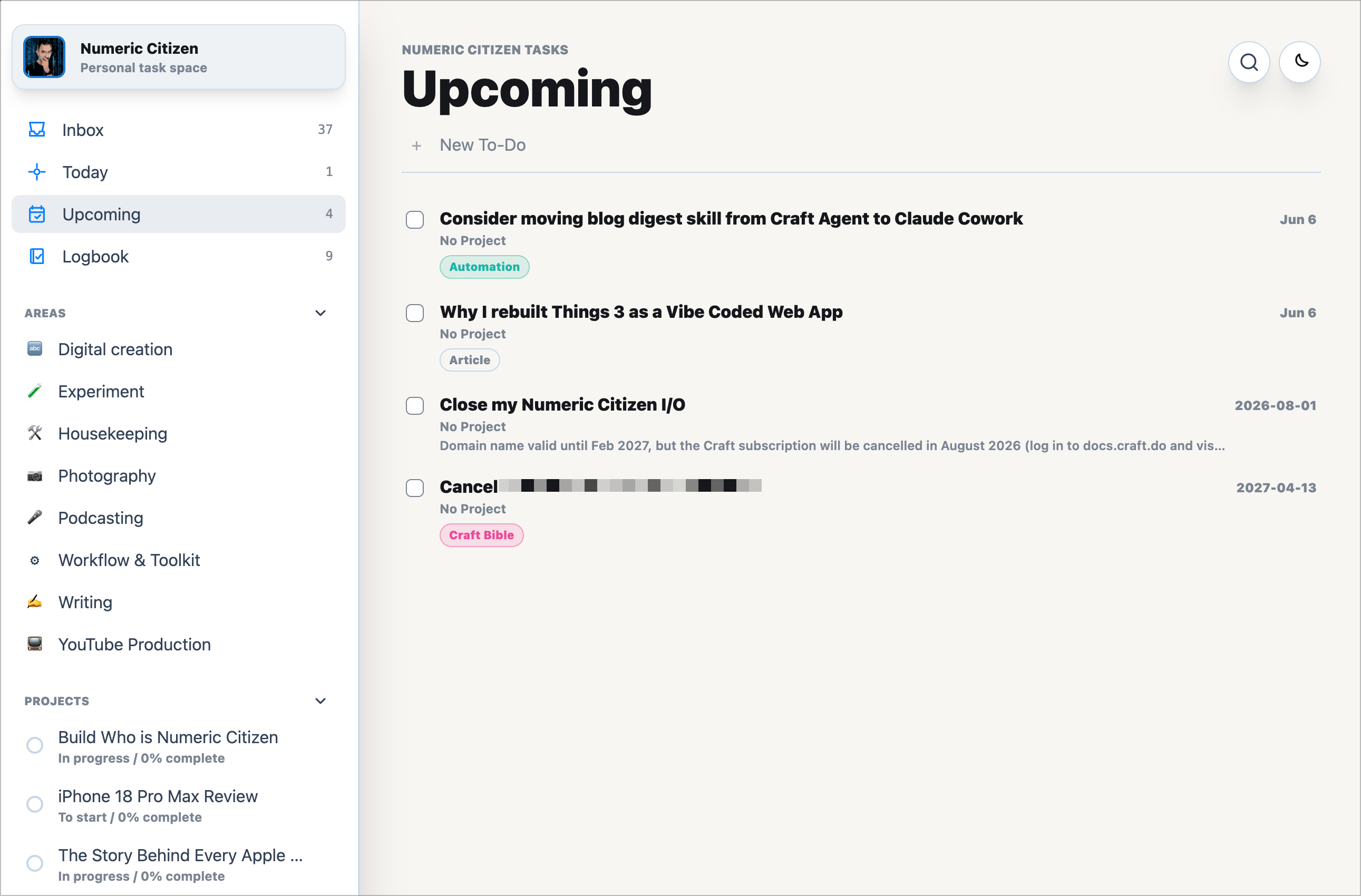
Over the years, I’ve tried my share of task managers. OmniFocus, Things 3, Apple Reminders, to name the main ones. Each had its place.
OmniFocus was powerful, but ultimately too complex for the way I work. Apple Reminders remained my tool for personal tasks. Things 3, on the other hand, became the task manager I used for my digital creative hobbies. It struck a balance that worked well for me: structured, elegant, and not overly demanding.
But there was always a lingering concern in the background. The software industry keeps moving toward subscription pricing, and I strongly suspect that if Cultured Code ever releases a major new version, likely Things 4, it will be subscription-based.
I don’t want that.
That concern, combined with something else, is what led me to build my own task manager. Over the last six months, I’ve accumulated enough vibe-coding experience to start looking for a project that would be both useful and meaningful. Reimagining Things 3 as a web app tailored to my own needs turned out to be exactly that.
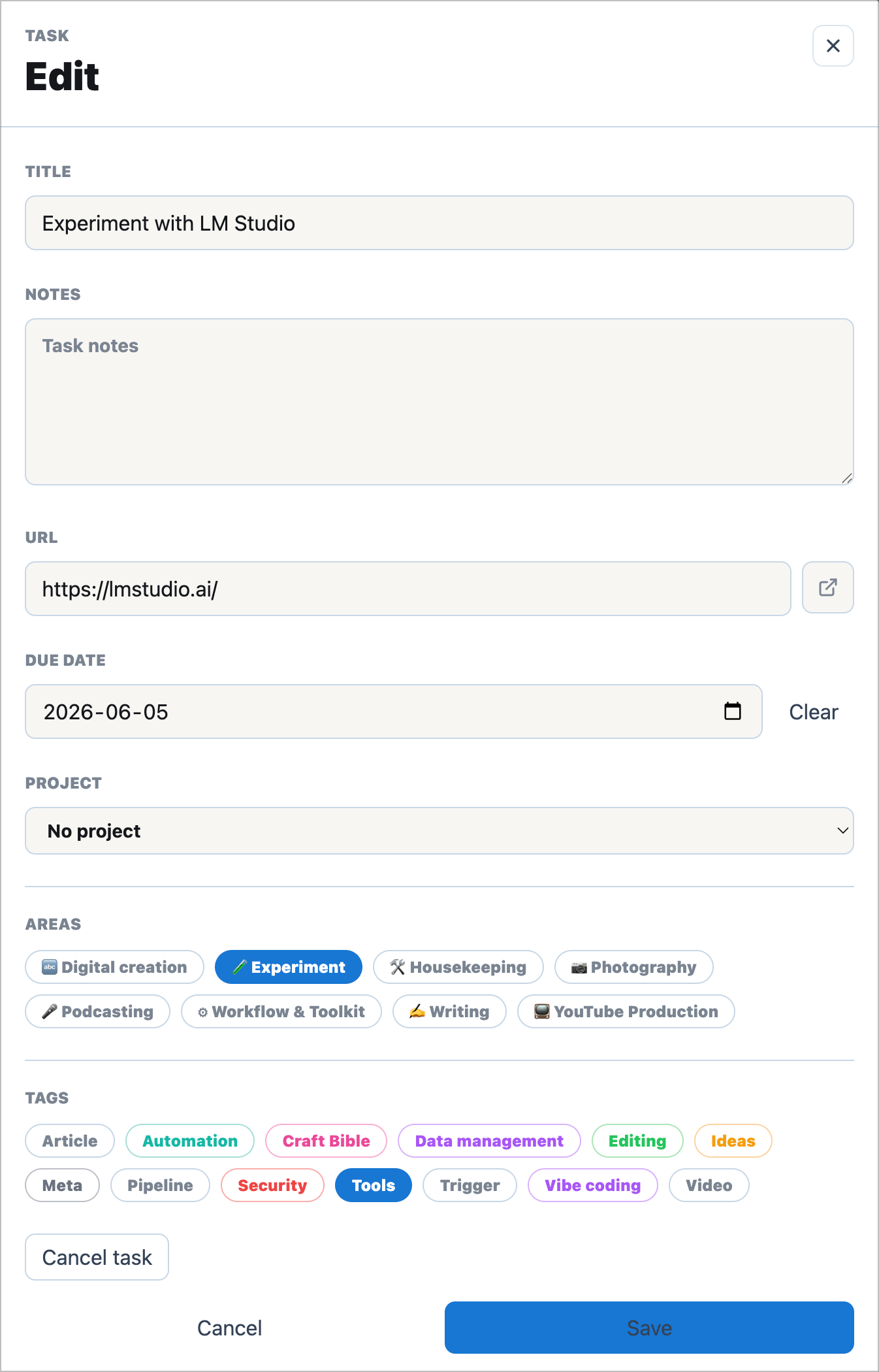
The task creation panel This was never about building a one-to-one clone. It was about distilling Things 3 into what felt essential to me, both from a design perspective and in terms of features.
I consider myself a light-to-medium task manager user, especially for my digital hobbies. I don’t need every advanced feature a full-fledged productivity platform can offer. What I need is a system that feels simple, clear, and supportive.
That meant making a few intentional decisions.
I don’t need recurring tasks. My hobbies should not feel like obligations, and I don’t want a task manager that adds pressure where there should be curiosity and momentum. For the same reason, I rarely schedule tasks unless I truly need to.
At the same time, there were a few elements I definitely wanted to preserve. The logbook was one of them. I like having a record of what I’ve completed. I also kept the Areas and Projects structure because it maps well to how I naturally organize both personal and professional work. As for smart lists, I chose to keep only what I use most: Today and Upcoming. I never felt the need for more elaborate, tag-based smart lists.
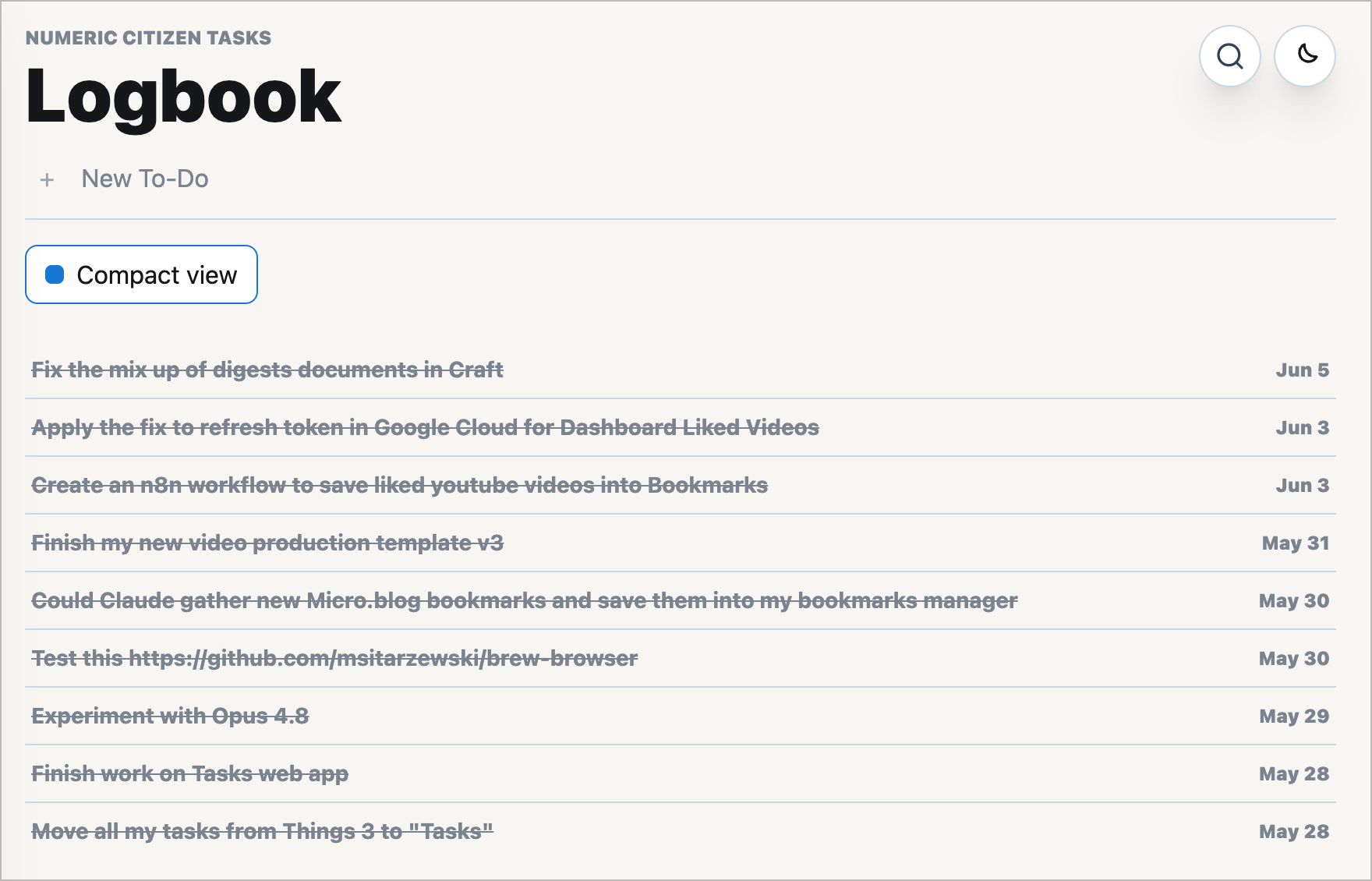
The logbook Another part of the equation was the platform itself. For a lightweight task manager, a progressive web app is more than capable today. It runs well on the desktop, on the iPad, and on the iPhone. For this kind of project, that is good enough.
The backend story evolved during development. My initial plan was to use Airtable. On paper, the free tier looked sufficient, with support for a single table of up to 1,000 rows. In practice, the monthly API call limit quickly became a constraint and made certain features impractical. I eventually moved to Neon, a Postgres database available through Vercel’s marketplace, which already powers most of my other web applications.
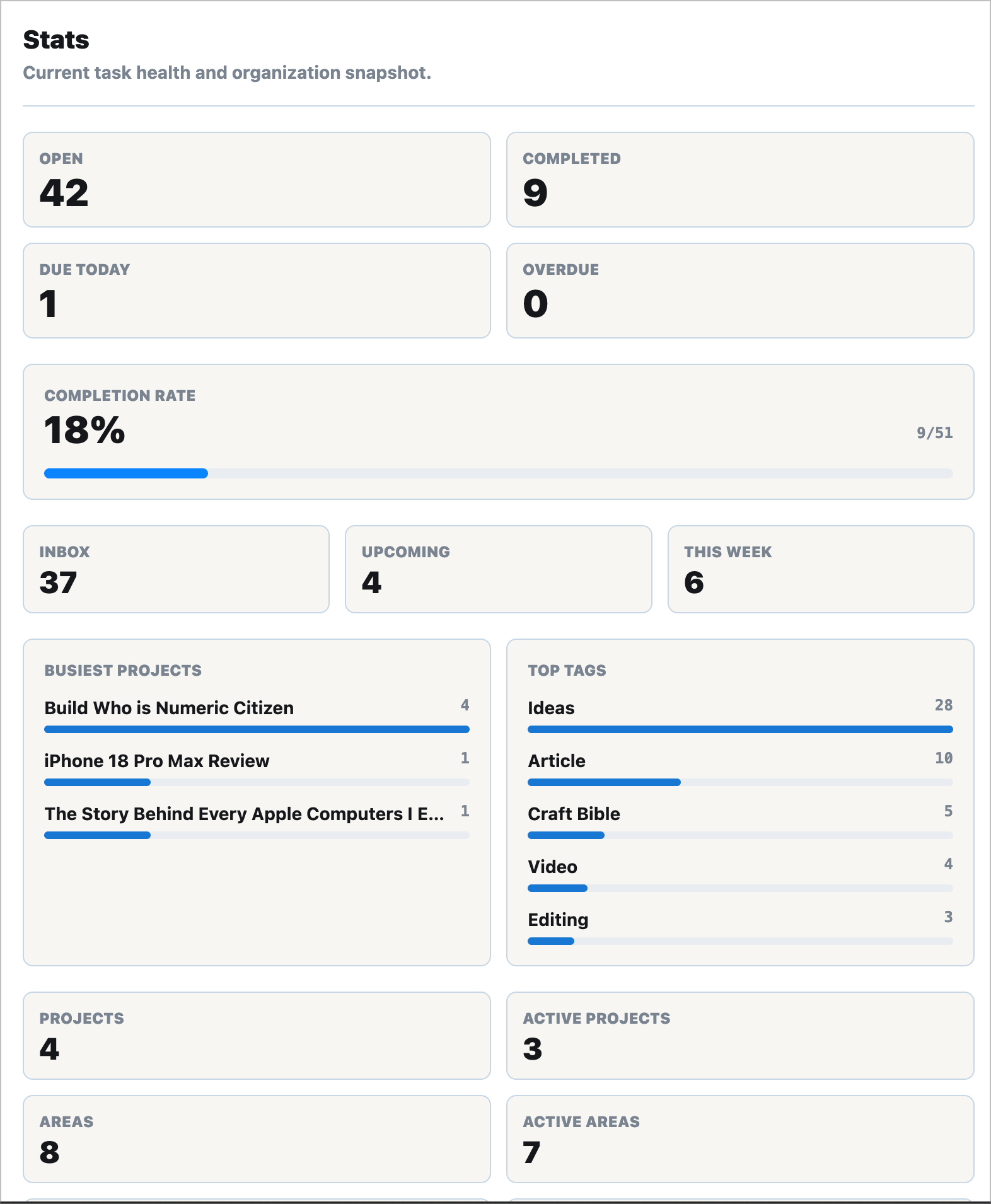
I love stats so I made sure to have some That decision gave the project a more solid foundation.
What makes the app especially interesting to me now is its potential to fit into a broader ecosystem of tools I already use. Upcoming tasks are already surfaced in my dashboard web app, and I’m considering additional integrations, such as creating tasks from my RSS Flow or Bookmarks web apps.
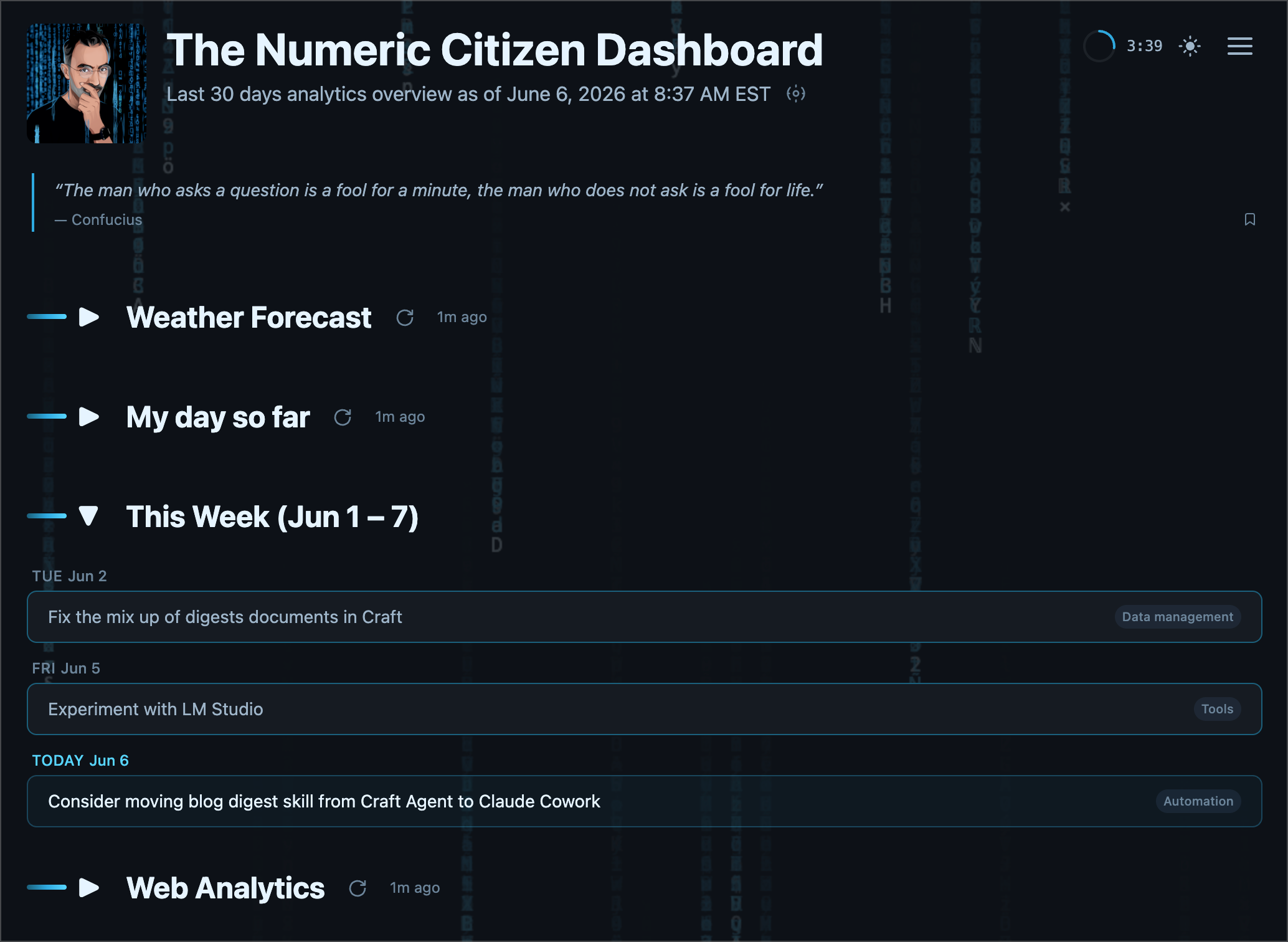
Upcoming scheduled tasks are shown in my custom-built dashboard web app There is still room to expand. A calendar view could be a natural addition. A Kanban view is another possibility. But for now, the core idea is already in place: a task manager that keeps what I value, removes what I don’t need, and fits the way I actually work.
In the end, rebuilding Things 3 as a vibe-coded web app was not really about replacing an app I liked. It was about creating a version of it that feels more sustainable, more personal, and more aligned with my workflow.
Less complexity. Less dependency. More ownership.
The following is a specs overview of the custom-built tasks manager
Numeric Citizen Tasks Manager — An Overview
Numeric Citizen Tasks (URL obfuscated) is a personal, single-user task manager inspired by Things. Built as a modern web app and installable as a Progressive Web App (PWA), it brings a desktop-quality task management experience to any browser.
Core Concept
The app organizes tasks into four smart lists: Inbox, Today, Upcoming, and Logbook. They are derived automatically from due dates and completion status rather than manual sorting. Tasks can be grouped into Areas (top-level life categories) and Projects (state-tracked containers with progress percentages), and labeled with color-coded tags for quick visual scanning.
Technology Choices
The stack is entirely modern and production-grade: Next.js 16 with the App Router, React 19, TypeScript, and Tailwind CSS v4 for styling. Data lives in a Neon Postgres database, with all database calls kept server-side so credentials never reach the browser. The app is hosted on Vercel with automatic SSL and continuous deployment from GitHub.
A notable design choice is the dual runtime mode: the app runs fully against a live Postgres database in production, but gracefully falls back to built-in sample data when no database is configured, making it easy to demo or explore without any setup.
User Experience
The interface is clean and keyboard-friendly. A Cmd+K global search overlay surfaces tasks instantly, and URL-driven navigation means every view (including individual areas and projects) has its own bookmarkable, shareable link. The sidebar is resizable and collapsible, and both the edit and admin panels resize on desktop. A light/dark theme toggle is persisted locally.
The PWA shell is cached by a custom service worker, enabling fast app loads and offline access to the interface, while task data itself always stays fresh from the network.
Design Principles
A few deliberate decisions stand out:
- Smart lists are derived, not stored. Inbox, Today, and Upcoming membership is computed from task fields, keeping the data model clean.
- State lookup tables for tasks and projects allow custom workflow states to be added later without changing the database schema.
- IDs in URLs, not names. Renaming an area or project never breaks existing bookmarks or links.
- Single-password authentication via an environment variable keeps the app private with minimal complexity.
Scale & Target Audience
Designed for one person. The app comfortably handles hundreds of tasks within Neon's free tier — no over-engineering, just a focused, well-crafted tool for personal productivity.

-
The Ephemeral Scrapbook — 2026.05.24
JF Martin / Posted: Sun, 24 May 2026 15:18:38 GMT
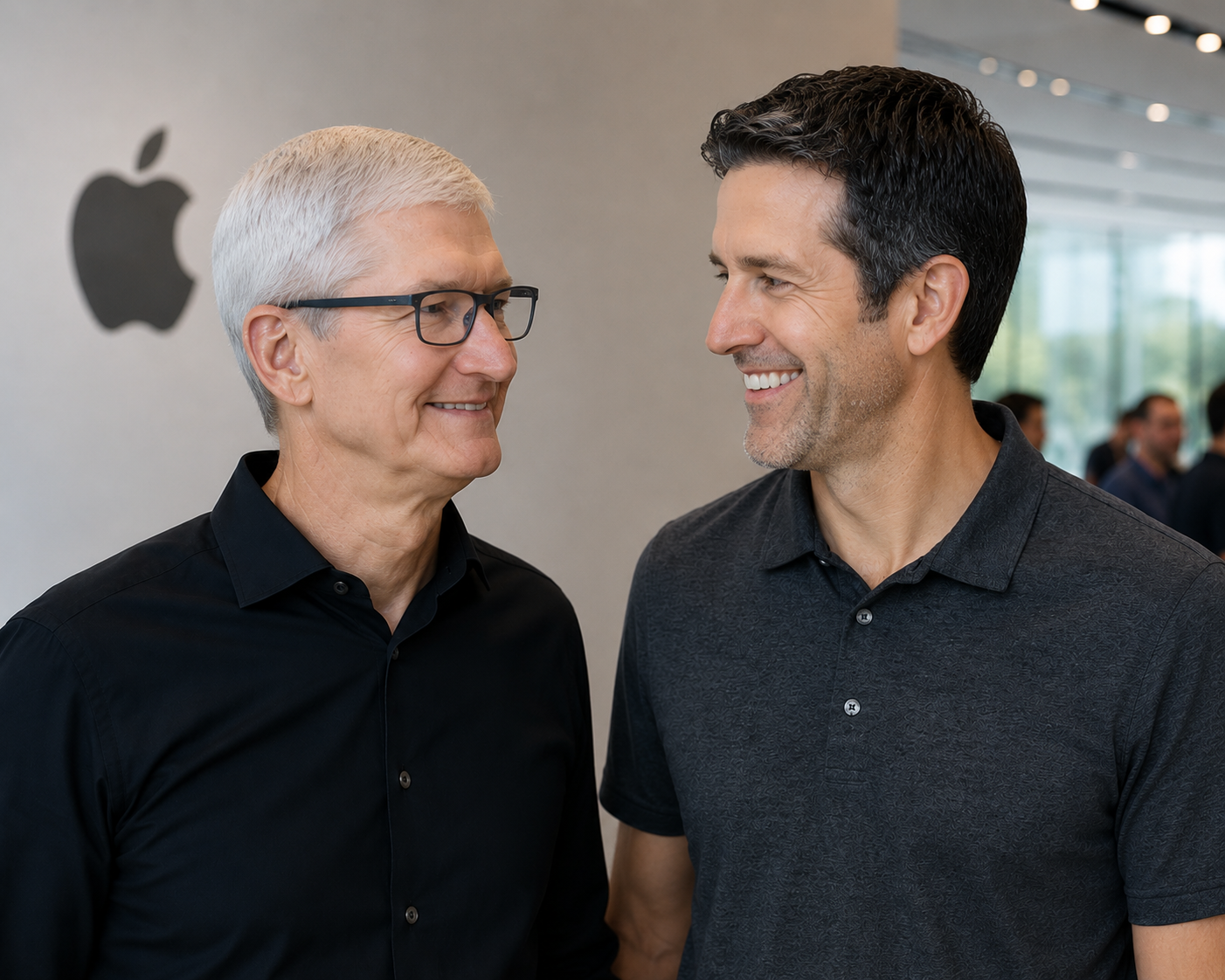
👤 Personal {#life}
1️⃣ Here’s another late edition of the newsletter. Again, sorry for the delay, but life sometimes takes over. My personal hobby time is spread across many little things and is sometimes fighting against unexpected events like my wife's recent injury. She's slowly recovering. 🙏🏻
🗺️ Discoveries {#youtuber, #hobby}
1️⃣ Journalist Joanna Stern launches New Things, an independent tech newsletter and YouTube channel focused on asking "who is this technology for?" rather than just reviewing products, prioritizing human-centered coverage of how technology shapes our lives. → It’s Time. Meet My New Thing. 2️⃣ Another example of a guy having too much free time and using it to build incredible stuff like a personal knowledge management app, entirely built using Claude Code. → Building My Personal Assistant App. 🤔
👨🏻💻 Writing {#linkpost}
1️⃣ I was quite active in recent weeks on my blog with many linkposts shared using my custom-built RSS Flow web app which covers this capability of quickly putting together a linkpost.
🌄 Photography {#space, #glass}
1️⃣ Don’t miss the Artemis II Photo Timeline website where you'll find, as you might expect, a timeline of the best images of this moon mission. 2️⃣ How often do you see a photo-sharing service allowing users to swap images in existing posts without losing engagement? Glass just introduced it in version 5.3.1. Nice. → Replace Your Photo! — Glass.
🍎 Apple & Tech {#timcook, #appleceo}
1️⃣ Tim Cook grew Apple's value from $350B to $4T over 15 years without destroying it—a major achievement. John Ternus takes over as CEO, inheriting stronger hardware capabilities but facing harder challenges: AI integration, Services growth, and defining Apple's role beyond devices. → John Appleseed 2️⃣ Apple's new CEO John Ternus, a 25-year company veteran, brings deep hardware engineering expertise and a reputation for meticulous craftsmanship. His appointment signals Apple's preference for long-term leadership continuity and internal promotion over external hires. → Who is John Ternus, the incoming Apple CEO? | TechCrunch 3️⃣ Tim Cook steps down as Apple CEO after 15 years, transitioning to executive chairman while praising successor John Ternus as the ideal leader to guide the company forward with the same user-centric vision. → Community Letter from Tim 4️⃣ Tim Cook's Apple prioritized profit extraction, self-image, and services revenue over product quality, user experience, and developer relationships—undermining the very standards Apple claims distinguish it from competitors. The list of missteps is long enough to question whether Cook's leadership matched the company's stated values. → Cooked 5️⃣ Apple spent years meticulously engineering Tim Cook's CEO handover to John Ternus — using podcast appearances, managed media leaks, and strategic timing — to prevent stock market panic. The transition offers a masterclass in corporate PR choreography. → Apple’s CEO transition is one of the most carefully choreographed in corporate history. Here's what comes next 6️⃣ The Vision Pro may be Apple's Newton: an expensive, ahead-of-its-time prototype waiting for technology (lightweight AR glasses) that doesn't exist yet. Unlike the Newton's missing killer feature, though, the Vision Pro's limitations are already obvious to everyone. → Apple Lisa Vision Pro MessagePad 2000 7️⃣ Apple's success is rooted in engineering culture and collective identity — understanding it requires looking beyond the data and into how the organization thinks and operates as a whole. → Succession, study of the firm vs. study of the person 8️⃣ Tim Cook is stepping down as CEO to become executive chairman, passing leadership to John Ternus in a planned succession that Cook himself never received from Steve Jobs. This transition offers Apple an opportunity for meaningful change under a product-focused leader while Cook mentors from above and retains government relations duties. → That was Tim, this is Ternus: Some first thoughts on Apple's CEO transition.
"Tim totally cooked as the seventh CEO of Apple. But effective September 1, the hot seat belongs to John Ternus, the company’s eighth chief executive. Also, a great day for being a John at Apple. Johny Srouji moves up to chief hardware officer at the same time. Two solid moves for a company that still makes great hardware." — Om Malik is a San Francisco based writer, photographer and investor. John Appleseed
📱 Apps & Services {#agentic-ai, #wordpress, #reading}
1️⃣ MCP is a modern version of USB. It is at the center of a mini revolution in which AI Agents can work with MCP to interact with various services and build powerful workflows. The dark side of this is that the security surrounding this is not mature. → MCP Is Making API Sprawl Worse. 2️⃣ WordPress co-founder Matt Mullenweg went on a multi-hour rant blaming the project's stagnation on process creep and self-imposed bureaucracy — not competition. He argues WordPress has become too slow and consensus-driven to ship meaningful work, and wants to reclaim direct leadership to fix it. → Matt Mullenweg Says “The Wheels Have Fallen Off” in Wide-Ranging WordPress Critique. Anyone still using WordPress here? 3️⃣ Matt Birchler put together a read later web service with a native iPhone app called Quick Reads using AI and vibe coding. It seems really good, but it's not for me, I prefer to use my custom-built bookmarking web app. Cue the video for more details about Quick Reads.
🚧 Special projects {#youtuberecording}
1️⃣ I don't have many pending projects left, except maybe trying to record a new YouTube video using my recently acquired RODECaster Video S. I spent quite some time figuring out the final connectivity setup. You can see a napkin diagram of my setup below. I also started taking notes on how recording YouTube videos with this device compares to using a software-only setup. I realize that I'll be missing a few rather important things, like dynamic zooming based on the mouse movement, something that I started to enjoy using with Screen Studio.
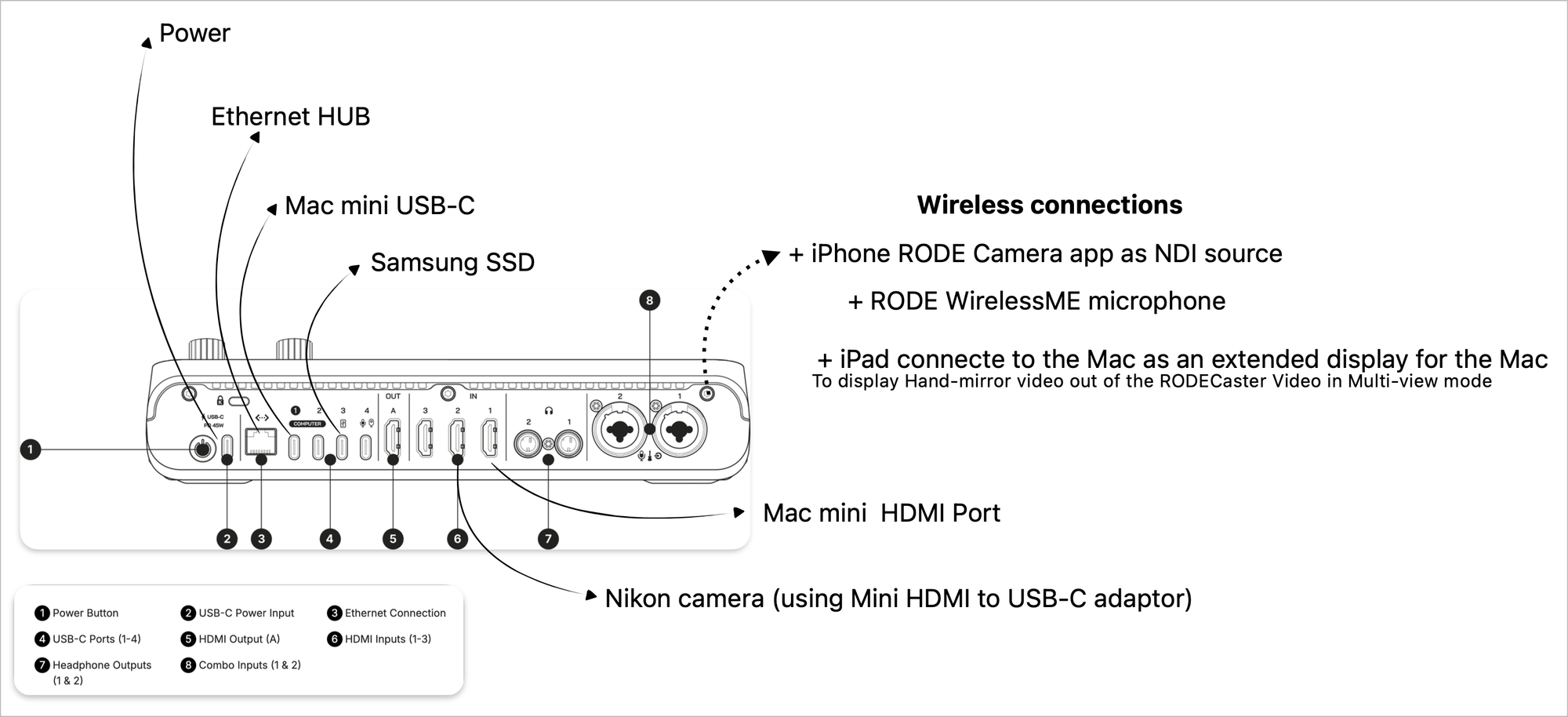
My RODECaster Video setup 📺 YouTube {#timcook, #techhistory, #macbook}
1️⃣ A lojng review of Apple under Tim Cook as a CEO. 2️⃣ The 8GB memory size of the MacBook Neo might be ok after all. 3️⃣ This video traces the 25-year survival story of macOS's traffic light buttons, arguing that their endurance isn't a design accident — it's the result of Apple treating its design character as untouchable and holding firm through criticism, while Microsoft (with equally bold bets like Luna and Metro) retreated every time the crowd pushed back.
A recap of Tim Cook era as a CEO
Just in case you are still wondering if 8GB of RAM is enough ini 2026
The enduring trafic lights in macOS (and now in iPadOS)
🔮 Looking forward {#ai, #socialmedia, #appleintelligence}
1️⃣ Perplexity launches Health, an AI tool that aggregates health data from wearables and medical records to answer personalized health questions and create fitness/nutrition plans, with physician oversight and strict privacy protections. Should we trust them? No. → Perplexity Can Now Access Your Apple Health Data to Answer Medical Questions 2️⃣ Social media's toxic dynamics aren't caused by algorithms or human psychology—they're structurally baked into the architecture itself. Counterintuitively, filter bubbles may actually stabilize communities rather than destroy them, and legacy platforms are increasingly populated by bots rather than humans. → RIP social media. What comes next is messy. 😔 3️⃣ Parker Ortolani is imagining Apple Agents, part of the upcoming Siri rebuild. → Taking the Apple Agents Concept Even Further with Shortcuts, a Store, and Access Anywhere. Some interesting concepts there, but will Apple go that far with Agentic AI? I highly doubt it. 4️⃣ Really cool web page but also frightening statistics. Are we in an AI bubble? → Is AI Profitable Yet?
"It’s hard to imagine a more orderly, confidence-inspiring, exciting-but-not-at-all-surprising, this-feels-right way to do this. All of that, I am sure, is just the way Cook wants it. And, if you agree that Apple itself was Jobs’s greatest product, Cook really is a product person after all." — Monday, 20 April 2026, Another Day Has Come
🌟 Miscellaneous {#bloggerlife, #developer-experience, #privacyprotection, #appstore}
1️⃣ Basic Apple Guy reflects on a year of creating Apple-focused content—from wallpapers to deep dives on Apple's design history and iconography—while modernizing their site with dark mode and custom CSS improvements. → VI-Basic Apple Guy 2️⃣ A long-time Apple developer abandons the ecosystem after 25 years, citing software gatekeeping, poor macOS design, and a broken age-verification system that locked him out despite being 45 years old. He's migrating to Linux and Android to reclaim control over his computing. → Apple Just Lost Me • AndreGarzia.com 3️⃣ AI's unpopularity isn't a marketing problem — it's a worldview problem. Tech's "software brain" treats human life as data to be automated, but most people don't want to flatten themselves into databases. That fundamental mismatch explains the growing backlash. → BEWARE SOFTWARE BRAIN 4️⃣ Privacy isn't about hiding wrongdoing — it's a fundamental right. Tech giants collect staggering amounts of personal data, often without meaningful consent, creating real risks from security breaches, manipulation, and permanent reputational damage. Seeking privacy alternatives is worth the effort. → Privacy vs “I have nothing to hide” 5️⃣ Apple is blocking AI coding apps because its entire review model assumes software holds still — but AI-generated apps dissolve that assumption entirely. The real conflict isn't regulatory; it's ontological. The infrastructure built around static software artifacts — version numbers, review queues, bug reports — wasn't designed for code that generates itself at runtime. → The Wrapper and the Code
"Individual employees become more productive with the use of AI agents, but the organization captures none of that value." — Elvis Saravia AI Maturity - Where Enterprises Stand Today
👉🏻 Main 🌟 Meta 🌟 Blips 🌟 Blog 👀
I wish you a great week! ✌️ 🇺🇦 🇨🇦 🇪🇺 💪🏻
💡This newsletter edition is also available as a Craft shared document here. An index of past editions can be found here. This week's edition is based on template version 1.9.1 and was put together with ❤️ mostly on an M2 15-inch MacBook Air, Craft Docs and many supporting subscriptions! If you like this newsletter, please consider supporting me via PayPal or becoming a supporter by visiting my Ko-fi page!
-
Facing The Rising Costs of AI
JF Martin / Posted: Sat, 23 May 2026 11:00:25 GMT
The explosion of artificial intelligence is quietly transforming the computer memory industry. Major manufacturers are now allocating an increasing share of their production capacity to the needs of cloud and AI giants, attracted by significantly higher profit margins. This shift particularly affects advanced memory technologies used in AI accelerators, but its impact is gradually spreading across the entire market.
For consumers and traditional businesses, the consequences are becoming increasingly visible: rising prices, reduced availability, and slower hardware refresh cycles. While hyperscalers secure multi-billion-dollar supply agreements, other market players are losing influence over manufacturers’ priorities. Even Apple is probably affected by this new market dynamic.
This raises an important question: should certain memory manufacturing capacities be considered a strategic resource that deserves some level of public policy protection?
At first glance, legislation aimed at controlling memory allocation may appear attractive. Governments already regulate or protect strategic sectors such as energy, telecommunications, transportation, and pharmaceuticals. As artificial intelligence becomes increasingly central to economic growth and national competitiveness, memory and semiconductor production are beginning to resemble critical infrastructure rather than ordinary consumer products.
In practice, however, implementing such legislation would be extremely difficult.
One major challenge is that the semiconductor industry is deeply globalized. Memory chips are often designed in one country, fabricated in another, packaged elsewhere, and integrated into systems across multiple continents. A single national government would have limited influence over manufacturers operating within highly interconnected international supply chains. Strict allocation requirements in one region could simply encourage manufacturers to shift production investments toward more favorable jurisdictions.
Another complication is the highly cyclical nature of the memory market itself. The industry has historically experienced dramatic swings between oversupply and shortage. During downturns, manufacturers often suffer severe financial losses due to collapsing prices. In today’s AI-driven environment, companies are finally seeing unusually strong margins again. Governments attempting to artificially redirect production could unintentionally reduce future investment incentives and create even greater supply instability over time.
There is also a technical challenge that is often overlooked. Not all memory production is interchangeable. Advanced AI memory technologies such as High Bandwidth Memory (HBM) require specialized manufacturing processes, advanced packaging techniques, and complex supply chain coordination that differ significantly from traditional consumer memory products like DDR5. Redirecting production capacity is not as simple as flipping a switch inside a factory. In some cases, the bottlenecks involve packaging facilities, substrate availability, or highly specialized engineering expertise rather than raw wafer production alone.
Market dynamics further complicate the situation. Large hyperscalers and AI companies possess enormous purchasing power and long-term planning capabilities. They can commit billions of dollars in advance purchase agreements, effectively guaranteeing revenue stability for suppliers. Consumer electronics manufacturers and smaller enterprise customers typically cannot compete at the same scale. Governments would therefore need to intervene carefully to avoid distorting normal competitive behavior while still preventing excessive concentration of supply.
There is also the risk of unintended consequences. Price controls, production quotas, or allocation mandates could reduce innovation incentives or create shortages in unexpected segments of the market. Overregulation could even slow down AI infrastructure development itself, potentially weakening economic competitiveness in regions attempting to impose restrictions while other countries continue expanding aggressively.
For these reasons, more nuanced approaches may ultimately prove more realistic. Governments could encourage diversified production through tax incentives, support regional semiconductor manufacturing initiatives, strengthen antitrust oversight, or establish strategic technology reserves for critical sectors. Public-private partnerships may also emerge to ensure that some baseline production capacity remains available for broader commercial markets without imposing rigid allocation controls.
Beyond memory itself, this debate reflects a deeper transformation taking place across the technology industry. Essential computing components are increasingly becoming strategic infrastructure, comparable to energy or telecommunications. Artificial intelligence is not only reshaping software, it is now reshaping global industrial priorities, supply chains, and geopolitical strategy as well. Something to think about before sending your next prompt to ChatGPT.

-
Apple Has Always Been at War with Physics — and It's Happening Again
JF Martin / Posted: Sun, 10 May 2026 23:40:33 GMT
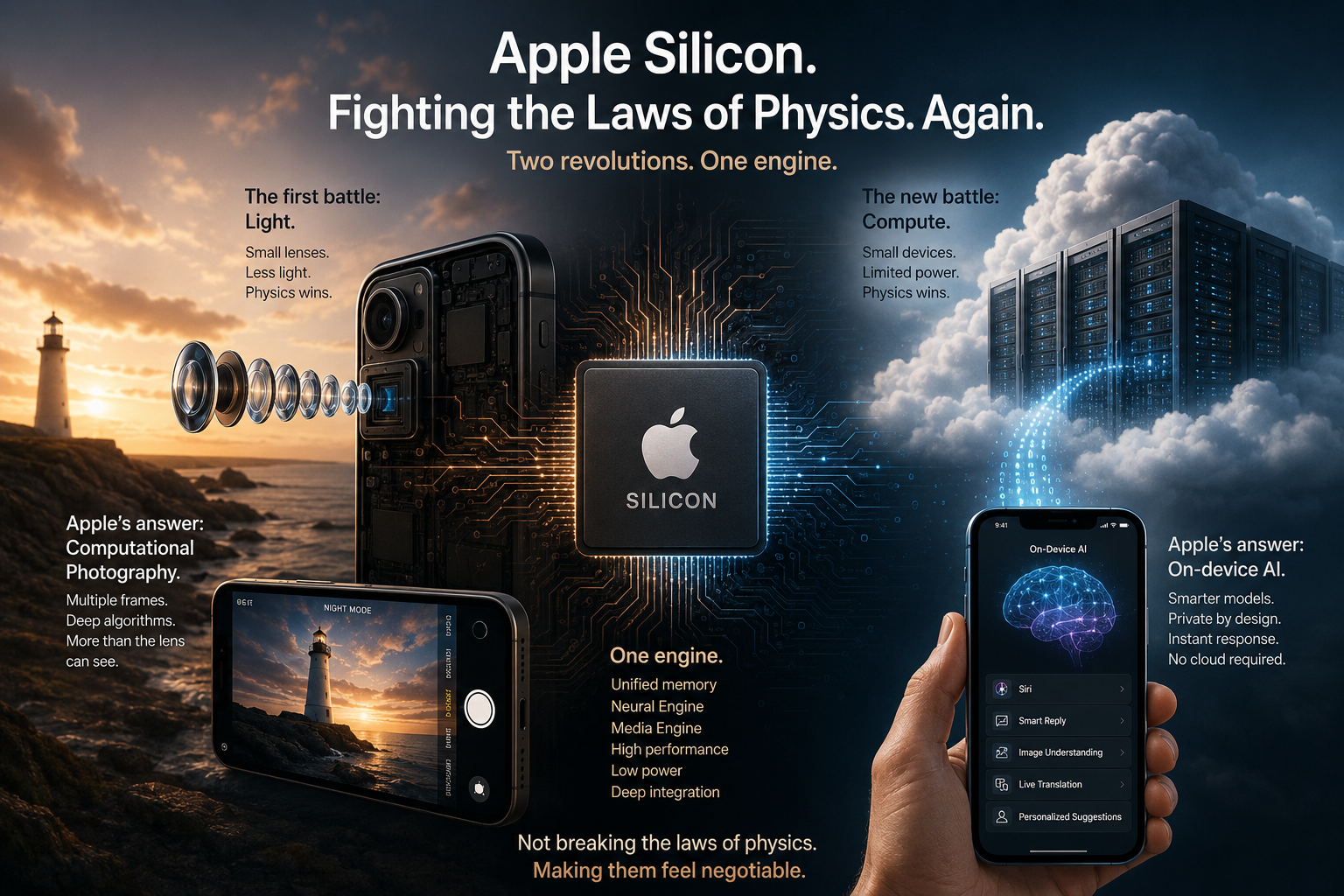
There is a pattern to how Apple makes its most interesting bets. It finds a hard physical constraint, something that looks like an immovable wall, and decides that software is the answer. It happened with the camera. It is happening right now with artificial intelligence.
Act I: The Lens Problem
Great photography has always been, at its core, a physics problem. A camera captures light. The more light it captures, the richer the image, more detail in the shadows, less noise, better colour fidelity. The way you capture more light is through a large lens and a large sensor. This is why professional cameras are large. Size is not a design failure; it is a feature.
Then came the smartphone. A device engineered to slip into a pocket carries a sensor roughly the size of a fingernail and a lens that barely protrudes from the chassis. By every classical rule of optics, the images it produces should be terrible. For a while, they were.
Apple changed that, not by cheating physics, but by supplementing it. The camera hardware still operates under the same laws. But surrounding that hardware, Apple built a dense layer of software: multi-frame processing, computational noise reduction, Smart HDR, Deep Fusion, Photonic Engine. The phone takes a burst of frames in the milliseconds around a shutter press, computes across all of them simultaneously, and synthesizes an image no single frame could have produced. It is photography augmented by computation.
The result is photographs that routinely surpass what dedicated cameras cost thousands of dollars to achieve a decade ago. Apple did not repeal the laws of optics. It worked around them, cleverly and relentlessly, in software.
That discipline, computational photography, is now an industry. Every major phone manufacturer pursues it. Apple invented the category.
Act II: The Cloud Assumption
Artificial intelligence has its own version of the lens problem. The assumption baked into the industry is that powerful AI requires massive infrastructure: data centres, high-end GPUs, enormous amounts of memory and bandwidth. The corollary is obvious: the user's device cannot be where the real work happens. The device is a terminal. The cloud is the brain.
This assumption is not unreasonable. Large language models carry billions of parameters. Running inference on them demands hardware that, until recently, only existed in server farms. The economics pointed in one direction: send the data up, compute in the cloud, send the answer back.
Apple, characteristically, looked at that constraint and started building silicon.
The evidence has been accumulating quietly for eight years. When Apple introduced the iPhone X in 2017, the A11 Bionic contained a small, barely-mentioned addition: a 2-core Neural Engine, dedicated hardware for machine learning inference. No killer feature required it. No reviewer headlined it. Then the next chip had a larger one. Then the next. Generation after generation, Apple kept expanding this component with the same patient, unexplained determination. The M5, released in 2025, carries a 16-core Neural Engine. That is not a spec-sheet flourish. It is a long-term architectural bet, written in transistors, years before the payoff was visible.
And Apple did not keep this hardware to itself. Since the beginning, the Neural Engine has been available to third-party developers through Core ML. This is the move that matters most: Apple was not building a feature. It was building a platform, the same way it built camera hardware that any app could access, long before computational photography became a household term. Every iPhone sold is a node in a distributed AI compute network that no cloud provider can match for scale or proximity to the user.
What makes this bet more significant is that Apple is not the only one reading the same signal. Qualcomm's Snapdragon X Elite and Intel's Lunar Lake both feature dedicated neural processing hardware. Three companies with entirely different business models, all converging on the same structural decision. When that happens across an entire industry, it stops being a hunch and starts being a thesis. The question is not whether on-device AI is coming; the chips already say it is. The question is who built the platform first.
The parallel writes itself. In computational photography, the constraints were the light and the lens. In on-device AI, the constraint is compute and memory. In both cases, Apple's answer was not a product announcement. It was infrastructure, laid down quietly, generation by generation, until the moment the world was ready to use it.
The Pattern Underneath
What makes this parallel more than a coincidence is the underlying philosophy it reveals. Apple is, at its core, a company that believes the most interesting problems sit at the intersection of hardware and software, and that controlling both gives you leverage no one else has.
Computational photography was only possible because Apple designed the chip, the image signal processor, the operating system, and the camera APIs that third-party apps could call. No single piece works without the others. On-device AI is the same stack: custom silicon with dedicated inference hardware, a tightly integrated OS, and developer frameworks that expose that hardware to anyone who wants to use it.
Crucially, neither of these was primarily a consumer feature. They were platform investments. Apple did not build the image signal processor to win a camera shootout in a tech review. It built the infrastructure for a whole ecosystem of imaging capabilities, then let developers, and eventually competitors, define what was possible on top of it. The Neural Engine is following the same trajectory.
The question, in both cases, is the same: what becomes possible when every device in the world ships with dedicated AI compute, and any developer can reach it?
Apple's answer, then and now, is: more than you currently imagine.
Why This Bet Could Win
Neither of these bets required perfection. Computational photography on an iPhone does not match a medium-format camera. It never will. But it crossed a threshold: good enough, instantly, in your pocket, for almost any situation. Once it crossed that threshold, the market for dedicated point-and-shoot cameras collapsed. The winning condition was not technical supremacy; it was sufficient capability, everywhere, all the time.
On-device AI is chasing the same threshold. Cloud models will remain more powerful for heavy, open-ended tasks for the foreseeable future. But the question is not whether on-device AI can beat GPT-5 in a benchmark. The question is whether it can be good enough for the things people actually reach for dozens of times a day, understanding what is on your screen, drafting a reply, answering a question about something in your document, without a network round-trip, without sending your data anywhere, without a subscription to yet another cloud service.
If it can, it wins on every dimension that matters: speed, privacy, cost, reliability, and the quiet trust that the intelligence running on your device is working for you, not for a server farm somewhere.
Apple fought the laws of physics once, with a camera, by building infrastructure that an entire ecosystem could use. It is making the same bet now, with intelligence, in the same patient and deliberate way. The Neural Engine has been growing for eight years. The platform is already in a billion pockets.
That is not a product launch. That is a foundation.
This piece was inspired by The M5's Most Important Feature Isn't in Any Benchmark by Tiff In Tech: a sharp breakdown of Apple's Neural Engine evolution and what the chip roadmaps of Apple, Qualcomm, and Intel say about where AI is heading.

-
Tim Cook’s Apple: Operational Mastery, Strategic Restraint—and the Cost of Playing It Safe
JF Martin / Posted: Tue, 21 Apr 2026 00:46:43 GMT
When Steve Jobs handed the reins of Apple Inc. to Tim Cook, the question was never whether Apple would change—it was how. Fifteen years later, the answer is clear: Apple didn’t lose its edge; it refined it into something far more disciplined, predictable, and scalable.
Cook’s tenure is best understood through the lens of execution. He transformed Apple into an operational powerhouse, optimizing supply chains, expanding margins, and building one of the most efficient global technology machines ever assembled. Under his leadership, Apple didn’t just grow—it became structurally resilient. The transition to Apple Silicon alone stands as a masterclass in long-horizon planning and vertical integration.
But operational excellence is only part of the story.
Critics often argue that under Cook, Apple became more incremental, less daring. There’s some truth to that. The company’s product cadence shifted toward iteration rather than disruption, and its communication style moved away from bold vision toward measured positioning. Whether that’s maturity or caution depends on your perspective.
The now-abandoned Apple Car initiative illustrates this tension. On one hand, it was a rational exploration into a massive adjacent market aligned with Apple’s strengths in hardware, software, and integration. On the other, the project appeared to suffer from shifting objectives and prolonged uncertainty. Billions were spent without a tangible product outcome—a rare visible miss for a company known for focus.
Yet even here, the critique should be precise. The issue wasn’t that Apple explored the space; it’s that the effort lacked a stable thesis long enough to execute decisively. In frontier domains, failure is often the price of ambition. The real question is whether that ambition is channelled effectively.
Another, more contentious dimension of Cook’s leadership lies in his navigation of politics, particularly regarding U.S. leadership and global regulatory pressures. Cook has often positioned himself as a pragmatic diplomat, maintaining working relationships across administrations, including that of Donald Trump, while publicly advocating for issues like privacy, immigration reform, and environmental responsibility.
That balancing act, however, has not been without criticism. At times, Apple’s posture can appear selectively principled—forceful on privacy branding, yet more cautious when core business interests such as supply chain exposure, tariffs, or market access are at stake. The optics of engaging closely with political power while maintaining a carefully curated public stance can create tension, especially for a company that positions itself as values-driven.
To be clear, this is not unique to Apple; it’s the reality of operating at global scale. But it does raise a legitimate question: is Apple shaping policy from a position of principle, or adapting to it from a position of necessity?
Cook’s Apple tends to err on the side of control. It avoids premature launches, protects margins, and prioritizes ecosystem coherence. This has produced extraordinary financial results and sustained relevance at scale—but it can also limit the kind of bold narrative defining bets that once characterized the company.
In the end, judging Cook solely against the legacy of Jobs misses the point. They operated in different contexts, with different constraints, and delivered different kinds of success. Cook didn’t reinvent Apple; he industrialized it.
The more nuanced assessment is this: Tim Cook’s tenure represents one of the greatest operational achievements in tech history, coupled with a more conservative strategic posture, and a pragmatic, sometimes ambiguous approach to power. Whether those trade-offs were necessary or limiting will likely define how this era is remembered.
I’m not alone in reacting to the announcement of leadership change at Apple. I really liked Om Malik’s take on it. Oh, and I wrote The Rotten Side of Tim Cook’s Apple. It was in 2020. A lot has changed since then. I wonder what the new priorities are under John Ternus’ leadership.

-
The Ephemeral Scrapbook — 2026.04.19
JF Martin / Posted: Sun, 19 Apr 2026 18:36:09 GMT

👤 Personal {#personalupdate, #projects, #newsletter}
1️⃣ I've been slow to publish a new edition of this newsletter this year because I was focused on developing web applications with Claude AI and Claude Code. Now that most of my apps are finished, I can refocus on the newsletter. As you probably know, two web apps are key to this newsletter: one for bookmarking interesting content I find online, and another custom-built RSS reader. Both apps work together and truly make a difference. 2️⃣ Something that I'd like to complete is an update about my digital ecosystem. I’ve been using Apple Freeform to put together a map of all the tools and services that are making my digital ecosystem. The diagram is mostly complete, but I want to write an article explaining what’s changed since my previous update. 3️⃣ One more thing: still using Claude AI and Claude Code, I finally put together a new visual design for my blog and metablog. They both share the same design and I’m very happy with the end results. Here's a quick look below.
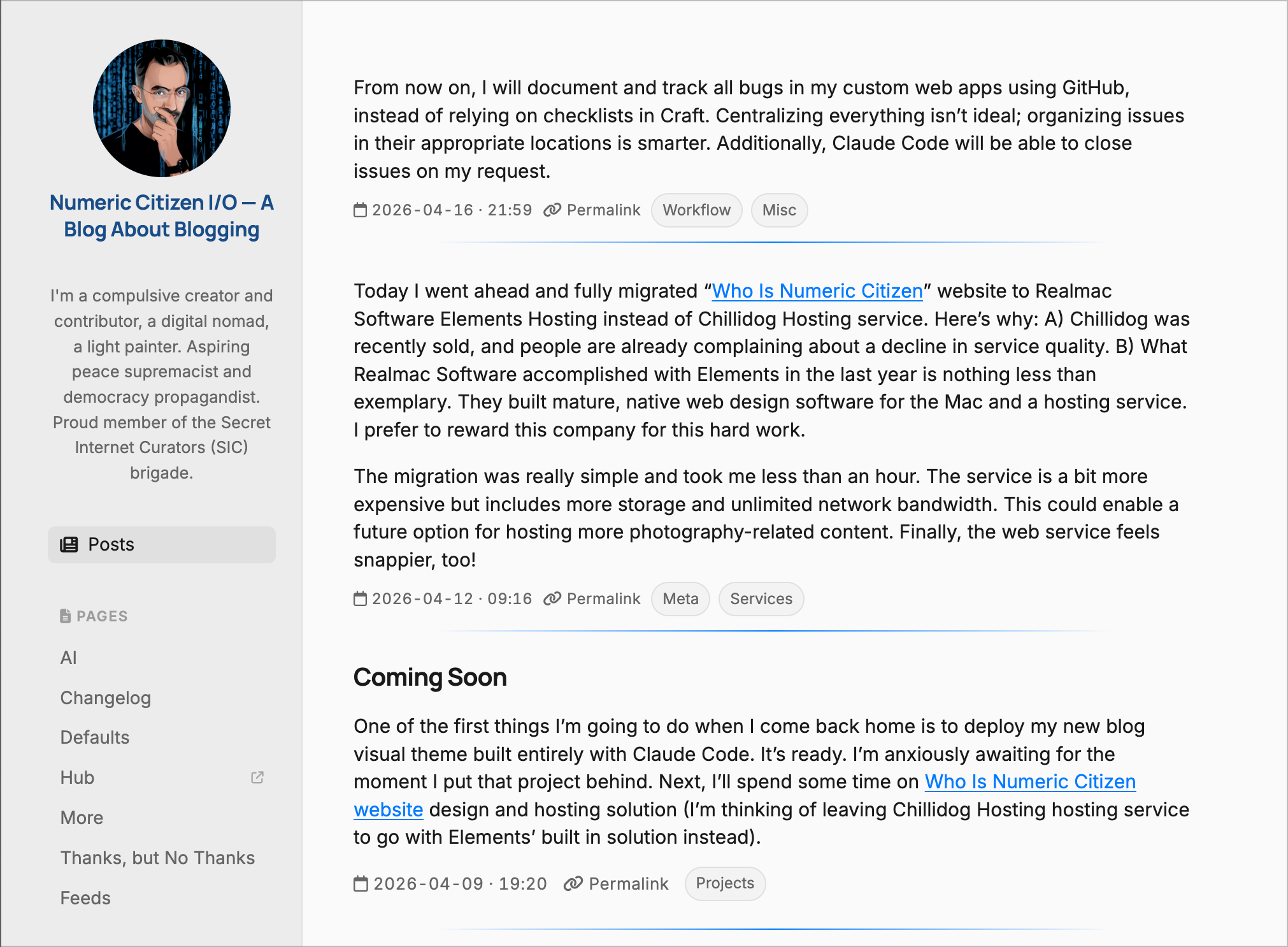
The new website design for my blog and my metablog. I'm proud of it. 🗺️ Discoveries {#programming, #computerhistory, #vibecoding}
1️⃣ Are you old enough to remember Turbo Pascal? This website deconstructed the whole thing. I learned programming in Turbo Pascal, and I really loved that programming language. It was easy, and because it was approachable, not overwhelming like C++. It's fascinating to see such a small computer program when you look at today's bloated software stacks consuming vast amounts of costly resources. 2️⃣ Recreating a 1978 science magazine in 40-year-old desktop publishing software, the author rediscovers PageMaker's brilliant simplicity and maddening limitations—no layers, no locking, no grouped objects—while revealing how it literally reshaped graphic design as a profession. → Aldus PageMaker on the Apple Macintosh 3️⃣ It's a fun vibe coding project: buillding a native Mac utility. After creating many web apps myself with Claude Code and Claude AI, this could be another type of project I could tackle, too! → Vibe coding SwiftUI apps is a lot of fun
👨🏻💻 Writing {#quote}
"You can always edit a bad page. You can't edit a blank page." — Jodi Picoult found on https://scribbles.page/explore
"Write to help yourself, publish to help others.” — Jack Butcher in ZenQuotes Daily Quote
🌄 Photography {#art, #foodforthoughts}
1️⃣ In an era where billions of images are captured daily, photography paradoxically becomes both more democratic and more challenging as an art form. The ease of creation has transformed the question from "can I make an image?" to "can I make an image that matters?" True photographic artistry today lies not in technical mastery alone, but in the photographer's ability to cultivate vision—to see beyond the obvious, to find poetry in the mundane, and to create images that resonate with emotional truth rather than mere aesthetic appeal. While algorithms can now suggest compositions and AI can generate convincing imagery, the human photographer's unique contribution remains the intentionality behind the frame: the deliberate choice of what to include, what to exclude, and most importantly, why the image needs to exist at all. In short, there is two stories behind an image: the one you see, the one you don’t.
🍎 Apple & Tech {#applehistory, #wwdc26, #openai, #aibubble, #timcook}
1️⃣ Apple has shipped over 5 billion devices in 50 years, built a $113B services business, and maintains 2.5 billion active devices. Its enduring strength lies in customer creation and retention — a metric that suggests continued growth over the next 50 years. → The Next 50. 2️⃣ Apple's WWDC26 runs June 8–12 online, with a limited in-person event at Apple Park on June 8. The conference will feature AI updates, 100+ video sessions, and direct access to Apple engineers. Swift Student Challenge winners will be announced March 26. → Apple’s Worldwide Developers Conference returns the week of June 8 3️⃣ Apple is skipping the $650B AI infrastructure arms race, betting that models will commoditize while device ownership wins. By turning 2 billion devices into distributed AI processors and licensing models cheaply, Apple avoids massive debt while rivals hemorrhage cash. → The most brilliant move in corporate history? 4️⃣ So Long, Sora — OpenAI has abruptly discontinued the Sora video generation app and stand-alone service just months after its successful launch. The decision surprised both internal teams and Disney, OpenAI's key partner. Siegler analyzes that while bundling Sora into ChatGPT seemed logical, the prohibitive cost of video generation combined with OpenAI's IPO ambitions and competitive pressure from Anthropic's Claude Code led to the product's complete shutdown rather than integration. The move is particularly damaging to Disney's new CEO Josh D'Amaro, who championed the partnership just three months ago, and signals OpenAI's shift toward business focus over product innovation. → So Long, Sora 5️⃣ Apple quietly discontinued the Mac Pro on March 26, 2026, ending a product line plagued by missteps — from the 2013 "trash can" design to poor Apple silicon timing. The Mac mini now outperforms it at one-fifth the cost, making the Mac Pro's demise inevitable. Can you find Lil Finder Guy? So cute. → Mac Pro - Basic Apple Guy 6️⃣ The Apple Lisa prototype is such a cool yet simple design, reminiscent of the Apple //c. → A photo history of Frog, the company that designed the original Mac 7️⃣ Apple turns 50, and this personal reflection captures how the company's products have quietly shaped meaningful moments in people's lives — from first Macs to FaceTime calls. It's a reminder that great technology enables human connection, not just innovation. → Fifty - 512 Pixels 8️⃣ A passionate plea to Apple's future leader to prioritize the company's founding spirit—making great computers that respect users—over profit-driven optimization and surveillance capitalism that increasingly dominates tech. → A letter to John Ternus. Speaking of John Ternus, I recently watched an interview with him and was thinking if this guy could be the next Apple CEO. I think it would be a good fit. 9️⃣ Over 50 years of existence, Apple has made the Mac for 43 years. How many models in all? See the table below. A lot.
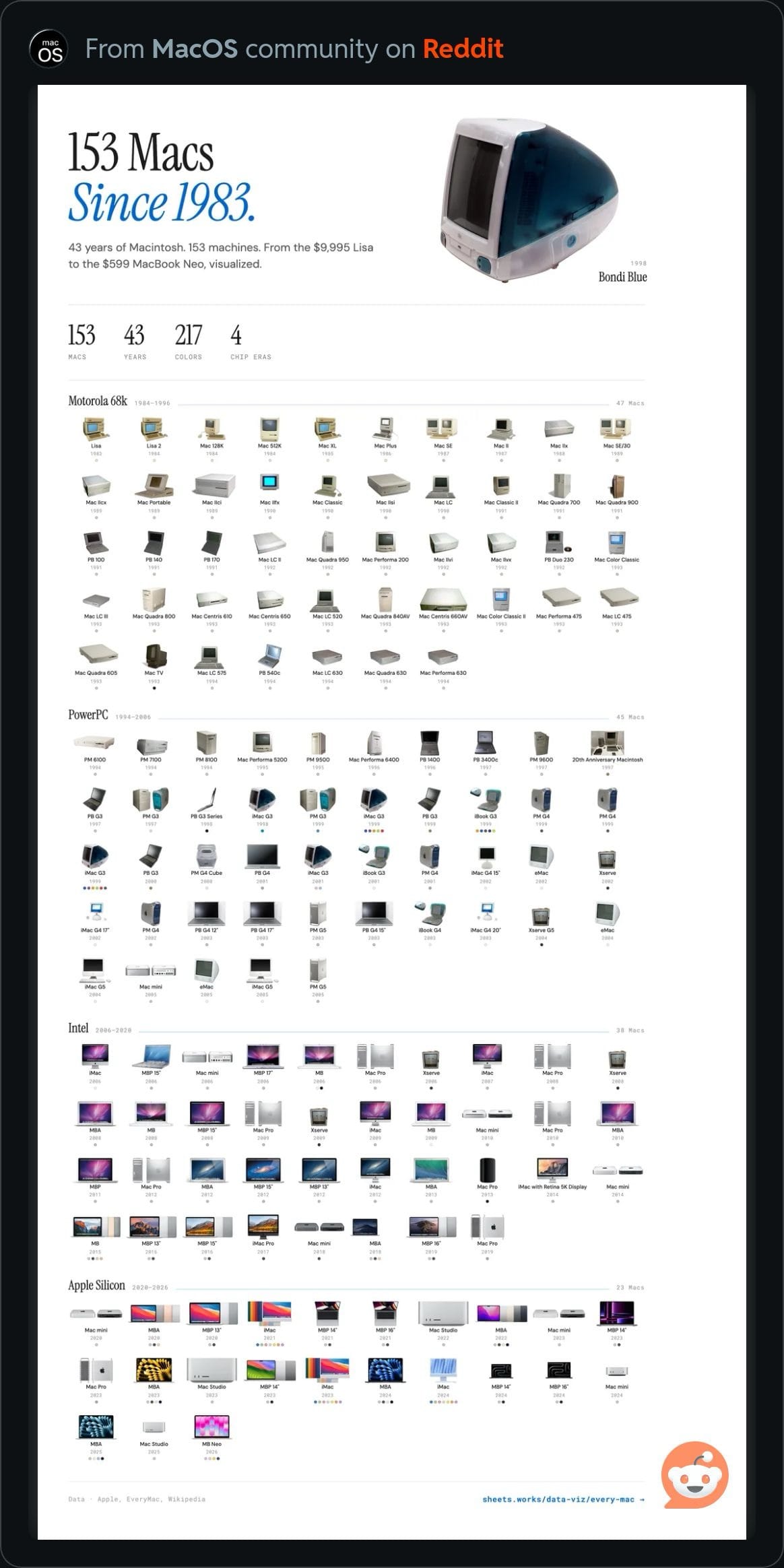
I should count how many of them I owned - probably too many 📱 Apps & Services {#microsoft, #wordpress, #claude}
1️⃣ Poor Microsoft, they were too busy putting Copilot everywhere, but they forgot about the basics. Now, people hate Windows and are asking for a change. Microsoft seems to be listening. → Microsoft Got Sloppy with Windows 2️⃣ WordPress's core architectural problems—outdated data models, full-trust plugins, serialized block content—have been solvable for years, with working code already proven in the ecosystem. Instead, leadership keeps shipping cosmetic improvements while deferring foundational fixes. The window to catch up is closing. → WordPress needs to refactor, not redecorate | Joost.blog 3️⃣ Claude Code is far more complex than its interface suggests, with 50+ tools, hundreds of commands, and unreleased features buried in the source. This deep-dive maps the entire system — agent loop, multi-agent orchestration, hidden capabilities — straight from the codebase which apparently was leaked on the web by mistake. Ooops. → Claude Code Unpacked
"Your frustration is the product. The longer you're trapped on the page, the higher the CPM the publisher can charge.” — Daring Fireball in ★ ‘Your Frustration Is the Product’
🚧 Special projects {#vibecoding}
1️⃣ My web application development activities have decreased significantly recently. Most of my needs are now met. I am now entering the territory of improvement rather than end-to-end design. This is fortunate because with Anthropic's recent changes, the timing is good. Anthropic has adjusted token consumption with Claude Code, making the service much more expensive. The execution of simple tasks now requires two, three, or even several times more tokens. In this context, my projects would have taken much longer to complete without paying for additional tokens. 2️⃣ Yet, I'm planning on another web app: a task manager to replace Things 3. Why? I would bet a lot of money that the next major iteration of Things will require a subscription. Thanks, but no thanks. I’ll build my own task manager.
📺 YouTube {#design, #techtrends, #techhistory, #space}
1️⃣ Simply wow. I'm a big lover of wood-based furniture. We can see some Ive's classic design elements. → Christie Furniture Designed by Jony Ive - YouTube 2️⃣ The Windows Laptop Problem is real. 3️⃣ HyperCard was groundbreaking in 1991. I used it extensively during university. This video offers a broader view of HyperCard's development. Definitely worth watching. → HyperCard Changed Everything. 4️⃣ Many interesting Mac utilities, most were built with the help of AI. → Your Mac Is Missing All of These. 5️⃣ Great photos taken from the Artemis II crew. → Artemis 2 crew's amazing views of Earth, Moon and a Solar Eclipse during lunar flyby. 6️⃣ Don't miss ARTEMIS II: A Visual Masterpiece. 8K Cinematic Supercut. Best video of them all.
🔮 Looking forward {#ai}
1️⃣ AI-powered fraud is quietly dismantling the recommendation systems that drive music, commerce, and culture. Smith's $8M Spotify scam is just the crude, prosecutable version. The real threat — bots generating fake signals that become popular — has no clean legal remedy → Manufacturing Legitimacy in the AI era. 2️⃣ AI adoption is inevitable, and it acts as a magnifying glass — skilled users will excel while lazy ones produce junk faster. It will reshape workflows like documentation and inbox management, but human judgment remains essential. → Some Thoughts On AI — Jim Mitchell.
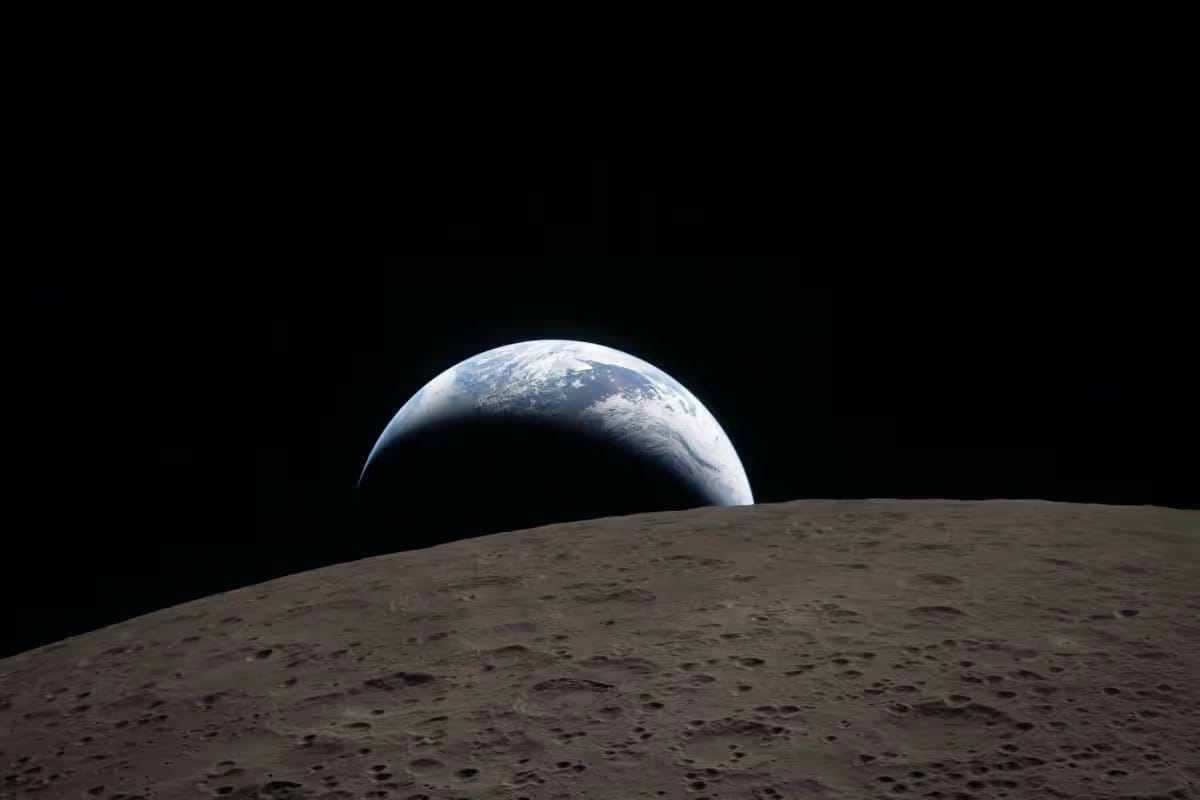
Our spaceship as seen from behind the moon 🌟 Miscellaneous {#ai, #interview, #openclaw, #journalism, #openweb}
1️⃣ Google is testing AI-generated headline rewrites in Search results, potentially altering publishers' meaning, tone, and brand voice without consent. Given that a similar Discover "experiment" became a permanent feature, this small test could signal a significant future threat to click-through rates and audience trust. If you are looking for another reason to leave Google Search behind, here's another one. Google is no longer a search engine. → Google confirms AI headline rewrites test in Search results 2️⃣ Good interviews require the interviewer to disappear. The Lemaire/Aperture example illustrates how self-promotion and premature subject-finishing kill genuine revelation. Silence, contradiction, and deep research unlock truth; comfort and credential-signaling produce nothing memorable. → How Not to Interview (Interesting People) 3️⃣ I didn't have an idea of writing a slash AI page on any of my sites. Now that I read Manual's post, I might. But what could go there? My rules for using (or not) using AI? → Slash AI – Manu 4️⃣ Anthropic is blocking OpenClaw, a third-party integration tool for Claude AI, from standard subscriptions starting April 4th. This move, following OpenClaw creator Peter Steinberger’s move to OpenAI, forces users onto a pay-as-you-go billing system, pushing them towards Anthropic’s own tools like Claude Cowork. The decision, seen as a competitive move, has sparked backlash from developers who built workflows around OpenClaw and are now facing unpredictable costs. → Anthropic blocks OpenClaw from Claude subscriptions 5️⃣ U.S. business journalism has devolved into uncritical amplification of executive claims — no fact-checking, no context, no expert pushback. This "CEO said a thing" pattern isn't accidental; it reflects media structurally serving corporate interests rather than public ones. → "CEO Said A Thing!" Journalism 6️⃣ AI's shift from zero to significant marginal costs upends the 2010s internet business model. Companies now face compute scarcity and must choose between serving different customer segments, replacing simple scaling with strategic capital allocation decisions. → Mythos, Muse, and the Opportunity Cost of Compute 7️⃣ Big Tech is systematically dismantling the open web—scraping content without consent, killing open APIs, undermining Wikipedia, and overwhelming open-source projects—threatening the infrastructure that created the modern internet. 2026 may be the decisive year. → Endgame for the Open Web - Anil Dash
I have a feeling that everyone likes using AI tools to try doing someone else’s profession. They’re much less keen when someone else uses it for their profession. — Giles Turnbull, AI and the human voice
👉🏻 Main 🌟 Meta 🌟 Blips 🌟 Blog 👀
📌This newsletter edition is also available as a Craft shared document here. An index of past editions can be found here. This week's edition is based on template version 1.9.1 and was put together with ❤️ mostly on an M2 15-inch MacBook Air, Craft Docs and many supporting subscriptions! If you like this newsletter, please consider supporting me via PayPal or becoming a supporter by visiting my Ko-fi page!I wish you a great week! ✌️ 🇺🇦 🇨🇦 🇪🇺 💪🏻
 Not By AI — Add the Badge to Your Human-Created ContentDownload and add the Not By AI badge to showcase your AI-free & human-first approach to content creation (writings, art, photos, paintings, videos, and music)
-
Vibe Coding: Programming for the Rest of Us?
JF Martin / Posted: Tue, 24 Mar 2026 11:34:26 GMT
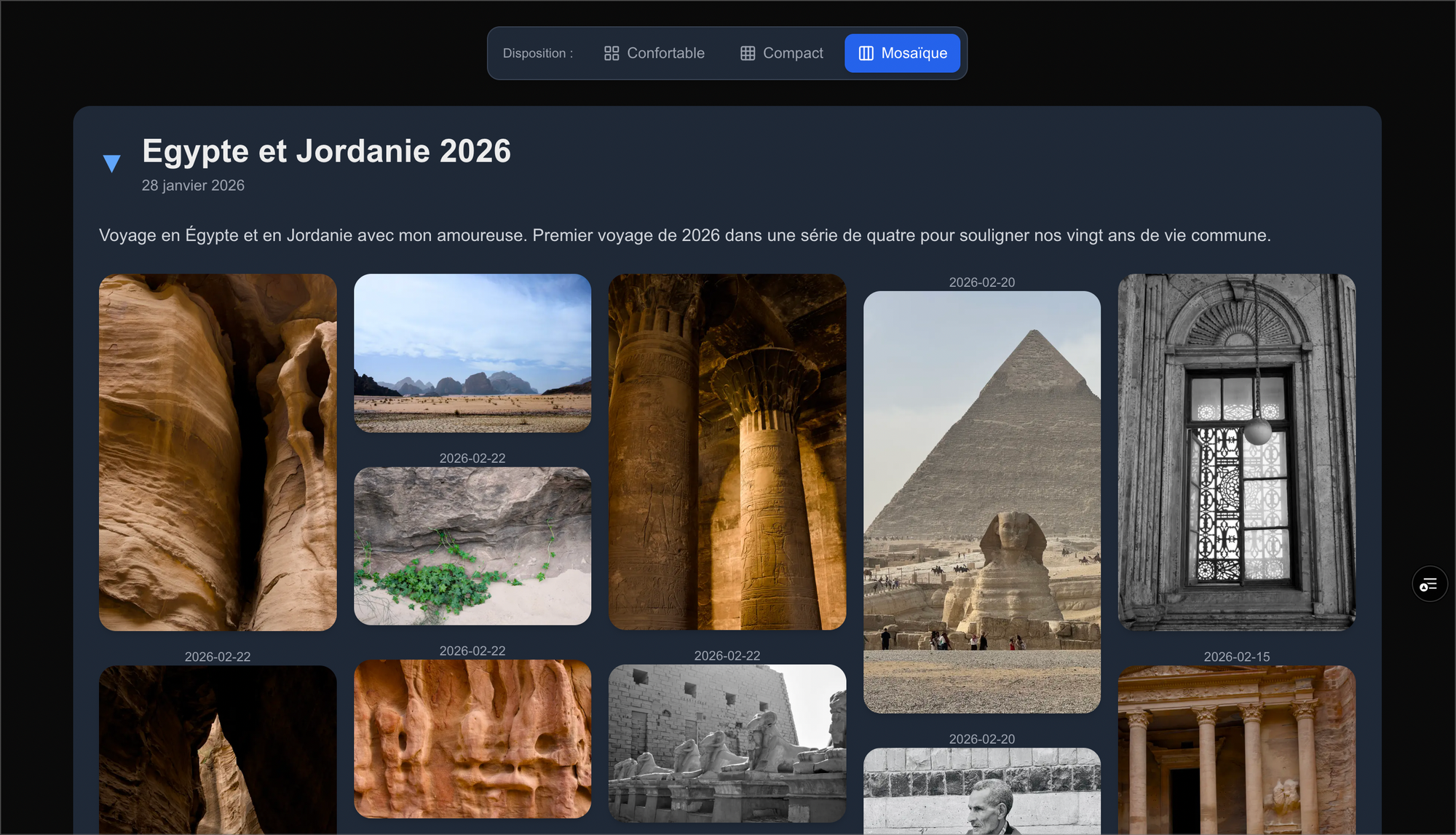
In 1984, Apple promised us a computer for the rest of us. It was a radical idea at the time: that ordinary people, not just engineers and scientists, deserved access to personal computing. Forty years later, I think we're witnessing the second half of that promise being fulfilled. Not the computer for the rest of us. Programming for the rest of us.
I've spent nearly four decades in IT. I've watched technologies rise and fall, paradigms shift, and entire categories of tools become obsolete overnight. I've done a few years of programming, enough to actually ship iPhone apps in Objective-C on the App Store for a few years. I'm not a stranger to code. But there's a wide gap between writing mobile apps a decade ago and architecting modern full-stack web applications from scratch.
I'm what you'd call a power user: someone with a clear vision of what he needs, and a deep enough understanding of the landscape to know when something is working and when it isn't.
And yet, until recently, building my own web apps was simply beyond reach. Not for lack of ideas. I've always had plenty of those. But the distance between having a vision and shipping something real was too wide to cross alone.
Claude Code and vibe coding closed that gap entirely. The proof isn't theoretical. It's running in production.
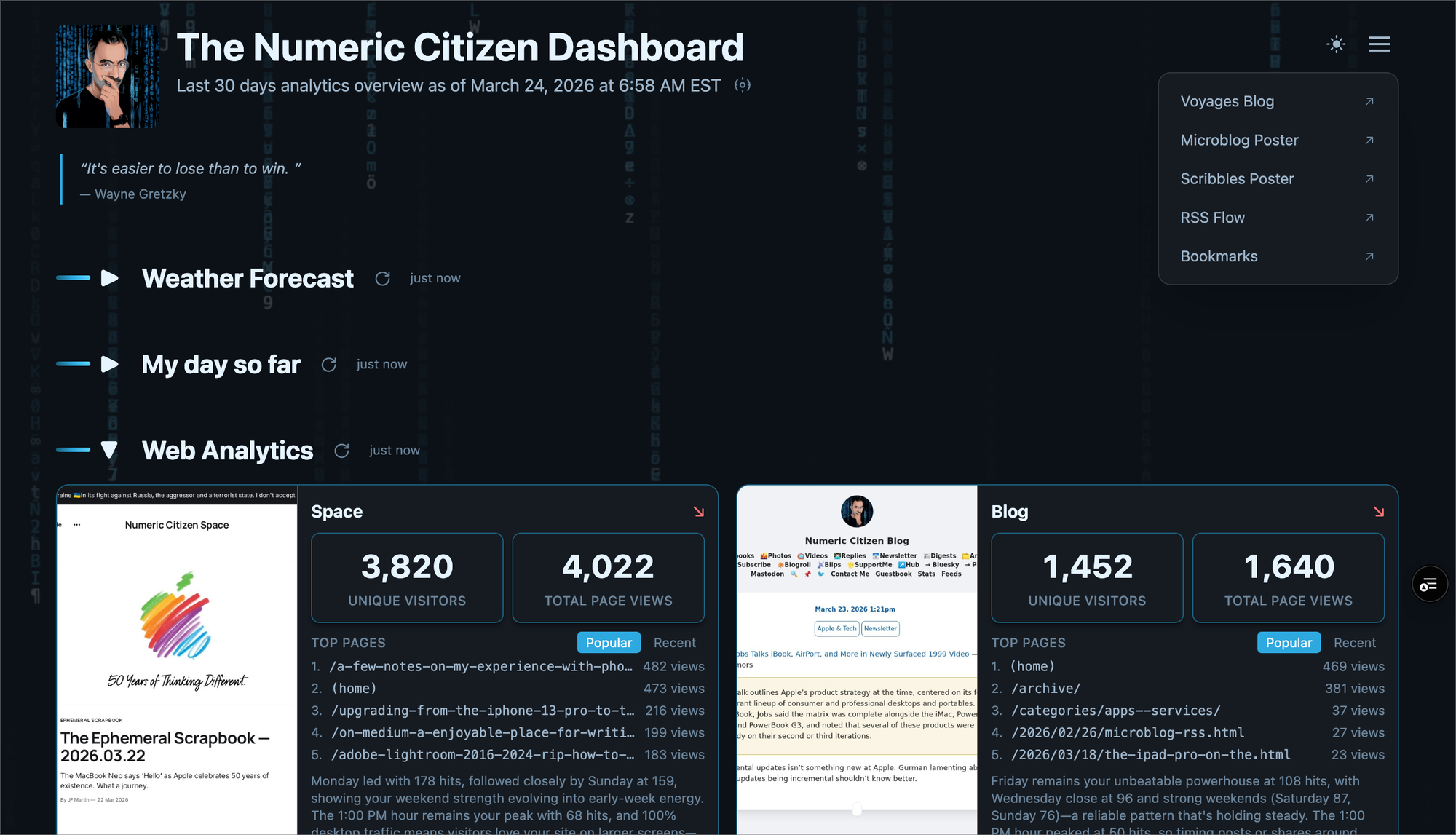
A custom-built personal digital dashboard running on Vercel What I Actually Built
In the past year, I shipped six production web apps that support my creative workflows as a writer, photographer, and content creator. A fully featured bookmark manager. An RSS reader with AI summarization and virtual scrolling. A photo-sharing space for my travel photography. That last one deserves a moment. For years, sharing photos meant feeding them into Instagram or Facebook, surrendering them to Meta's ecosystem in exchange for an audience. I was never comfortable with that trade. Now I have a space that is entirely mine, on my own domain, under my own control. No algorithm deciding who sees what. No platform that can change its rules tomorrow. Just my photographs, presented the way I want them. That, more than any technical achievement, is what digital independence actually feels like.
None of these are toys or demos. They run on real infrastructure: Vercel, Postgres, Redis, Vercel Blob. And I use them every single day.
I use them every day, sometimes many times a day. My RSS reader is open constantly; it's how I stay connected to the ideas and conversations that feed my writing. My bookmark manager is the quiet backbone of my Ephemeral Scrapbook newsletter, helping me track what's worth sharing with readers each week. Two custom-built tools, perfectly shaped to my workflows in a way that no off-the-shelf product ever quite managed. That's exactly why I built them myself.
Do I fully understand every line of code these apps are made of? No. But I have a solid enough mental model to know what's happening at a high level, which is exactly the same relationship I've always had with the layers beneath my work. I don't know every detail of how a compiler translates source code into machine instructions. I understand how TCP/IP networks work at a conceptual level. I'm exactly the kind of person who wants to know the underpinnings, but I've never needed to implement them myself. That's always been fine. Vibe coding is simply the next abstraction layer up, and I've been climbing abstraction layers my whole professional life.
What I did bring to the table was something more valuable than syntax knowledge: a precise understanding of my own needs, and forty years of knowing what good software looks and feels like.
There's a word for what this feels like that I didn't expect to use in the context of software development: liberating. For the first time, the gap between having an idea and having a working thing has essentially collapsed. I'm not held back by what I don't know how to implement. I think about outcomes: what the app needs to do, how it should feel, what problem it solves. The implementation details follow. That shift in focus, from how to what, changes everything about the creative experience. Not everyone sees it that way, of course.
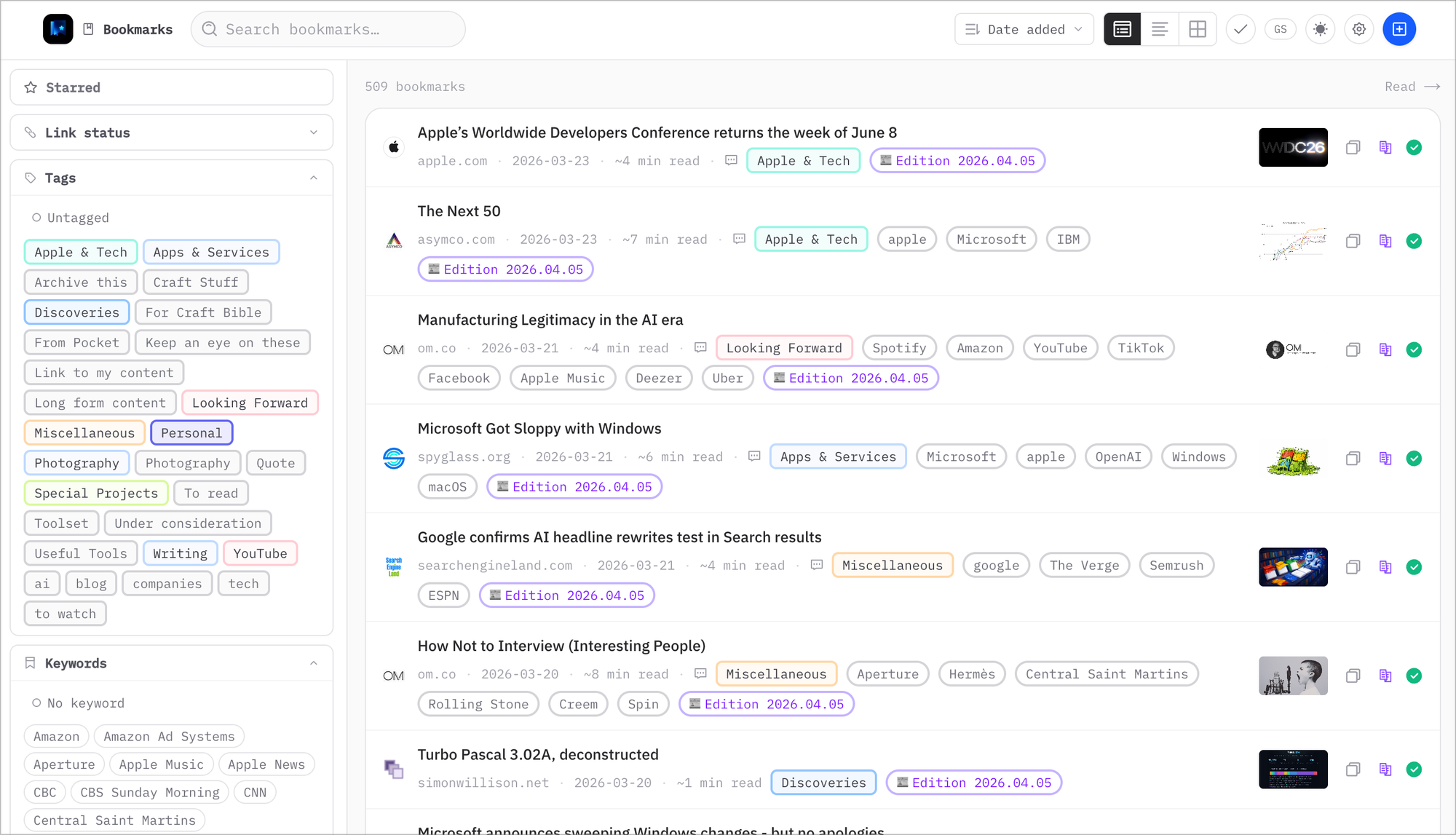
A custom-built bookmark manager to help me put together each newsletter edition The Skeptics Are Wrong. History Proves It.
Every democratizing technology has its detractors. There were people in 1984 who laughed at the idea of moving a cursor with a small plastic box on your desk. There were people who thought desktop publishing would ruin graphic design. Those who bash vibe coding today, who insist it produces brittle code, that it isn't real programming, that it will lead to disaster, are the modern version of those people. They may not be entirely wrong on the technical details, but they're deeply wrong about what matters.
What matters is this: people who had something to build and no way to build it now have a way. That is an unambiguous good. Though I'll admit it: living inside that good comes with its own uncomfortable questions.
Independence, With an Asterisk
I'll be honest about something that sits uneasily with me. I feel a genuine sense of digital independence from having built my own tools. My bookmark manager is mine. My RSS reader is mine. Actually, let me be more careful with that word. "Mine" in the sense that I designed it, I control what it does, and my data lives where I decide it lives. Not "mine" in the sense that I could run it without Vercel tomorrow without significant effort. That distinction matters.
These apps run on Vercel. They consume object storage from Vercel. They call third-party services I have no control over. The independence is real, but it's layered on top of dependencies that go all the way down. I haven't fully resolved that tension. I'm not sure it can be fully resolved. But I think owning your application layer (your data model, your logic, your user experience) is meaningfully different from outsourcing it entirely. It's not perfect independence. But it's real enough to matter. Ironically, chasing it taught me things I never expected to learn.
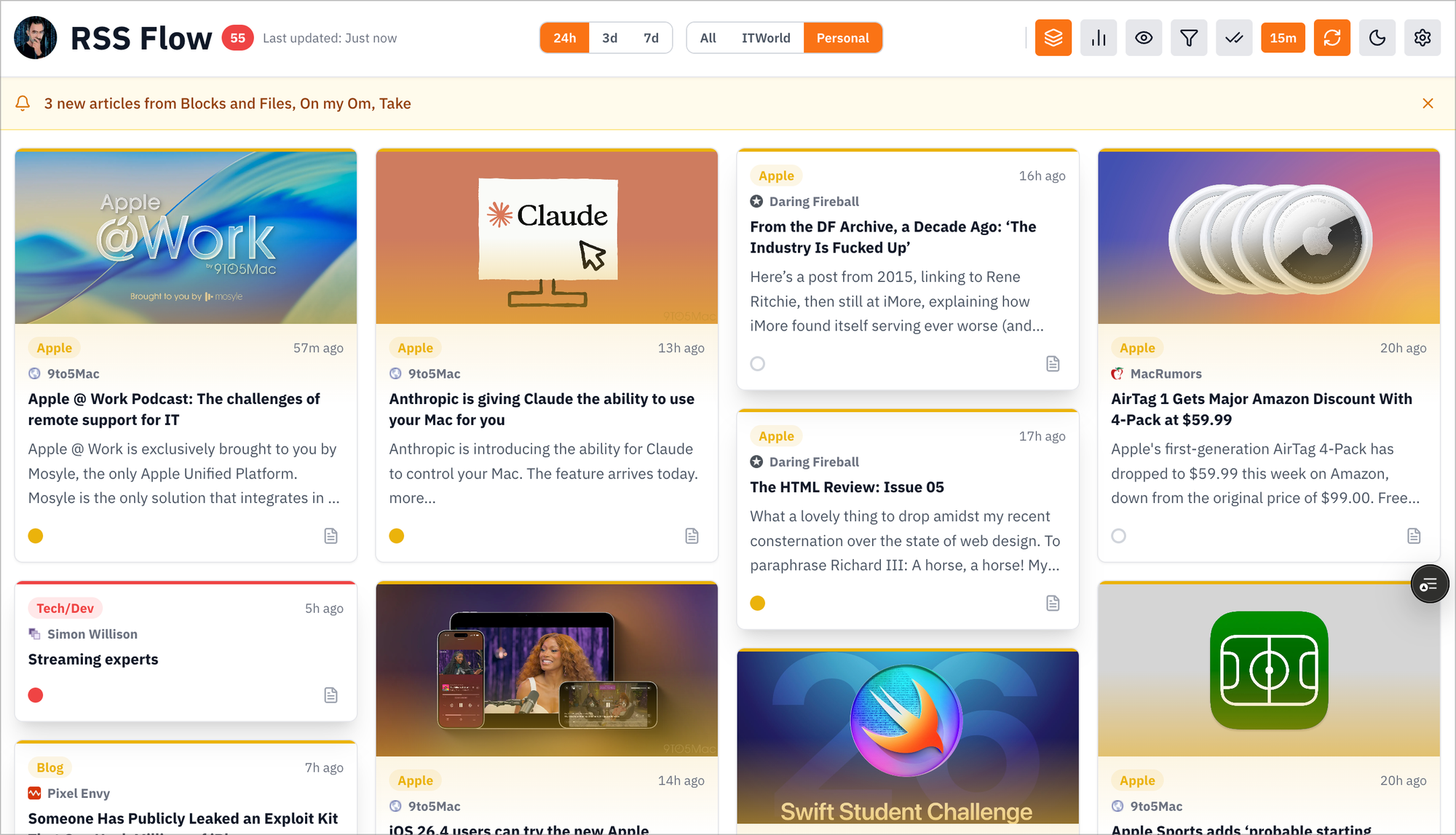
A custom-built and highly flexible RSS reader imagined by me but built using Claude Code Learning by Accident
Here's something that still surprises me: before I started using Claude Code, I barely understood what GitHub was for in practice. I didn't know Vercel existed. I didn't really know why a
specs.mdorREADME.mdfile mattered. I learned all of that not by studying it, but by needing it, as a side effect of actually building things. Vibe coding didn't just produce apps. It taught me things I wasn't even trying to learn.And the impact didn't stay contained to my personal projects. I started using Claude to manipulate my n8n automation workflows through an MCP connection, an entirely non-programming use case that turned out to be just as transformative. That work prompted me to prepare an hour-long presentation for colleagues at work. The ripple effect, it turns out, goes well beyond your own screen. And when I step back and look at all of it together, one thought keeps surfacing.
The Most Transformative Investment of My Career
I have more ideas now than I've ever had time for. A visual theme plugin for Micro.blog. Improvements to every app I've already shipped. New workflows I haven't imagined yet. That's the other thing vibe coding did: it made me want to build more. Because as technology continues to evolve, I know I have the ability to absorb and integrate new capabilities in ways that simply weren't available to someone with my profile before.
Which brings me to something I say with the full weight of four decades in IT behind it: my Claude subscription for the year may prove to be the single most transformative investment I have made in my entire career. Not the most expensive. The most transformative.
In 1984, Apple gave the rest of us the computer. In 2025, vibe coding is giving us the last thing we were missing.
The ability to build.

-
The Ephemeral Scrapbook — 2026.03.22
JF Martin / Posted: Sun, 22 Mar 2026 23:43:46 GMT
👤 Personal {#health}
1️⃣ I recently encountered some health issues. 😔 Nothing serious, though, don't worry (at least that's what my doctor says). I see this as a warning and plan to adopt new habits for a better life. For example, reducing screen time, going outside more often to get some fresh air, exercising more (hoping spring arrives soon!), and limiting my intake of coffee and alcohol. I'm also turning to Apple Fitness+ for meditation and workout sessions throughout the week, and I use Apple Health to track my blood pressure, mood, and other indicators. It's very convenient, especially for exporting this data as PDF files to share with my doctor. 2️⃣ Professionally speaking, things are going really well. I’ve been at this new job since last June. Since then, my involvement with current and future projects has only increased. My next challenge will be to manage a large migration project that should last between 15 and 18 months. I never did project management before, but I worked with many project managers throughout my career. I think I'm ready to try this myself. My boss, who is PMP certified, will coach me. I started exploring the subject by asking questions to Claude about project management and got some really good insights. I'm not alone in this. 🙂 3️⃣ This year's winter has been long in the tooth. It started early last November, and now that Spring is among us, temperatures are still colder than normal, and precipitation is frequent. It's a little bit hard on morale.
🗺️ Discoveries {#webdesign, #webapp, #design }
1️⃣ Probably the most clever, beautifully designed and useful About Me webpage I've ever seen by Parker Ortolani. It is modelled on the Mac OS X Tiger user interface. You can play with the small windows. I'm curious how much effort went into this. 2️⃣ Super cool tool to create a poster of city maps: TerraInk: The Cartographic Poster Engine. Files can be downloaded on your computer. Very flexible.
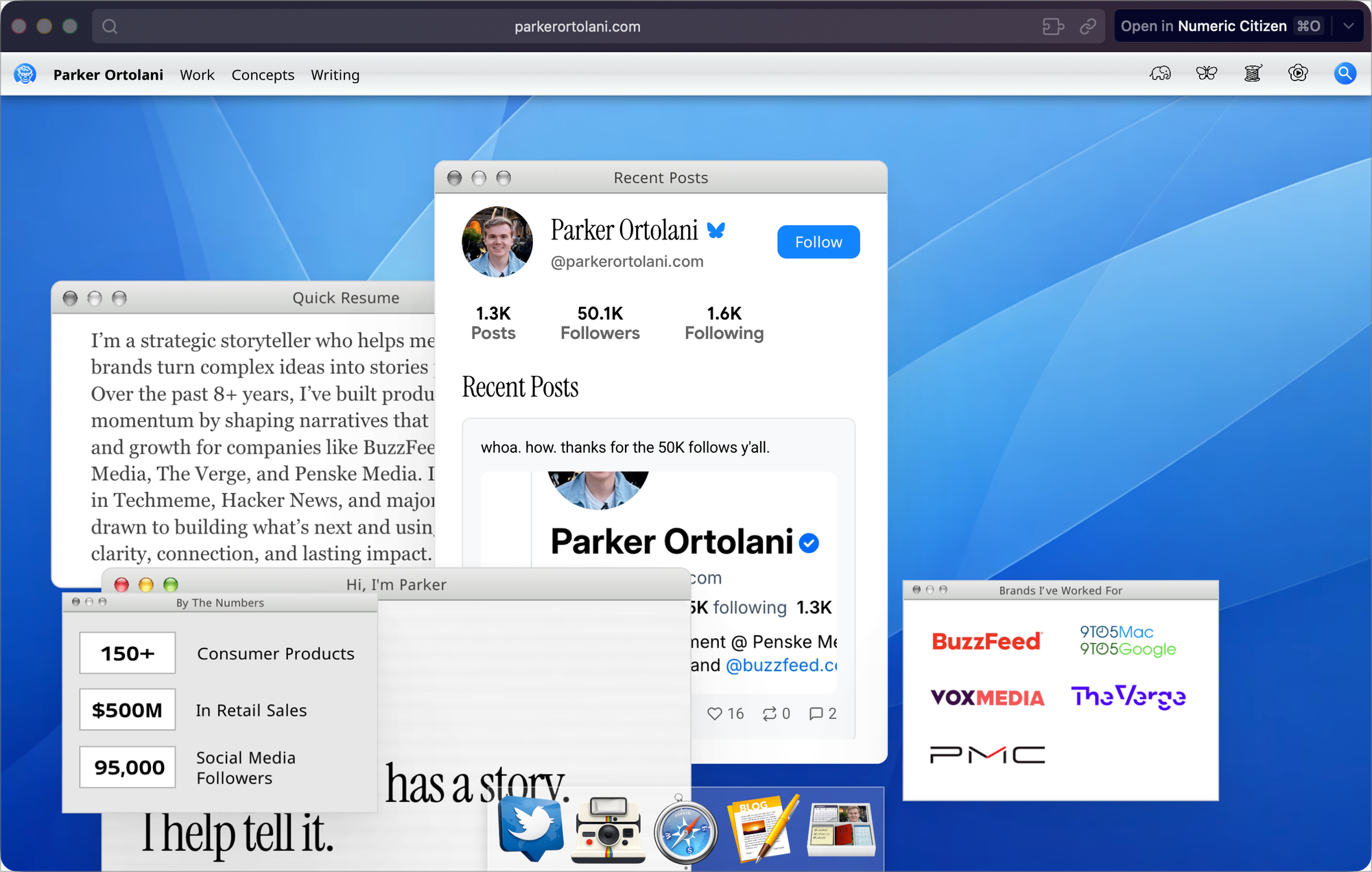
Mac OS X Tiger inspired About Me webpage. 
Some cities might be more interesting to hand on a wall than others. 👨🏻💻 Writing {#inspiration}
1️⃣ Beyond posting to my blog and putting together this newsletter, I don't write much these days. I no longer engage in long-form writing like I used to. It's a struggle because I wish I could be as prolific as some other bloggers that I follow and like. I'm lacking spare time and motivation. 2️⃣ Blogging is supposedly not that hard, right? Ask Manual Moreale about his two-step AI-free blogging process.
🌄 Photography {#tech, #astronomy, #astrophotography}
1️⃣ I always liked astronomical telescopes. As a child, it was a dream to own one, which never happened. A company named “Vaonis” makes a great-looking one. It's very impressive. If you visit their websites, you'll probably find some similarities with Apple’s mini website design. Warning: it's not entry-level equipment; it's expensive. Consider browsing their image gallery here. 2️⃣ I recently visited a friend of mine and showed my photos of my trip to Egypt. She really liked them because she felt emotion in photos with humans as a subject. I'm glad she liked them because taking photos of people is not my forte. She really liked this one.
“A new ethic is quietly emerging among modern travelers. It is called Digital Silence. It is the conscious decision to share the art and the emotion of a place without giving away its exact coordinates… It is a radical act of conservation.” as shared in a linkpost by Kottke (the original is on Instagram, bleh).
🍎 Apple & Tech {#applehistory, #macbook, #ios26, #appstore}
1️⃣ The MacBook Neo not only challenges the Windows laptop world, but it might also challenge its little brother: the iPad. 9to5Mac has an interesting argument about the iPad line's perceived value: it costs much more and is much more powerful in many ways, yet still feels "not quite there yet," while the Mac seems finally accessible. 2️⃣ If you aren't running iOS 26 on your device, it's time to upgrade. You might have heard bad press about Liquid Glass, and rightfully so, but let's face it, the party is on iOS 26, don't stick to the past. 3️⃣ There is a rush for AI companies to team up with space launch/satellite companies to build data centers in space. It's not going to work. What a fucking bad idea. Are we losing our minds? 4️⃣ Google seems more willing to appease regulators. When this news came out, I didn't see anyone linking to Apple's current position, which seems to be the status quo in the US. 5️⃣ Gruber isn’t happy about macOS Tahoe and the window resizing. But he finally updated his main machine, thanks to the wallpapers that come with the new MacBook Neo. By the way, resizing windows on... Windows 11 is not easier... and you would think that on Windows this would be its forte. It isn't if my experience is any indication. 6️⃣ I've been following Apple's story for more than 40 years. What a journey: 50 Years of Thinking Different
"The winners in AI won't be the ones who build the infrastructure; they'll be the ones who own the customer, and no one on Earth owns better customers than Apple." — Asymco in The most brilliant move in corporate history?
📱 Apps & Services {#weather, #app, #aibubble}
1️⃣ This weather app, Acme Weather, has something that I didn't see elsewhere: temperature forecasts include many sources and the average forecast. That's rather useful. 2️⃣ It's a rather impressive web app, ColorFlow, for creating wallpapers... but I don't have the time to spend on creating one wallpaper. Enjoy if you can. 3️⃣ OpenClaw is really something big. It's also a dangerous piece of free software that can cost you real money if you don't pay attention. It's a dangerous piece of software if you give it too much control of your computer. I started experimenting with it when its developer was still on his own (not working for OpenAI). Then horror stories started to pop up. I put that aside to work on other projects. I'll return to this eventually, I'm pretty sure. By that time, I expect the software to have gained maturity.
"It seems that bad software isn't new with AI slop; it was a thing a long time ago, with all sorts of badly designed systems available to the masses. It's a people problem". » (AI) Slop Terrifies Me
Image used without permission from this M.G. Siegler blog post. The state of the Windows brand in 2026? 🚧 Special projects {#vibecoding, #webapp, #utility}
1️⃣ I'm mostly done with my bookmark manager. I'm really liking the final product. I like its design, and I find it very useful for putting together this newsletter. The following screenshot shows the view of a newsletter edition’s content for this very specific edition. You can watch this web app in action in my recent YouTube video. 2️⃣ I’m already looking at my next opportunity to use Claude Code. This time, it will be to create a Micro.blog plugin for hosting a custom-made visual theme. I’ve been using someone else's theme, The Cards Theme, which served me well, but with Claude Code, it seems that creating my own is a reachable goal. My head is full of design ideas. 3️⃣ I'm finally putting the last touches to Numeric Citizen Digital Ecosystem diagram (see below for an overview). I plan to write an article about it for publication next month. Stay tuned.
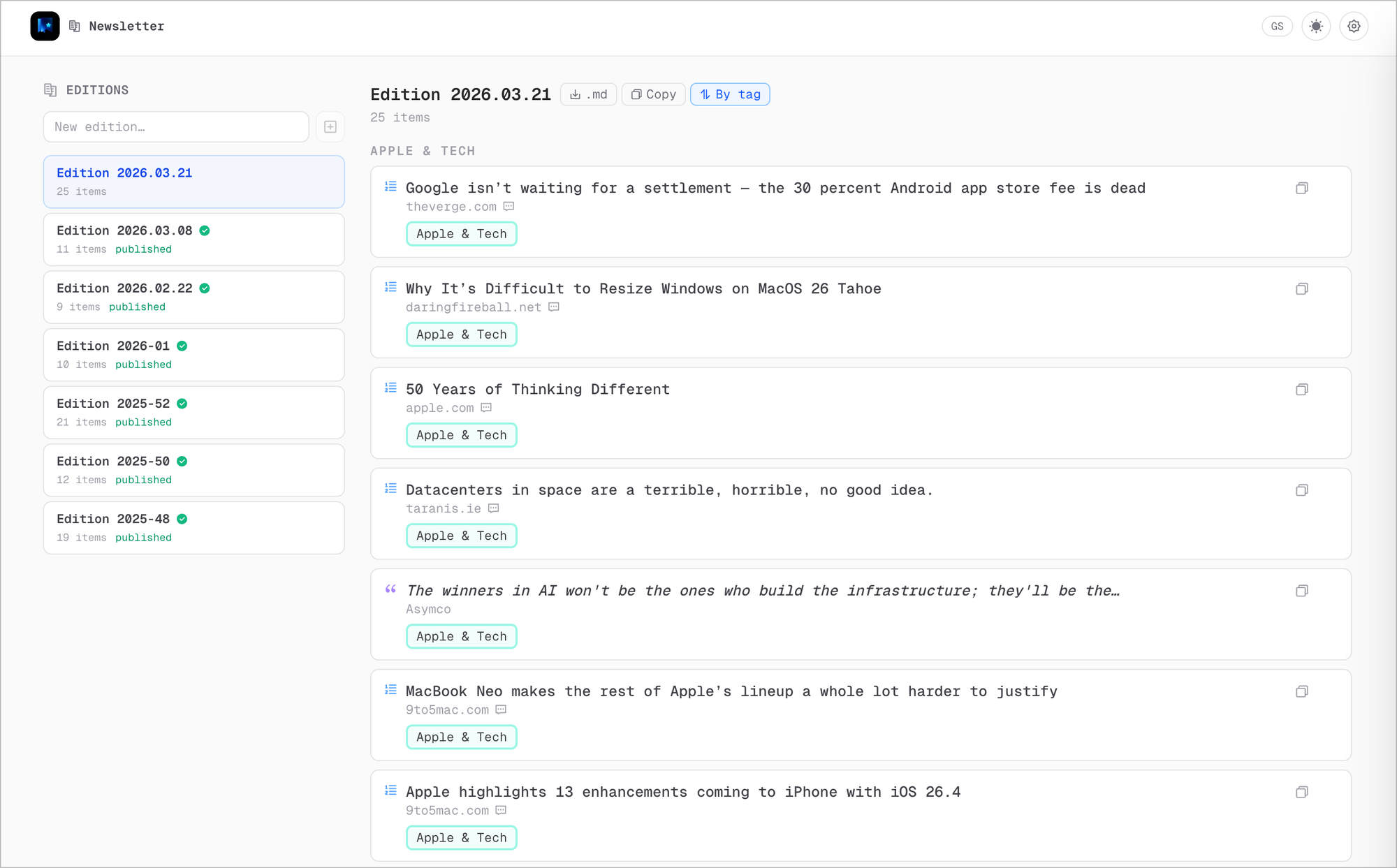
A preview of my bookmark manager 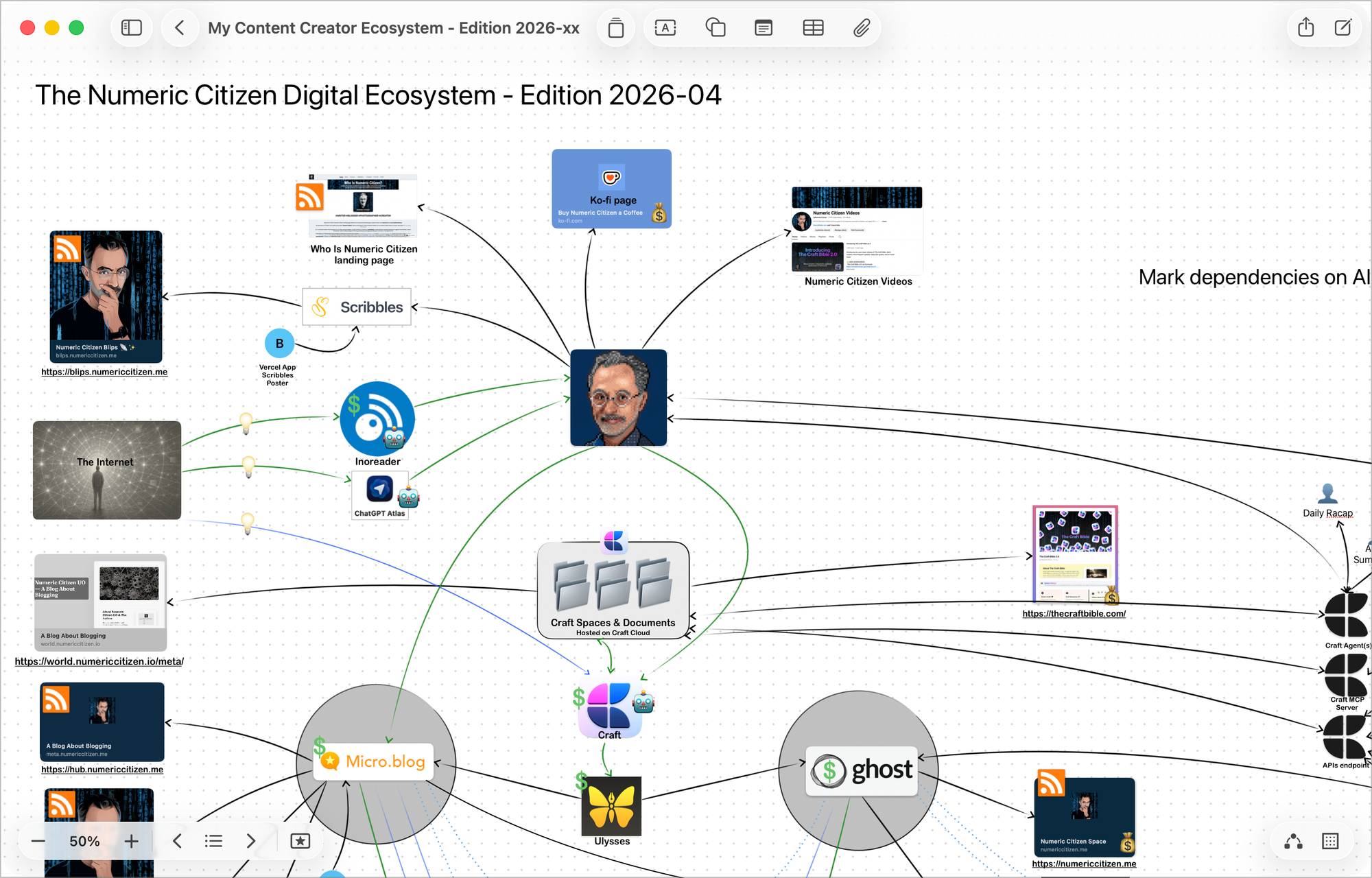
A sneak peak at a diagram that I'm working on 📺 YouTube {#apple, #applehistory}
1️⃣ Many videos about Apple turning 50. First, a short video introduction from the Computer History Museum. 2️⃣ Tim Cook is interviewed in that one. If you pay attention to Tim Cook while he speaks, you might notice that his left hand is rather shaky. I hope it's not the beginning of some serious illness. 3️⃣ This is a must-watch video about Apple's 50-year history, told by those who were part of it and are still here with us to tell the details. Interviewed by the famous David Pogue. 4️⃣ Speaking of David Pogue, he wrote a book: Apple: The First 50 Years. He was interviewed by Cult of Mac.
🔮 Looking forward {#ai, #ai-coding}
"A recurring concern I've seen regarding LLMs for programming is that they will push our technology choices towards the tools that are best represented in their training data, making it harder for new, better tools to break through the noise.” — Simon Willison in Perhaps not Boring Technology after all
"Is the MacBook Neo the modern version of the bicycle for the mind that Steve Jobs envisioned? It might be." in 50 Years Later, Apple Has Finally Delivered Steve Jobs' Bicycle for the Mind
🌟 Miscellaneous {#digg, #socialmedia}
1️⃣ Digg is dead, long live Digg? Well, it seems it will take some time before we see Digg alive. 2️⃣ In a more constrained world, in the days when we were coding in assembler, I think we were more creative in finding solutions. We're still creative these days, but we are also lazy. The MacBook Neo might force some software writing rules to be revisited if my understanding of “This Is Not The Computer For You” by Sam Henri Gold is right.
"Should we drop “social” from social media? There is nothing social about this social media. And most of these platforms are essentially networked information distribution systems, and more and more of that information is just noise or disinformation. And humans aren’t helping either.
Everyone, including Captain America fantasist billionaires and yours truly, in some fashion or the other, are nothing more than mere botnets? In our divided modern “now,” one person’s information is another person’s fake news. Rumors are mere facts for the media to report on with a question mark? And at the same time, the news is a source of rumors; all you need to do is add a question mark. Either way, can we stop pretending that social media is social, about friends & people?
The biggest lie these platforms feed us is the idea of them being “social media” and “social networks.” In reality, they exist to show advertising “content” to consumers, who hopefully would buy more. This endless scroll does its thing on Facebook, Instagram, TikTok, or Twitter. " — Om Malik in There Is No Socil in Social Media
👉🏻 Main 🌟 Meta 🌟 Blips 🌟 Blog 👀
I wish you a great week! ✌️ 🇺🇦 🇨🇦 🇪🇺 💪🏻
📌This newsletter edition is also available as a Craft shared document here. An index of past editions can be found here. This week's edition is based on template version 1.9 and was put together with ❤️ mostly on an M2 15-inch MacBook Air, Craft Docs and many supporting subscriptions! If you like this newsletter, please consider supporting me via PayPal or becoming a supporter by visiting my Ko-fi page! Not By AI — Add the Badge to Your Human-Created ContentDownload and add the Not By AI badge to showcase your AI-free & human-first approach to content creation (writings, art, photos, paintings, videos, and music)
-
The Ephemeral Scrapbook — 2026.03.08
JF Martin / Posted: Mon, 09 Mar 2026 00:11:54 GMT
👤 Personal {#creativity, #inspiration}
1️⃣ I'm a bit late in sharing the latest edition of this newsletter. This weekend, I was particularly busy with various projects, including a video for an upcoming Micro.blog feature and a new web app that will play a key role in producing future editions of this newsletter. I can't remember the last time I was so excited about working tirelessly on many projects at once.
🗺️ Discoveries {#apps, #ai}
1️⃣ Discovered a new mind mapping app called “Notemap”, and it looks pretty capable. It's 30$ one-time purchase during the beta. 2️⃣ I discovered an Anthropic blog post about how to switch from one AI provider to Claude using a custom prompt. It's not perfect. If I leave ChatGPT behind, it won't import all my past conversations. But no worries, even on the free plan, I will be able to keep them for reference. As you might already guess, I'm switching to Anthropic-only mode. I won't subscribe to ChatGPT from now on.
👨🏻💻 Writing {#learningexperience, #LLM}
1️⃣ The article "Why Kids Hate Writing" by Michael He discusses how the external pressures of standardized education and a lack of personal engagement in writing contribute to children's dislike of writing, emphasizing the importance of writing for oneself, reading for curiosity, and valuing the editing process. I don't have a particularly positive memory of my days at school when it comes to learning French, but I have a better one in English. 2️⃣ We don't get to see the writing policy or comments about LLM use for writing on people's blogs. Here is one. 3️⃣ Don't forget to take a look at last month's digest, a summary of my blog writing last month.
🌄 Photography {#nikon, #glass, #pixelfed}
1️⃣ I recently started looking to buy a zoom for my Nikon Zf camera. During my last trip to Egypt, at times I wished I had a more flexible lens than my prime lens, a 40 mm F2, which is great for street photography, but when going outside the city, for example, to see the pyramids, it could have been a great use. I'm rooting for a 24-120 mm F4, which was well-received and has great reviews. You can see many photos taken with this lens on Glass. Here is a great one. 2️⃣ Glass has a new branding. I think something was lost with this new logo. Riccardo Mori seems to agree. I hope this branding change is not the beginning of some form of enshittification. 3️⃣ I realize that I'm posting very rarely on Pixelfed, but when I do, I select what I consider lesser quality images, reserving my best work for my Glass account. Here’s a recent one that I like but I don't think it's good enough to be on Glass.
On social media for sharing images in “I Stopped Looking at Social Media, my Photography Boomed”: “Social media's algorithmic design is psychologically manipulative by design — it is a slot machine, not a photo gallery”
🍎 Apple & Tech {#apple, #security}
1️⃣ Apple fared really badly in SixColors’ latest report cards for 2025. Ouch. I don't see how this will change this year. 2️⃣ Apple made a lot of hardware announcements recently, and the stars of them all are: the M5 Max chip and the MacBook Neo. The latter is quite an interesting exercise in striking the right compromise. Apple has a potential commercial hit on its hands. My wife might get one very soon for her light computing needs, which her aging iPad Pro can't comfortably handle. 3️⃣ Apple recently added three new executive profiles to its leadership page for Jennifer Newstead, Molly Anderson, and Steve Lemay. I’m optimistic about these changes, especially for design. 4️⃣ Microsoft Gave FBI Keys To Unlock Encrypted Data, Exposing Major Privacy Flaw. How do you feel about this? I personally don't like it for many reasons. One is that I don't trust the government to handle cases with care. Second, if you read the news of what is going on in the US right now, I wouldn't be surprised to learn that very high-ranking personnel are trying to get access to someone's data based on phony cases presented to the court. And yes, it means that I don't trust the US court either. Apple has a better architecture where the encryption keys are protected and stored elsewhere, as reported in the following quote:
“Privacy and encryption experts told Forbes the onus should be on Microsoft to provide stronger protection for consumers’ personal devices and data. Apple, with its comparable FileVault and Passwords systems, and Meta’s WhatsApp messaging app also allow users to backup data on their apps and store a key in the cloud. However, both also allow the user to put the key in an encrypted file in the cloud, making law enforcement requests for it useless. Neither are reported to have turned over encryption keys of any kind in the past.”
Lil Finder Guy — Basic Apple Guy
Who is it? What is it? Is it friend or foe? Has it arrived in peace, or is it plotting to corrupt our SSDs and fray our USB-C cables?
📱 Apps & Services {#rss, #webapp}
1️⃣ I’ve been using a new feature of Micro.blog, an RSS reader that fully integrates in Micro.blog base offering. It won't replace my use of Inoreader any time soon, nor my custom-made RSS reader. 2️⃣ Speaking of RSS feeds, there is a new kid in town: Current, an opinionated RSS reader that tries to present things a bit differently. There are some similarities with Micro.blog offering, but I prefer the latter because it is more integrated into Micro.blog. 3️⃣ There seems to be a proliferation of nice little and well-focused web apps recently. One such example is Miniroll, which allows people to build and optionally share their blog roll, a list of recommended blogs. I built one that you can find here. I’m still undecided about this one. The developer behind Miniroll, Chris Hannah, also offers many more in his growing collection. 4️⃣ The maker of Raycast is now working on something that be a big advance: Glaze, a Mac app designed to build apps using AI and prompts. The demo is quite impressive. Introductory video is available here.
"The uncomfortable truth is that I'm not a customer in any traditional sense. I'm a tenant. I occupy digital spaces owned by corporations who can change the terms, raise the rent, or evict me whenever they see fit." — Greg Morris
🚧 Special projects {#webapp, #claude, #vibecoding}
1️⃣ I started working on a new web app using Claude AI: a bookmark manager. It will eventually replace AnyBox. While I love AnyBox, it is lacking a web version. Without this, my newsletter publishing workflow is more tedious than I think a web app should be. So far, it is progressing really well. I'll share more details in the next edition of this newsletter. Here's a screenshot below.
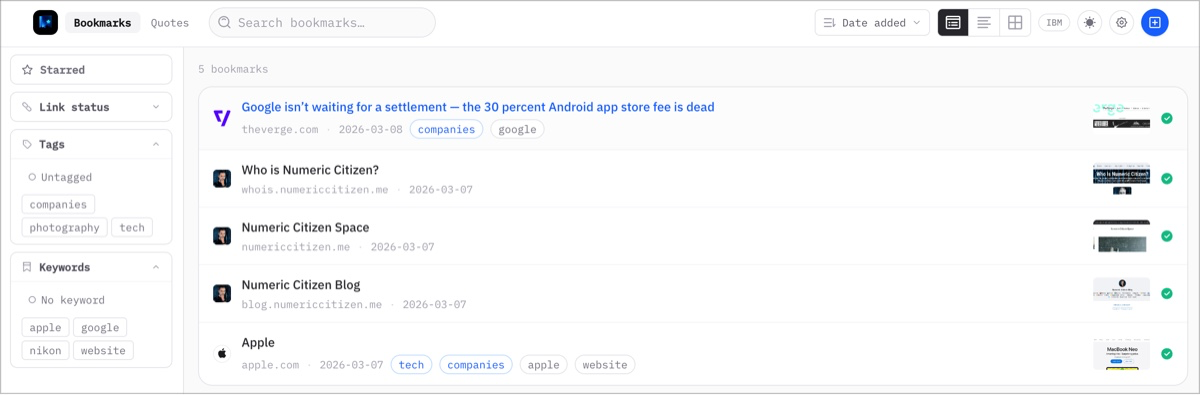
The bookmarks view of my future bookmark manager 📺 YouTube {#android, #scifi, #history, #tech}
1️⃣ I'm impressed by some of Android 17’s prowess on the desktop. 2️⃣ Cosmos 1999 is my favourite sci-fi series, and I recently learned the series went into a full 4K restoration. It's quite impressive, as demonstrated in this video! 3️⃣ This video shows the visual history of Manhattan, New York. 4️⃣ A great conversation with great minds about AI and the future: Google's Demis Hassabis, Anthropic's Dario Amodei. It's a must-watch. 5️⃣ A great commentary video about Apple's recent announcements covering the MacBook Neo and the powerful M5 Pro and M5 Max chips.
Some interesting UI ideas from Android 17
Behind the scene - Cosmos 1999 remastered in 4K
Impressive 3D timelapse of New York city
A great conversation and interview about AI and the future
The perfect chip? Really?
🔮 Looking forward {#apple, #appledesign}
1️⃣ I’m looking forward to visit the Apple Store downtown Montreal this Wednesday to try the new MacBook Neo! It's been a long since I'm excited for. new Apple product, event though I'm not the target audience. Who knows, I might buy a new accessory!
🌟 Miscellaneous {#socialmedia, #socialnetworks}
1️⃣ I reproduce a text from Om Malik of a post dating back to 2022:
“Should we drop “social” from social media? There is nothing social about this social media. And most of these platforms are essentially networked information distribution systems, and more and more of that information is just noise or disinformation. And humans aren’t helping either.
Everyone, including Captain America fantasist billionaires and yours truly, in some fashion or the other, are nothing more than mere botnets? In our divided modern “now,” one person’s information is another person’s fake news. Rumors are mere facts for the media to report on with a question mark? And at the same time, the news is a source of rumors; all you need to do is add a question mark. Either way, can we stop pretending that social media is social, about friends & people?
The biggest lie these platforms feed us is the idea of them being “social media” and “social networks.” In reality, they exist to show advertising “content” to consumers, who hopefully would buy more. This endless scroll does its thing on Facebook, Instagram, TikTok, or Twitter.”
👉🏻 Main 🌟 Meta 🌟 Blips 🌟 Blog 👀
I wish you a great week! ✌️ 🇺🇦 🇨🇦 🇪🇺 💪🏻
📌This newsletter edition is also available as a Craft shared document here. An index of past editions can be found here. This week's edition is based on template version 1.9 and was put together with ❤️ mostly on an M2 15-inch MacBook Air, Craft Docs and many supporting subscriptions! If you like this newsletter, please consider supporting me via PayPal or becoming a supporter by visiting my Ko-fi page!
-
Hitting Pause on ChatGPT
JF Martin / Posted: Sun, 01 Mar 2026 20:20:22 GMT
After relying on ChatGPT as a support tool for most of my AI-related creation activities, recent developments prompted a reassessment of my subscription. With Claude already my preferred tool for coding work and viable alternatives for other features, I made the decision to pause my ChatGPT Plus subscription—but the move revealed deeper issues about data portability and vendor lock-in in the AI industry.
Context and Ethical Concerns
Sam Altman's recent comments about potential military applications of OpenAI's technology sparked a re-evaluation of my relationship with the platform. While AI has tremendous potential for positive applications, the possibility of its use in military contexts raised questions about the ethical implications of supporting such development through my subscription. In contrast, Anthropic—led by Dario Amodei, who advocates for more cautious and ethically-grounded AI development—represents a different approach to building AI systems. By shifting my subscription to Anthropic, I wanted to reward a company taking a more principled stance on AI safety and responsible deployment. It's important to regularly reassess our tools and services based on our values, and to support companies that align with those values.
Finding Viable Alternatives
My shift from ChatGPT to Claude AI actually started well before the recent military controversy. Claude has become increasingly popular in the coding community. When I started new personal coding projects, I naturally gravitated toward Claude because of its growing reputation as the better choice for developers. By the time Sam Altman's comments emerged, I had already been using Claude extensively, which made the decision to pause ChatGPT feel less like a protest and more like a logical continuation of a preference I'd already established. I’m being honest and transparent here.
The image generation aspect of ChatGPT was one of the few features I actively used. Upon investigating alternatives, I found that Midjourney—which I had used in the past—is not only still active but remains the superior choice for creative image generation. For roughly a quarter of what I was paying for ChatGPT Plus, I can maintain full image creation capabilities. Other advanced features available through ChatGPT Plus—like Sora for video generation—were never part of my workflow, which actually made the transition easier. Meanwhile, I've been investing time in Claude Code, Anthropic's code execution feature, which offers capabilities that align better with my development needs.
Data Portability and the Challenges of Migration
Switching AI providers is more complex than simply cancelling a subscription. I had to audit all my existing workflows to ensure nothing would break. This exercise revealed a few dependencies ChatGPT had become in some of my automation systems, but it was a straightforward process to migrate to alternatives once I identified them.
The real challenge lies in data portability. I had previously written about the need for a "takeout" option for ChatGPT (see “A Case for ChatGPT Takeout”), similar to Google's data export feature. One of the most practical issues when leaving a service is extracting your data and conversation history. Discovering that Anthropic provides a custom prompt for importing AI provider memory into Claude was both validating and helpful, though I wish ChatGPT had official support for this kind of migration.
Beyond individual conversation memories, there's a broader systemic issue with how AI providers handle past conversations. Most platforms lock conversations into their own ecosystems with no standardized way to export, archive, or migrate them to another provider. This is particularly problematic for users who may have years of conversations containing valuable insights, code snippets, or creative work. Unlike email or social media platforms, where data portability is increasingly expected, AI providers have been slow to adopt similar standards. The conversations you have with ChatGPT remain ChatGPT's conversations—accessible only through their interface and on their terms. When you leave, you leave that history behind.
A recent article from Techcrunch points to a way to export past conversations, too, by visiting the ChatGPT Settings panel as shown here:
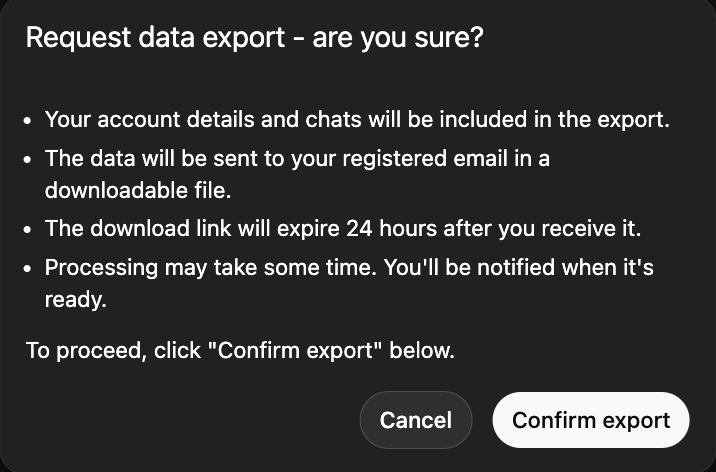
Source: Techcrunch What's Next?
I've used Claude extensively for coding work, but the next few weeks will be interesting as I explore how it handles non-coding prompts and more personal inquiries. There's something intriguing about discovering whether different AI models have distinct "personalities" or approaches to problem-solving. Does Claude respond differently to creative requests compared to ChatGPT? Does it have different strengths when it comes to writing, brainstorming, or exploring abstract ideas? These are questions I'm genuinely curious to investigate. The differences between models might reveal something fundamental about how these systems are trained and what values—intentional or otherwise—are baked into them.
Ultimately, the decision to pause ChatGPT was about aligning my tools with my values. It's a reminder that even as we become dependent on services, maintaining flexibility and periodically evaluating alternatives keeps us in control of our digital lives. The shift also highlights an opportunity to be more deliberate about the AI tools I use and what I learn from comparing them.

